Commentary - (2025) Volume 14, Issue 4
Received: 01-Dec-2025, Manuscript No. jms-25-177890;
Editor assigned: 03-Dec-2025, Pre QC No. P-177890;
Reviewed: 17-Dec-2025, QC No. Q-177890;
Revised: 22-Dec-2025, Manuscript No. R-177890;
Published:
29-Dec-2025
, DOI: 10.37421/2167-0943.2024.13.425
Citation: Blythe, Rowan. ”Type 2 Diabetes: Management, Advances, Future.” J Metabolic Synd 14 (2025):425.
Copyright: © 2025 Blythe R. This is an open-access article distributed under the terms of the Creative Commons Attribution License, which permits unrestricted use, distribution and reproduction in any medium, provided the original author and source are credited.
The global prevalence of diabetes, particularly Type 2 Diabetes (T2D), continues to rise at an alarming rate, presenting a significant public health challenge [7].
This study provides crucial estimates for 2021 and alarming projections for 2045, underscoring the urgent need for robust public health interventions and policy changes worldwide to curb this growing epidemic [7].
Here's the thing, the pathophysiology of T2D involves a complex interplay of insulin resistance, impaired insulin secretion from pancreatic beta cells, increased hepatic glucose production, and various other organ dysfunctions [1].
Understanding these intricate and multifaceted mechanisms is crucial for developing effective diagnostic tools and targeted therapeutic strategies that go beyond just managing blood sugar levels, aiming for more comprehensive disease modification [1].
Cardiovascular complications represent a major and often debilitating concern for individuals living with T2D [3].
What this really means is that diabetes significantly increases the risk of serious conditions such as heart failure, coronary artery disease, and peripheral artery disease [3].
This reality emphasizes the critical need for comprehensive risk assessment and proactive management strategies that target both glycemic control and overall cardiovascular health, not just in isolation but as interconnected elements of patient care [3].
In addition to macrovascular issues, microvascular complications are also prevalent and significantly impact patient well-being [10].
Let's break down these microvascular complications, which include retinopathy, nephropathy, and neuropathy, recognizing them as common and debilitating consequences of long-term T2D [10].
This review highlights the paramount importance of early detection and intensive glycemic control to prevent or slow the progression of these complications, which profoundly diminish patient quality of life [10].
Recent advancements in pharmacological treatments for T2D have broadened our therapeutic options considerably, offering new hope for improved patient outcomes [2].
We now have novel agents like GLP-1 receptor agonists, SGLT2 inhibitors, and dual GIP/GLP-1 receptor agonists, which not only demonstrate effectiveness in improving glycemic control but also offer significant cardiovascular and renal benefits [2].
These newer therapies represent a substantial evolution, moving beyond older monotherapies to provide more comprehensive, organ-protective effects [2].
Complementing these pharmacological strategies, dietary interventions remain foundational for managing T2D [6].
A systematic review confirms that various evidence-based dietary patterns, including low-carbohydrate, Mediterranean, and plant-based diets, can effectively improve glycemic control and facilitate beneficial reductions in body weight [6].
The key is finding a sustainable and personalized approach that is tailored to individual preferences and metabolic needs, ensuring long-term adherence [6].
Beyond lifestyle and medication, metabolic surgery, particularly bariatric procedures, offers a highly effective treatment option for certain individuals with T2D, especially those who also present with obesity [9].
This guideline outlines the specific criteria for eligibility and the substantial benefits of such interventions, emphasizing its significant role in achieving durable remission of T2D, alongside profound improvements in glycemic control and sustained weight loss [9].
Simultaneously, preventing the onset of T2D remains a critical public health goal worldwide [4].
The article points out that lifestyle interventions, encompassing dietary modifications and regular exercise, are highly effective in delaying or preventing T2D, but significant challenges persist in implementing these programs widely and ensuring long-term adherence within diverse populations [4].
We need innovative approaches to overcome these persistent barriers to effective prevention [4].
Looking towards the future, precision medicine in T2D is about moving beyond a "one-size-fits-all" approach, recognizing the heterogeneity of the disease and individual patient responses [8].
The article highlights that by considering an individual's unique genetic makeup, phenotypic characteristics, and lifestyle factors, clinicians can tailor treatments more effectively [8].
This personalized approach promises to lead to better therapeutic outcomes, potentially minimizing adverse effects and optimizing patient-specific management strategies [8].
Furthermore, genomic risk scores are emerging as a promising and powerful tool for predicting an individual's susceptibility to T2D [5].
This review delves into how combining multiple genetic variants can provide a more accurate and nuanced risk assessment than analyses based on single genes, potentially allowing for the development of highly personalized prevention strategies in the future [5].
The intricate pathophysiology of Type 2 Diabetes (T2D) involves a sophisticated interplay of several key mechanisms [1]. At its core, the condition is characterized by significant insulin resistance, where target tissues fail to respond adequately to insulin, alongside impaired insulin secretion from the pancreatic beta cells [1]. Furthermore, increased hepatic glucose production contributes to hyperglycemia, while various other organ dysfunctions collectively drive the disease progression [1]. Understanding these complex, interconnected mechanisms is paramount for developing effective diagnostic tools and targeted therapeutic strategies that aim beyond symptomatic relief to address the underlying disease processes [1]. This holistic view helps in navigating the complexities of T2D management and innovation.
Managing T2D has seen substantial advancements in pharmacological treatments, significantly broadening the available therapeutic options [2]. What this really means is we now have novel agents that offer more than just glycemic control [2]. GLP-1 receptor agonists, SGLT2 inhibitors, and dual GIP/GLP-1 receptor agonists represent a new generation of medications [2]. These not only effectively improve blood sugar levels but also provide significant cardiovascular and renal benefits, a crucial development considering the common comorbidities of T2D [2]. This moves us beyond the limitations of older monotherapies, offering a more comprehensive approach to patient care [2]. Alongside these, dietary interventions remain a foundational pillar for T2D management [6]. A systematic review highlights that various dietary patterns, including low-carbohydrate, Mediterranean, and plant-based diets, can effectively improve glycemic control and reduce body weight [6]. The real challenge lies in finding a sustainable approach tailored to individual preferences and needs, emphasizing personalized nutrition as a key component of successful long-term management [6].
However, the disease brings with it a spectrum of serious complications. Cardiovascular complications are a major concern, as diabetes significantly increases the risk of heart failure, coronary artery disease, and peripheral artery disease [3]. This underscores the critical need for comprehensive risk assessment and management strategies that concurrently target both glycemic control and cardiovascular health [3]. Likewise, microvascular complications are common and debilitating, profoundly impacting patient quality of life [10]. Let's break down these complications: retinopathy, nephropathy, and neuropathy [10]. The importance of early detection and intensive glycemic control cannot be overstated in preventing or slowing the progression of these conditions [10]. These complications often require a multidisciplinary approach to maintain patient well-being and prevent severe long-term disability.
Beyond conventional management, metabolic surgery, particularly bariatric procedures, offers a highly effective treatment option for certain individuals with T2D, especially those with obesity [9]. This guideline clearly outlines the criteria and benefits, emphasizing its significant role in achieving durable remission of T2D and substantial improvements in glycemic control and weight loss [9]. This surgical approach often provides benefits beyond what medical therapy alone can achieve, particularly in patients with severe obesity [9]. The global prevalence of diabetes, particularly Type 2, continues its alarming rise, making prevention a critical public health goal [7]. Crucial estimates for 2021 and projections for 2045 underscore the urgent need for robust public health interventions and policy changes worldwide to curb this growing epidemic [7]. Lifestyle interventions, including diet and exercise, are highly effective in prevention, but significant challenges persist in widespread implementation and long-term adherence [4]. Innovative approaches are needed to overcome these persistent barriers [4].
Looking to the future, precision medicine in T2D is poised to revolutionize how we approach patient care [8]. The idea is to move beyond a "one-size-fits-all" approach by considering individual genetic, phenotypic, and lifestyle factors [8]. This tailored approach aims to deliver more effective treatments, leading to better outcomes and minimizing adverse effects for patients [8]. To support this, genomic risk scores are emerging as a promising tool for predicting an individual's susceptibility to T2D [5]. By combining multiple genetic variants, these scores can provide a more accurate risk assessment than single gene analyses, potentially allowing for more personalized and proactive prevention strategies in the future [5]. This shift towards individual-specific understanding promises a new era in diabetes management and prevention.
Type 2 Diabetes (T2D) remains a significant global health challenge, with its prevalence projected to rise alarmingly. The disease's complex pathophysiology involves insulin resistance, impaired insulin secretion, and increased hepatic glucose production, necessitating a deep understanding for effective management. T2D is often accompanied by severe complications, including major cardiovascular issues like heart failure and coronary artery disease, and debilitating microvascular complications such as retinopathy, nephropathy, and neuropathy. Comprehensive strategies are vital to address these, focusing on early detection and intensive glycemic control alongside cardiovascular health. Recent therapeutic advancements have broadened treatment options, introducing novel pharmacological agents like GLP-1 receptor agonists and SGLT2 inhibitors. These not only improve glycemic control but also offer significant cardiovascular and renal benefits, representing a shift towards more holistic patient care. Dietary interventions, including low-carbohydrate, Mediterranean, and plant-based diets, are foundational, emphasizing personalized, sustainable approaches. For specific individuals with obesity, metabolic surgery offers a highly effective path to durable remission and substantial improvements in glycemic control and weight. Prevention efforts, primarily through lifestyle interventions, are crucial but face challenges in implementation and adherence. The future of T2D management is moving towards precision medicine, utilizing individual genetic, phenotypic, and lifestyle factors to tailor treatments. Genomic risk scores are emerging as valuable tools for predicting susceptibility, paving the way for personalized prevention strategies. This evolution in understanding and managing T2D underscores the need for continuous innovation in diagnostics, therapeutics, and public health initiatives.
None
None
Indexed at, Google Scholar, Crossref
Indexed at, Google Scholar, Crossref
Indexed at, Google Scholar, Crossref
Indexed at, Google Scholar, Crossref
Indexed at, Google Scholar, Crossref
Indexed at, Google Scholar, Crossref
Indexed at, Google Scholar, Crossref
Indexed at, Google Scholar, Crossref
Indexed at, Google Scholar, Crossref
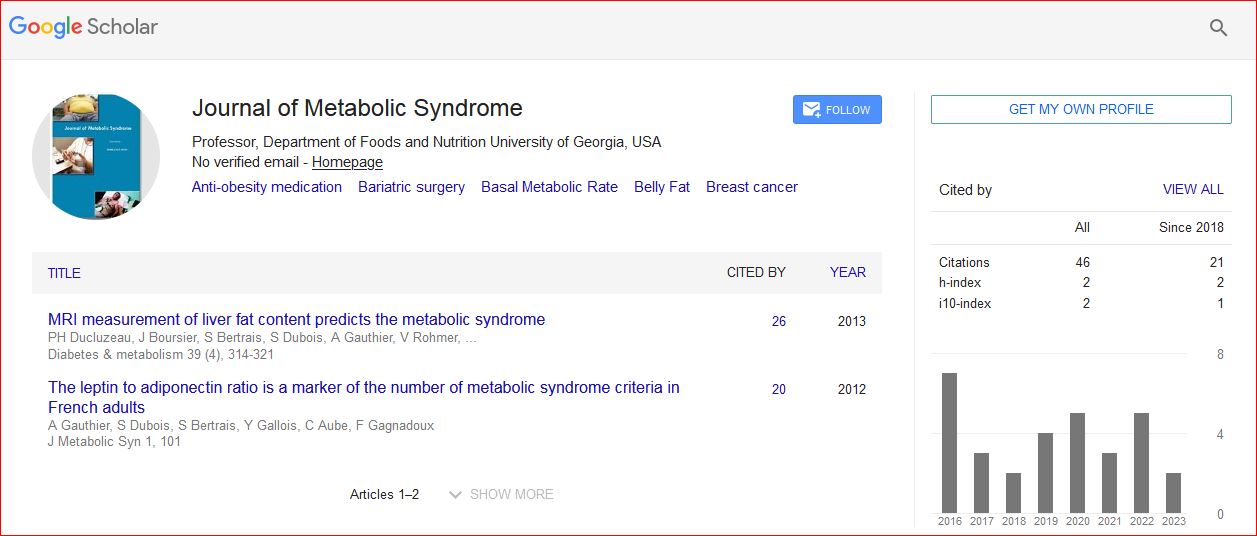
Journal of Metabolic Syndrome received 48 citations as per Google Scholar report