Opinion - (2025) Volume 11, Issue 4
Received: 01-Aug-2025, Manuscript No. JOV-26-186428;
Editor assigned: 04-Aug-2025, Pre QC No. P-186428;
Reviewed: 18-Aug-2025, QC No. Q-186428;
Revised: 23-Aug-2025, Manuscript No. R-186428;
Published:
29-Aug-2025
, DOI: 10.37421/2471-9544.2025.11.315
Citation: Johansen, Henrik. ”Twisted Conduits: Autoimmune Vasculitis Vascular Remodeling.” J Vasc 11 (2025):315.
Copyright: © 2025 Johansen H. This is an open-access article distributed under the terms of the Creative Commons Attribution License, which permits unrestricted use, distribution and reproduction in any medium, provided the original author and source are credited.
This review examines the critical role of aberrant vascular development, specifically the formation of "twisted conduits," in the pathogenesis of autoimmune vasculitis and its contribution to self-perpetuating inflammatory feedback loops. These structural vascular anomalies create localized pockets of inflammation, driving persistent immune cell activation and exacerbating tissue damage, thereby worsening the disease course. Targeting these "twisted conduits" is proposed as a novel therapeutic strategy to interrupt chronic inflammation [1].
Dysregulated endothelial cells forming "twisted conduits" amplify inflammatory signals in vasculitis by more effectively recruiting and retaining immune cells, fostering an environment conducive to sustained autoimmunity. Understanding the molecular cues governing this abnormal vascular architecture is paramount for developing interventions that disrupt these feedback mechanisms [2].
Specific genetic factors are investigated for their role in promoting "twisted conduits" formation in autoimmune vasculitis, suggesting that genetic predispositions can lead to abnormal angiogenesis and vascular stability, fueling the autoimmune response via persistent inflammatory triggers and impaired vascular repair [3].
Cellular mechanisms involving the interaction of immune cells, particularly T cells and macrophages, with "twisted conduits" are explored to understand how they perpetuate inflammation in vasculitis. The abnormal vascular structure facilitates prolonged immune cell adhesion and transmigration, creating a localized inflammatory niche that sustains chronic autoimmune feedback. Strategies aimed at disrupting these cellular interactions are under consideration [4].
Inflammatory mediators play a significant role in driving the formation of "twisted conduits" and sustaining autoimmune feedback loops in vasculitis. Cytokines and chemokines released during inflammation can directly influence endothelial cell behavior, promoting aberrant vascular remodeling that amplifies the immune response and leads to tissue damage [5].
The implications of "twisted conduits" for diagnostic imaging and therapeutic delivery in vasculitis are discussed, noting how altered vascular architecture can affect the distribution of contrast agents and drugs, potentially leading to suboptimal treatment. Understanding these vascular abnormalities is crucial for optimizing treatment strategies [6].
Advances in understanding how the microenvironment, influenced by "twisted conduits," perpetuates autoimmune feedback loops in vasculitis are reviewed. Altered vascular structure promotes immune cell survival, proliferation, and differentiation, creating a self-sustaining inflammatory cycle that is challenging to break [7].
The potential of targeting vascular remodeling processes leading to "twisted conduits" as a novel therapeutic approach for autoimmune vasculitis is explored. By stabilizing or normalizing vascular architecture, it may be possible to disrupt inflammatory feedback loops and improve treatment outcomes [8].
Dynamic changes in vascular structure during vasculitis progression, particularly the development of "twisted conduits," are investigated. Chronic inflammation can induce maladaptive vascular remodeling, establishing a vicious cycle of immune activation and endothelial damage that contributes to the chronic nature of the disease [9].
A comprehensive overview of the molecular pathways involved in the formation of "twisted conduits" and their contribution to autoimmune feedback loops in vasculitis is provided. Potential therapeutic targets that modulate these pathways to interrupt the inflammatory cycle and promote vascular health are discussed [10].
Aberrant vascular development, characterized by the formation of "twisted conduits," plays a pivotal role in the pathogenesis of autoimmune vasculitis, establishing self-perpetuating inflammatory feedback loops. These structural vascular anomalies create localized inflammatory pockets, leading to sustained immune cell activation and tissue damage, thereby exacerbating the disease course. Consequently, targeting these "twisted conduits" is emerging as a promising novel therapeutic strategy to break chronic inflammation [1].
The dysregulation of endothelial cells contributes significantly to vasculitis, with "twisted conduits" acting as amplifiers of inflammatory signals. These altered vessels enhance the recruitment and retention of immune cells, creating an environment that sustains autoimmunity. Therefore, elucidating the molecular cues that drive this aberrant vascular architecture is essential for developing interventions that can disrupt these detrimental feedback loops [2].
Genetic predispositions are implicated in the development of "twisted conduits" within the context of autoimmune vasculitis. Specific genetic factors can promote abnormal angiogenesis and compromise vascular stability, which in turn fuels the autoimmune response by providing persistent inflammatory triggers and impairing vascular repair mechanisms [3].
The intricate interplay between immune cells, particularly T cells and macrophages, and "twisted conduits" is fundamental to the perpetuation of inflammation in vasculitis. The abnormal vascular structure facilitates prolonged immune cell adhesion and transmigration, establishing a localized inflammatory niche that sustains chronic autoimmune feedback. Research is focusing on therapeutic strategies that can disrupt these cellular interactions [4].
Inflammatory mediators, including cytokines and chemokines, are key drivers in the formation of "twisted conduits" and the subsequent maintenance of autoimmune feedback loops in vasculitis. These mediators directly influence endothelial cell behavior, promoting aberrant vascular remodeling that amplifies the immune response and inflicts tissue damage [5].
The presence of "twisted conduits" has significant implications for both diagnostic imaging and therapeutic delivery in vasculitis. Alterations in vascular architecture can influence the distribution of contrast agents and therapeutic drugs, potentially leading to diagnostic inaccuracies or suboptimal treatment efficacy. A thorough understanding of these vascular abnormalities is therefore crucial for optimizing clinical management [6].
The microenvironment within vasculitic lesions is heavily influenced by "twisted conduits," contributing to the perpetuation of autoimmune feedback loops. Altered vascular structures can enhance immune cell survival, proliferation, and differentiation, fostering a self-sustaining inflammatory cycle that is notoriously difficult to interrupt [7].
Targeting the vascular remodeling processes that result in the formation of "twisted conduits" represents a promising novel therapeutic avenue for autoimmune vasculitis. By stabilizing or normalizing the abnormal vascular architecture, it may be possible to disrupt the underlying inflammatory feedback loops and ultimately improve patient outcomes [8].
The dynamic changes in vascular structure, specifically the development of "twisted conduits," are integral to the progression of vasculitis. Chronic inflammation drives maladaptive vascular remodeling, creating a vicious cycle of immune activation and endothelial damage that underlies the chronic and relapsing nature of the disease [9].
A comprehensive understanding of the molecular pathways governing the formation of "twisted conduits" and their role in fostering autoimmune feedback loops in vasculitis is essential. This knowledge facilitates the identification of potential therapeutic targets aimed at modulating these pathways, thereby interrupting the inflammatory cycle and promoting vascular health [10].
Autoimmune vasculitis is characterized by aberrant vascular development, leading to the formation of "twisted conduits." These structural anomalies create inflammatory pockets, promoting persistent immune cell activation and tissue damage, thereby exacerbating the disease. Genetic factors, immune cell interactions, and inflammatory mediators all contribute to this process. The "twisted conduits" also impact diagnostic imaging and therapeutic delivery. Targeting these vascular abnormalities and the underlying molecular pathways is a promising therapeutic strategy to disrupt chronic inflammation and improve treatment outcomes in vasculitis. Understanding the dynamic vascular remodeling and the microenvironment is crucial for managing this complex disease.
None
None
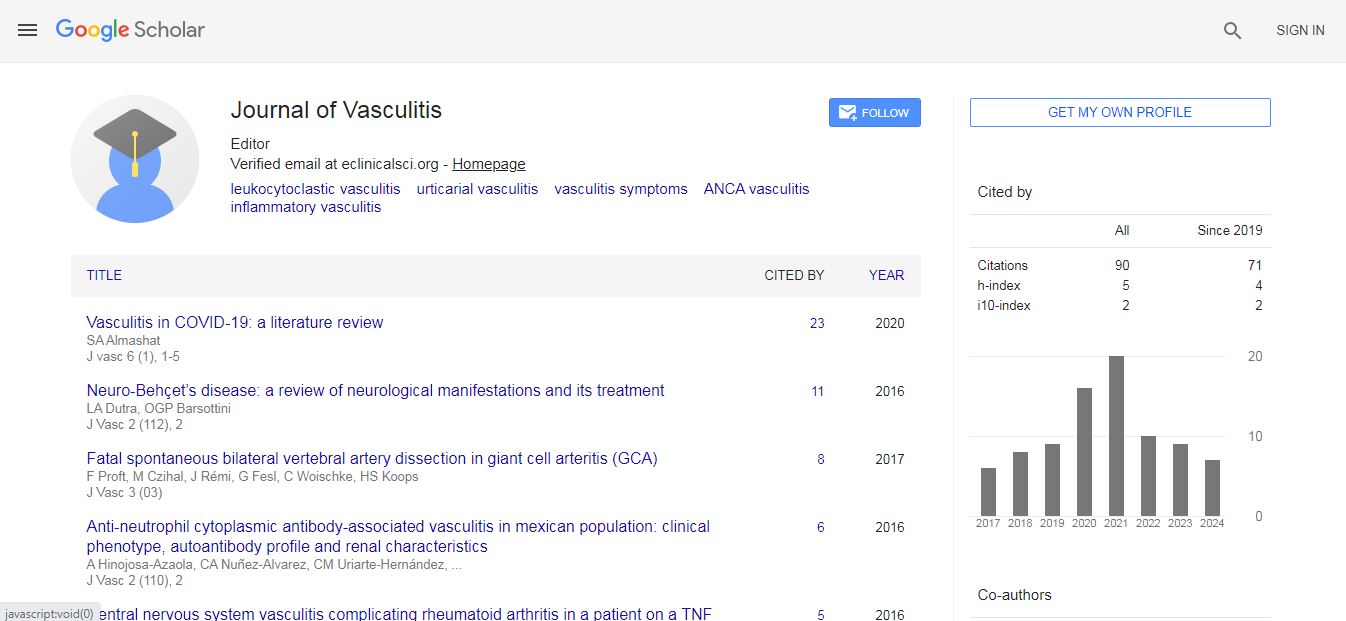
Journal of Vasculitis received 83 citations as per Google Scholar report