Perspective - (2025) Volume 15, Issue 5
Received: 30-Sep-2025, Manuscript No. jmcj-25-176917;
Editor assigned: 02-Oct-2025, Pre QC No. P-176917;
Reviewed: 14-Oct-2025, QC No. Q-176917;
Revised: 21-Oct-2025, Manuscript No. R-176917;
Published:
28-Oct-2025
, DOI: 10.37421/2165-7912.2025.15.643
Citation: Rowan, Samuel D.. ”Truth, Trust, and Political Journalism’s Digital Shift.” J Mass Communicat Journalism 15(2025):643.
Copyright: © 2025 Rowan D. Samuel This is an open-access article distributed under the terms of the Creative Commons Attribution License, which permits unrestricted use, distribution and reproduction in any medium, provided the original author and source are credited.
Political journalism today faces a myriad of profound challenges in a landscape increasingly defined by digital disruption, including audience fragmentation, eroding trust, and economic pressures. To address these issues and maintain its crucial relevance, a comprehensive framework for journalist engagement has been proposed, one that emphasizes adaptive roles, community building, and innovative content strategies designed to ensure effectiveness within democratic processes[1].
A comparative analysis highlights how political journalism across various European countries directly influences or moderates affective polarization. Diverse journalistic practices and distinct media systems play a crucial role in shaping public sentiment and the levels of inter-group animosity, thereby underscoring a complex relationship between media output and broader societal division[2].
Social media platforms, without a doubt, have profoundly altered established journalistic routines, particularly in the production of political news. We see substantial shifts in news sourcing, how information is verified, and the strategies used for dissemination, directly impacting the speed, depth, and overall perceived trustworthiness of political reporting. Ultimately, this means journalists must continuously adapt to remain effective in this rapidly evolving media landscape[3].
The question of public trust in political news is paramount, and research highlights the strong interaction between source cues and perceived journalistic standards. It turns out that transparency, impartiality, and accuracy are not just ideals; they are crucial determinants of whether the public trusts the news they consume, suggesting their consistent application by news organizations can effectively counter widespread skepticism toward media narratives[4].
Another pressing concern is the widespread impact of misinformation on political attitudes and the ways journalistic practices attempt to counteract its dissemination. It’s tough; journalists often face significant difficulties in effectively debunking false narratives once they've taken hold. Various strategies, such as rigorous fact-checking and clear labeling of content, are discussed as vital tools to mitigate the damaging impact of misinformation on democratic discourse[5].
Take, for example, the COVID-19 pandemic. Political journalism’s framing of the crisis showed a clear interaction between political narratives and public health messaging. What this really means is that political agendas frequently influenced news coverage, which could potentially affect how the public understood and complied with essential health guidelines, critically emphasizing the media's vital role in crisis communication[6].
The traditional watchdog function of political journalism is undergoing significant transformation within contemporary hybrid media systems. New digital actors and platforms present considerable challenges to long-established accountability mechanisms. This forces journalists to fundamentally reassess their strategies for holding power accountable and, crucially, for preserving their essential democratic role in an increasingly complex and interconnected information environment[7].
Engaging audiences with political news in an era of overwhelming information overload and declining traditional consumption requires new approaches. Digital political journalism is identifying effective strategies that include innovative storytelling, interactive formats, and robust community building. These are seen as primary approaches to fostering deeper public understanding and encouraging active participation in political discourse[8].
We also see a growing emotionalization within political journalism. Research analyzes its patterns and the very real potential ramifications for public discourse. The argument is that while emotionally framed content can certainly capture attention effectively, it also carries the risk of contributing to less rational debate and heightened polarization, prompting a critical examination of journalistic ethics and the broader societal impact of such reporting trends[9].
Finally, the mediatization of politics profoundly impacts the evolving role of political journalism. Media logic increasingly shapes political processes, leading to significant adaptations in how journalists practice their craft, the content they produce, and even their professional identities to this dynamic environment, highlighting critical implications for democratic discourse[10].
Contemporary political journalism navigates a complex terrain characterized by multifaceted challenges and rapid evolution. The digital age, for instance, has introduced significant disruption, leading to audience fragmentation and a palpable erosion of public trust in news institutions. Economic pressures further compound these difficulties, necessitating a re-evaluation of how journalism sustains itself. In response, scholars propose frameworks for journalist engagement that emphasize adaptive roles, foster community building, and implement innovative content strategies to maintain relevance and effectiveness in upholding democratic processes [1]. This includes exploring new ways to connect with audiences and deliver information that resonates amidst a crowded media landscape.
A crucial aspect of this evolving landscape is the pervasive issue of misinformation. Its impact on political attitudes is substantial, making it a priority for journalistic practices to counteract its dissemination. Journalists frequently encounter difficulties in effectively debunking false narratives, which often spread rapidly and widely. Consequently, the focus shifts to robust strategies such as comprehensive fact-checking initiatives and clear labeling of content to mitigate the damaging influence of misinformation on democratic discourse [5]. This ongoing battle requires continuous vigilance and adaptation of verification methods [3].
Furthermore, public confidence in political news is not a given; it's intricately linked to perceived journalistic standards and the cues audiences receive. Transparency, impartiality, and accuracy emerge as vital determinants of trust. News organizations are encouraged to consistently apply these principles to effectively counter widespread skepticism towards media narratives, thereby bolstering their credibility with the public [4]. This becomes particularly critical when considering how political journalism frames major events, such as the COVID-19 pandemic, where political agendas were observed influencing coverage, potentially affecting public understanding and compliance with health guidelines [6]. Such instances underscore the critical role media plays in crisis communication and the imperative for unbiased reporting.
The role of social media platforms cannot be overstated, as they have fundamentally reshaped journalistic routines. Shifts are evident in how news is sourced, the methods employed for verification, and the strategies for dissemination. This transformation directly impacts the speed of news cycles, the depth of reporting, and the perceived trustworthiness of political accounts [3]. Concurrently, there is a growing emotionalization within political journalism. While emotionally framed content can effectively capture audience attention, it carries the risk of contributing to less rational debate and potentially heightening political polarization. This trend demands a critical examination of journalistic ethics and its broader societal impact [9].
In light of these developments, the traditional watchdog function of political journalism is experiencing significant flux within contemporary hybrid media systems. New digital actors and platforms challenge established mechanisms for accountability, prompting journalists to reassess strategies for holding power to account and preserving their essential democratic role [7]. Concurrently, political journalism in different regions, like Europe, demonstrates how diverse journalistic practices and distinct media systems can influence or moderate affective polarization, shaping public sentiment and inter-group animosity [2]. This intricate relationship highlights the media's profound influence on societal division.
To counter declining traditional news consumption and information overload, digital political journalism is actively exploring effective audience engagement strategies. These include innovative storytelling techniques, interactive content formats, and community-building initiatives aimed at fostering deeper public understanding and participation in political discourse [8]. This adaptive approach is also seen in the broader context of the mediatization of politics, where media logic increasingly shapes political processes. Journalists are continually adapting their practices, content, and professional identities to this dynamic environment, highlighting critical implications for the future of democratic discourse [10]. The ongoing evolution requires vigilance, innovation, and a steadfast commitment to core journalistic values.
Political journalism faces significant challenges in the contemporary media landscape, marked by digital disruption, audience fragmentation, and eroding public trust. Economic pressures and the pervasive issue of misinformation further complicate its role. Journalists contend with the spread of false narratives, often struggling to debunk them effectively, which in turn impacts democratic discourse. Social media platforms have fundamentally altered journalistic routines, influencing news sourcing, verification, and dissemination, demanding continuous adaptation from reporters. Public trust in political news is heavily influenced by perceived journalistic standards; transparency, impartiality, and accuracy are key to countering skepticism. The emotionalization of political journalism, while capturing attention, risks contributing to less rational debate and heightened polarization. Amidst these shifts, political journalism's traditional watchdog function is challenged by new digital actors, requiring reassessment of accountability strategies. In response, the field is evolving, emphasizing adaptive roles, community building, and innovative content strategies. Engaging audiences in an era of information overload necessitates interactive formats and compelling storytelling. The mediatization of politics means media logic increasingly shapes political processes, compelling journalists to adapt their practices and professional identities. Even during crises, such as the COVID-19 pandemic, political agendas often influenced coverage, underscoring media's critical role in public communication.
None
None
Stephen C, Marianne F, Katrin V. "The Future of Political Journalism: A Framework for Engagement in a Disrupted World".Journalism Studies 21 (2020):1339-1355.
Indexed at, Google Scholar, Crossref
Christian B, Claes HdV, Philipp H. "Affective Polarization and Political Journalism in Europe: A Comparative Analysis".Political Communication 38 (2021):457-476.
Indexed at, Google Scholar, Crossref
Claudia M, David N, Carlos AC. "Journalistic Routines and the Production of Political News in the Age of Social Media".Journalism & Mass Communication Quarterly 99 (2022):699-719.
Indexed at, Google Scholar, Crossref
Lonneke R, Sanne K, Gijs HvdS. "Trust in Political News: The Role of Source Cues and Journalistic Standards".Media Psychology 26 (2023):153-174.
Indexed at, Google Scholar, Crossref
Benjamin KJ, Brian GS, Jennifer LM. "The Impact of Misinformation on Political Attitudes and Journalistic Responses".Journal of Communication 71 (2021):319-338.
Indexed at, Google Scholar, Crossref
Scott RM, Daniela MS, Mark RT. "Framing the Pandemic: Political Journalism and Public Health Communication During COVID-19".New Media & Society 24 (2022):834-855.
Indexed at, Google Scholar, Crossref
Wolfgang D, Thomas EP, Philipp NKGM. "The Watchdog Role in Flux: Political Journalism and Accountability in Hybrid Media Systems".International Journal of Press/Politics 25 (2020):700-719.
Indexed at, Google Scholar, Crossref
Nikki U, Tamara W, Barbie Z. "Engaging Audiences with Political News: Strategies for Digital Journalism".Digital Journalism 11 (2023):221-239.
Indexed at, Google Scholar, Crossref
Frank E, Andrea R, Christian PH. "The Emotionalization of Political Journalism: Trends and Consequences".Journalism Practice 15 (2021):955-972.
Indexed at, Google Scholar, Crossref
Frank E, Thomas H, Christian B. "The Mediatization of Politics and the Changing Role of Political Journalism".International Journal of Press/Politics 25 (2020):680-699.
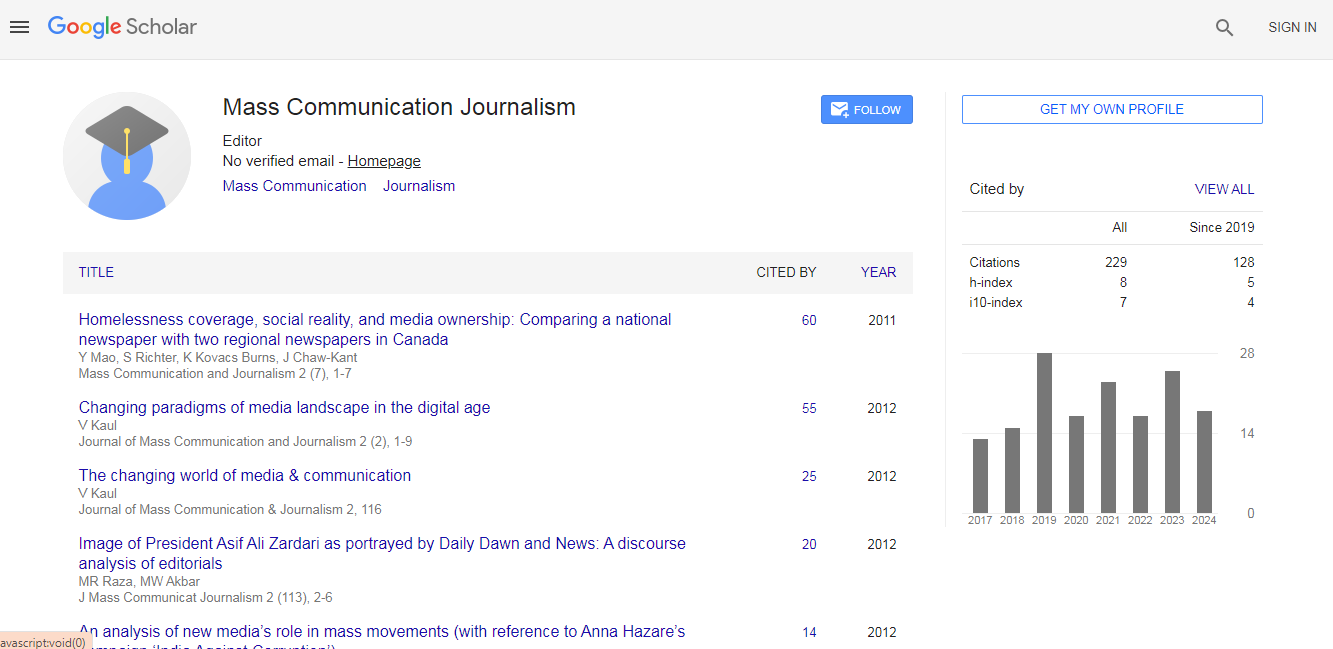
Journal of Mass Communication & Journalism received 205 citations as per Google Scholar report