Short Communication - (2025) Volume 9, Issue 2
Received: 02-Jun-2025, Manuscript No. rrms-25-175062;
Editor assigned: 04-Jun-2025, Pre QC No. P-175062;
Reviewed: 18-Jun-2025, QC No. Q-175062;
Revised: 23-Jun-2025, Manuscript No. R-175062;
Published:
30-Jun-2025
, DOI: 10.37421/2952-8127.2025.9.224
Citation: Osei, Samuel. ”Transforming Diagnostics: Precision, Early, Personalized Medicine.” Res Rep Med Sci 09 (2025):224.
Copyright: © 2025 Osei S. This is an open-access article distributed under the terms of the Creative Commons Attribution License, which permits unrestricted use, distribution and reproduction in any medium, provided the original author and source are credited.
This article discusses how hybrid imaging techniques, specifically PET/CT and PET/MRI, are enhancing cancer diagnosis and assessment of treatment response. The key insight is their ability to combine metabolic and anatomical information, leading to more precise lesion detection, better staging, and improved monitoring of therapeutic outcomes compared to standalone modalities. It highlights the advancements in tracer development and image reconstruction algorithms that contribute to this improved diagnostic accuracy[1].
This paper explores the significant progress in molecular diagnostic techniques for bacterial infectious diseases. It emphasizes the shift towards rapid, sensitive, and specific methods like next-generation sequencing, CRISPR-based diagnostics, and isothermal amplification. The key takeaway is how these advancements are crucial for early and accurate pathogen identification, enabling targeted treatment strategies and improving public health surveillance against antibiotic resistance[2].
This article reviews the role of biomarkers in diagnosing neurological disorders. It highlights the growing importance of various types of biomarkers, including those from cerebrospinal fluid, blood, and imaging, in enhancing the accuracy and early detection of conditions like Alzheimer's disease, Parkinson's disease, and multiple sclerosis. The core insight points to the potential of multi-modal biomarker approaches to overcome current diagnostic challenges and pave the way for personalized medicine in neurology[3].
This review provides a broad overview of diagnostic methods for cardiovascular diseases, encompassing both established and cutting-edge techniques. It discusses the utility of advanced imaging modalities, novel biomarkers, and genetic testing in early detection, risk stratification, and guiding therapy. The article stresses that integrated approaches, combining multiple diagnostic tools, are crucial for improving patient outcomes and addressing the complexity of cardiovascular conditions[4].
This paper focuses on the evolving landscape of molecular diagnostic methods for autoimmune diseases. It highlights advanced techniques such as multi-omics approaches, single-cell sequencing, and autoantibody profiling, which offer greater sensitivity and specificity for early diagnosis and disease stratification. The central insight is the potential of these molecular tools to distinguish between different autoimmune conditions and monitor disease activity more effectively, moving towards precision medicine[5].
This article delves into the intersection of precision medicine and personalized diagnostics. It underscores how diagnostic methods are becoming increasingly tailored to an individual's genetic, environmental, and lifestyle factors. The core insight is the imperative for integrating diverse data types, from genomics to real-time monitoring, to enable more accurate disease risk assessment, earlier intervention, and selection of therapies optimized for individual patient profiles, despite ongoing challenges in data interpretation and clinical implementation[6].
This review examines recent progress in point-of-care (POC) diagnostic devices for infectious diseases. It highlights the development of portable, rapid, and user-friendly technologies that allow for quick diagnosis outside traditional laboratory settings. The key insight is the crucial role of these devices in improving access to diagnostics, particularly in resource-limited areas, and in facilitating rapid public health responses to outbreaks, underscoring their potential to revolutionize decentralized healthcare[7].
This article discusses the advancements in liquid biopsy as a non-invasive diagnostic method in cancer management. It emphasizes its utility in early cancer detection, recurrence monitoring, and guiding personalized therapies by analyzing circulating tumor DNA, circulating tumor cells, and other biomarkers from blood samples. The main insight is how liquid biopsy offers a dynamic, real-time assessment of tumor biology, providing crucial information for clinical decision-making and overcoming the limitations of traditional tissue biopsies[8].
This review explores the transformative impact of Artificial Intelligence (AI) on medical imaging diagnostics. It details how AI algorithms, particularly deep learning, are being applied to interpret various imaging modalities, enhancing the accuracy and speed of disease detection, characterization, and prognosis. The core insight is that AI integration promises to augment radiologists' capabilities, reduce diagnostic errors, and enable more personalized treatment pathways, despite the ongoing need for robust validation and ethical considerations[9].
This article investigates the potential of the gut microbiome as a diagnostic and prognostic biomarker for various diseases. It highlights the intricate link between microbial composition and host health, showing how dysbiosis can be indicative of conditions ranging from metabolic disorders to neurological diseases and cancer. The key insight is that advanced sequencing and bioinformatics tools are enabling the characterization of microbial signatures, opening new avenues for non-invasive diagnostic methods and personalized therapeutic interventions based on microbiome modulation[10].
Hybrid imaging techniques, specifically PET/CT and PET/MRI, enhance cancer diagnosis by combining metabolic and anatomical information for precise lesion detection and improved therapeutic monitoring [1]. Liquid biopsy offers a non-invasive, real-time assessment of tumor biology for early cancer detection, recurrence monitoring, and guiding personalized therapies by analyzing circulating tumor DNA and cells from blood samples [8].
Molecular diagnostic methods, including next-generation sequencing and CRISPR-based diagnostics, are crucial for rapid and accurate identification of bacterial pathogens, aiding in targeted treatment and combating antibiotic resistance [2]. Concurrently, Point-of-Care (POC) diagnostic devices are revolutionizing infectious disease management by providing rapid, portable, and user-friendly testing outside traditional laboratory settings, which improves diagnostic access and public health responses [7].
Biomarkers from cerebrospinal fluid, blood, and imaging are increasingly important for early and accurate diagnosis of neurological disorders like Alzheimer's and Parkinson's, paving the way for personalized neurology [3]. Integrated diagnostic methods, combining advanced imaging, novel biomarkers, and genetic testing, are vital for managing cardiovascular diseases and improving patient outcomes by addressing their inherent complexity [4].
For autoimmune diseases, advanced molecular techniques such as multi-omics and single-cell sequencing provide greater sensitivity and specificity for early diagnosis and disease stratification, moving towards precision medicine [5]. Precision medicine tailors diagnostics to individual genetic, environmental, and lifestyle factors. This demands integrating diverse data, from genomics to real-time monitoring, for accurate disease risk assessment and optimized therapies [6]. The gut microbiome also holds significant potential as a diagnostic and prognostic biomarker, with dysbiosis indicative of various conditions, enabling new non-invasive methods and personalized interventions based on microbial modulation [10].
Artificial Intelligence (AI) is transforming medical imaging diagnostics. AI algorithms, especially deep learning, are applied across various imaging modalities to enhance the accuracy and speed of disease detection, characterization, and prognosis. This integration promises to augment radiologists' capabilities, reduce diagnostic errors, and enable more personalized treatment pathways [9].
The landscape of medical diagnostics is rapidly evolving, integrating advanced technologies for more precise, early, and personalized disease detection and management. Hybrid imaging techniques, like PET/CT and PET/MRI, significantly improve cancer diagnosis and treatment monitoring by combining metabolic and anatomical insights. Molecular diagnostic methods are transforming the detection of bacterial infectious diseases, offering rapid, sensitive, and specific identification of pathogens crucial for combating antibiotic resistance. Biomarkers, spanning cerebrospinal fluid, blood, and imaging, are increasingly vital for accurate and early diagnosis of neurological disorders such as Alzheimer's, Parkinson's, and multiple sclerosis, paving the way for tailored neurological care. A comprehensive review of cardiovascular disease diagnostics highlights the importance of integrated approaches, using advanced imaging, novel biomarkers, and genetic testing for better patient outcomes. Molecular diagnostics are also advancing in autoimmune diseases, employing multi-omics and single-cell sequencing to refine diagnosis and monitor disease activity, supporting precision medicine initiatives. Precision medicine itself underscores how diagnostics are adapting to individual genetic, environmental, and lifestyle factors, emphasizing the integration of diverse data for personalized interventions. Point-of-care diagnostic devices are revolutionizing infectious disease management, providing rapid, portable, and accessible testing, especially in resource-limited settings. Liquid biopsy stands out as a non-invasive cancer diagnostic, offering real-time insights into tumor biology for early detection, monitoring recurrence, and guiding personalized therapies. The transformative power of Artificial Intelligence (AI) in medical imaging is clear, enhancing diagnostic accuracy and speed through sophisticated algorithms for various modalities. Finally, the gut microbiome shows promise as a diagnostic and prognostic biomarker, with dysbiosis indicating a range of conditions and opening new avenues for non-invasive diagnostics and personalized interventions.
None
None
Jing L, Yan W, Hui C. "Advances in PET/CT and PET/MRI Hybrid Imaging for Improved Cancer Diagnosis and Treatment Response Assessment".Cancers (Basel) 15 (2023):2840.
Indexed at, Google Scholar, Crossref
Yan Z, Wei L, Qi Z. "Advances in molecular diagnostic methods for bacterial infectious diseases".Front Cell Infect Microbiol 13 (2023):1198656.
Indexed at, Google Scholar, Crossref
Surendra K, Pratibha S, Anil K. "Biomarkers in neurological disorders: Current status and future perspectives for diagnostic methods".J Integr Neurosci 21 (2022):68.
Indexed at, Google Scholar, Crossref
Shuang C, Zhi W, Hai L. "Current and emerging diagnostic methods for cardiovascular diseases: A comprehensive review".Theranostics 11 (2021):7808-7826.
Indexed at, Google Scholar, Crossref
Lei W, Shasha Z, Yong L. "Molecular Diagnostic Methods for Autoimmune Diseases: Current Status and Future Prospects".J Immunol Res 2021 (2021):6695392.
Indexed at, Google Scholar, Crossref
Miriam G, Marleen E, Anja Z. "Precision Medicine and Personalized Diagnostics: Current State and Future Challenges".Int J Mol Sci 23 (2022):9817.
Indexed at, Google Scholar, Crossref
Xiang L, Wei C, Yu W. "Advances in point-of-care diagnostic devices for infectious diseases: A review".Biosensors (Basel) 13 (2023):388.
Indexed at, Google Scholar, Crossref
Hong M, Yan L, Hao W. "Liquid Biopsy in Cancer Diagnosis and Treatment Monitoring: Recent Advances and Future Perspectives".Front Oncol 12 (2022):853245.
Indexed at, Google Scholar, Crossref
Chao W, Lei Z, Xiaochen C. "Artificial intelligence in medical imaging diagnostics: A review of recent applications and future challenges".Comput Biol Med 137 (2021):104847.
Indexed at, Google Scholar, Crossref
Chao H, Yan W, Huili X. "The gut microbiome as a diagnostic and prognostic biomarker for disease".Front Cell Infect Microbiol 13 (2023):1111979.
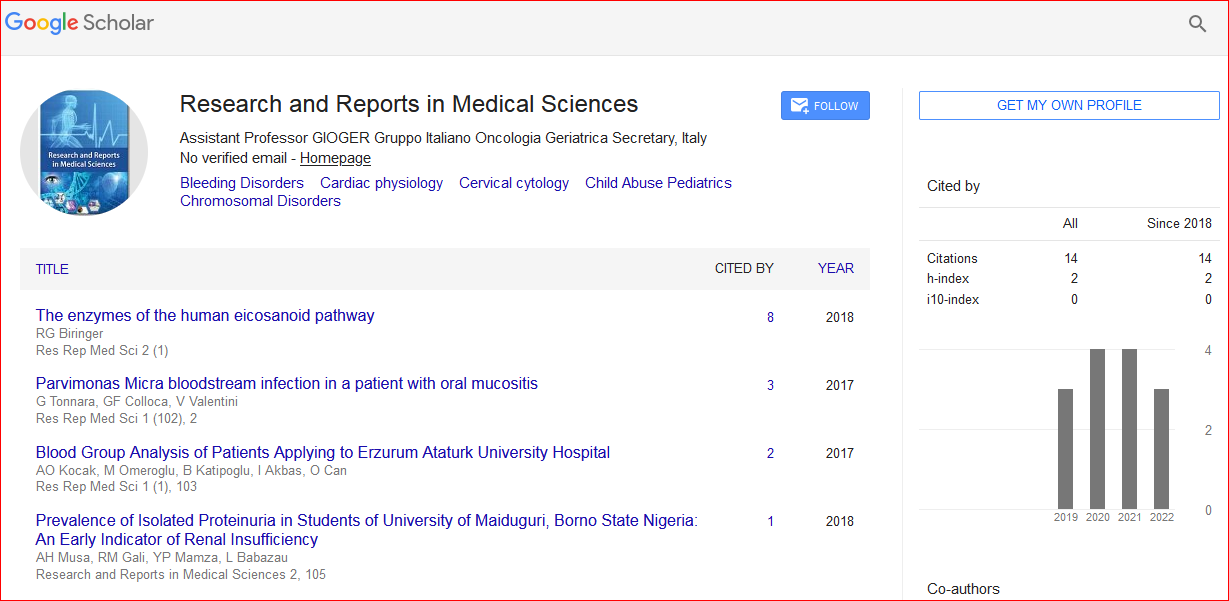
Research and Reports in Medical Sciences received 13 citations as per Google Scholar report