Short Communication - (2025) Volume 14, Issue 3
Received: 01-Sep-2025, Manuscript No. ms-25-172644;
Editor assigned: 03-Sep-2025, Pre QC No. P-172644;
Reviewed: 17-Sep-2025, QC No. Q-172644;
Revised: 22-Sep-2025, Manuscript No. R-172644;
Published:
29-Jun-2025
, DOI: 10.37421/2167-0943.2024.14.418
Citation: Borgstrom, Freja. "Transforming Breast Cancer: Precision, Progress, Equity." J Metabolic Synd 14 (2025):418.
Copyright: © 2025 Borgstrom F. This is an open-access article distributed under the terms of the Creative Commons Attribution License, which permits unrestricted use,
distribution and reproduction in any medium, provided the original author and source are credited.
Here's what's happening with metastatic breast cancer treatment: there's real progress being made, driven by new targeted therapies like antibody-drug conjugates (ADCs), CDK4/6 inhibitors, and PI3K inhibitors. These aren't just incremental changes; they're genuinely improving outcomes and changing how we approach advanced disease, offering more options than ever before[1].
When it comes to breast cancer screening, we're seeing continued evolution in recommendations. The conversation isn't just about starting age anymore; itâ??s really focused on personalized risk assessment and tailoring screening intervals. The goal is to maximize benefits while minimizing potential harms, which means moving away from a one-size-fits-all approach[2].
HER2-low breast cancer represents a significant shift in how we classify and treat this disease. It's a newly recognized subtype that opens up targeted therapy options for a patient group previously excluded from HER2-targeted treatments. This really means more people can access therapies that directly hit the cancer cells[3].
Triple-negative breast cancer remains challenging, but the landscape is changing, particularly with advances in immunotherapy and targeted therapies. The focus is on identifying specific vulnerabilities within these aggressive tumors to deliver more effective, less toxic treatments. We are seeing real progress here[4].
Understanding genetic susceptibility is key to personalized breast cancer prevention. It's about recognizing who is at higher risk based on their genetic profile, then offering tailored screening, risk-reducing medications, or even prophylactic surgery. This moves us towards preventing cancer before it even starts, which is a powerful step forward[5].
Artificial Intelligence is truly transforming breast cancer detection and diagnosis. What this means is AI tools are getting better at analyzing imaging like mammograms, often spotting subtle signs that might be missed. It's about augmenting human expertise, leading to earlier detection and potentially more accurate diagnoses[6].
Overcoming endocrine resistance is a significant hurdle in treating hormone-sensitive breast cancer. The good news is, research is pinpointing mechanisms of resistance and developing strategies to counteract them, often by combining existing therapies with newer agents. This work aims to extend the effectiveness of endocrine treatments for longer[7].
Antibody-drug conjugates, or ADCs, are genuinely a game-changer in breast cancer treatment. These smart drugs deliver chemotherapy directly to cancer cells while sparing healthy ones, which translates to powerful anti-tumor activity with fewer side effects. We are seeing incredible potential across various subtypes[8].
Precision medicine is truly the future of breast cancer care. It involves tailoring treatments based on a tumor's specific molecular characteristics, rather than a broad approach. While there are still challenges, the move towards individualized therapy promises more effective outcomes and reduced unnecessary treatments for patients[9].
When we talk about breast cancer, it's crucial to address racial and ethnic disparities. There are stark differences in incidence, treatment access, and outcomes among various groups. Understanding the underlying social, economic, and biological factors is essential to developing equitable strategies and improving care for everyone[10].
The landscape of breast cancer treatment is undergoing a profound transformation, marked by significant advances across various disease subtypes. For metastatic breast cancer, there's real progress being made with new targeted therapies, including Antibody-Drug Conjugates (ADCs), CDK4/6 inhibitors, and PI3K inhibitors. These aren't just incremental changes; they're genuinely improving patient outcomes and expanding treatment options beyond what was available before [1]. A major shift in classification and therapy has emerged with the recognition of HER2-low breast cancer, a newly identified subtype. This development is critical because it opens the door to targeted therapy options for a patient group previously excluded from HER2-targeted treatments, meaning more individuals can access therapies that directly target their cancer cells [3]. At the forefront of these therapeutic innovations are Antibody-Drug Conjugates, or ADCs. These smart drugs represent a significant leap, delivering chemotherapy directly to cancer cells while largely sparing healthy ones. This precision leads to powerful anti-tumor activity coupled with fewer side effects, demonstrating incredible potential across various breast cancer subtypes [8].
Despite these advancements, certain forms of breast cancer remain particularly challenging. Triple-negative breast cancer (TNBC), known for its aggressive nature, is one such area where the treatment landscape is evolving. Advances in immunotherapy and targeted therapies are offering new hope, with research focused on identifying specific vulnerabilities within these aggressive tumors to develop more effective and less toxic treatments [4]. Another critical hurdle in managing hormone-sensitive breast cancer is overcoming endocrine resistance. Research efforts are actively pinpointing the mechanisms behind this resistance and devising strategies to counteract them, often through combining existing therapies with newer agents. The goal of this ongoing work is to extend the effectiveness of endocrine treatments for patients over longer periods [7]. Underlying many of these developments is the burgeoning field of precision medicine. This approach is truly the future of breast cancer care, tailoring treatments based on a tumor's specific molecular characteristics rather than applying a broad, standardized approach. While challenges persist, this move towards individualized therapy holds immense promise for more effective outcomes and reducing unnecessary treatments [9].
Beyond active treatment, prevention and early detection are also seeing significant evolution. Breast cancer screening recommendations continue to evolve, moving beyond a simple focus on starting age. The current emphasis is on personalized risk assessment and tailoring screening intervals to individual needs. The aim here is to maximize the benefits of screening while actively minimizing potential harms, effectively moving away from a one-size-fits-all strategy [2]. A key component of personalized prevention is understanding genetic susceptibility. Recognizing individuals at higher risk based on their genetic profile allows for tailored interventions, which might include specific screening protocols, risk-reducing medications, or even prophylactic surgery. This proactive approach marks a powerful step forward, aiming to prevent cancer development before it even begins [5].
Technology is playing an increasingly pivotal role in improving breast cancer care. Artificial Intelligence (AI) is genuinely transforming detection and diagnosis. What this means is AI tools are becoming highly proficient at analyzing imaging, such as mammograms, often identifying subtle signs that human eyes might miss. This technology augments human expertise, leading to earlier detection and potentially more accurate diagnoses [6]. Lastly, it's absolutely crucial to acknowledge and address racial and ethnic disparities in breast cancer care. There are stark, documented differences in incidence rates, access to treatment, and overall outcomes among various demographic groups. A deep understanding of the underlying social, economic, and biological factors contributing to these disparities is essential for developing equitable strategies and ultimately improving care for every patient [10].
Advances in breast cancer treatment are transforming patient outcomes, particularly for metastatic disease with new targeted therapies like Antibody-Drug Conjugates (ADCs), CDK4/6, and PI3K inhibitors offering significant progress. A newly recognized HER2-low subtype is expanding therapy options, while ADCs themselves are game-changers, delivering potent anti-tumor activity with fewer side effects. Precision medicine is steering care towards individualized treatments based on molecular characteristics, despite ongoing challenges. Screening recommendations are evolving to prioritize personalized risk assessment, moving away from a uniform approach to maximize benefits and minimize harms. Genetic susceptibility is becoming crucial for personalized prevention, enabling tailored strategies from screening to prophylactic surgery. For challenging subtypes like triple-negative breast cancer, immunotherapy and targeted therapies are showing promise by exploiting specific tumor vulnerabilities. Overcoming endocrine resistance in hormone-sensitive breast cancer is a key research area, with new strategies combining existing and novel agents. Furthermore, Artificial Intelligence (AI) is enhancing detection and diagnosis by improving imaging analysis. Finally, addressing racial and ethnic disparities in incidence, access, and outcomes is paramount for equitable care.
None
None
Indexed at, Google Scholar, Crossref
Indexed at, Google Scholar, Crossref
Indexed at, Google Scholar, Crossref
Indexed at, Google Scholar, Crossref
Indexed at, Google Scholar, Crossref
Indexed at, Google Scholar, Crossref
Indexed at, Google Scholar, Crossref
Indexed at, Google Scholar, Crossref
Indexed at, Google Scholar, Crossref
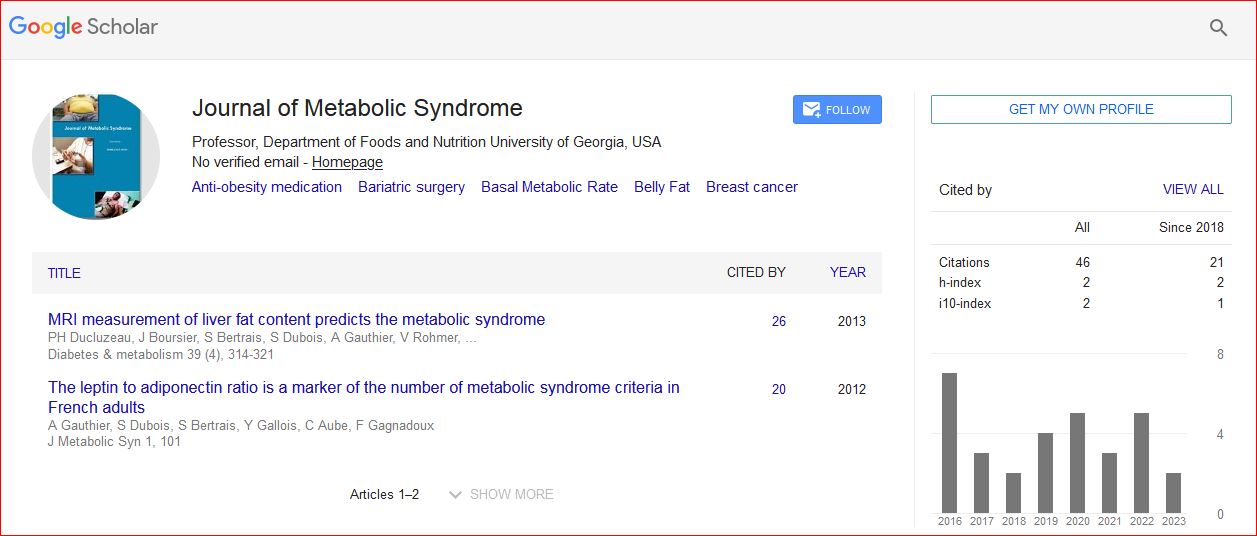
Journal of Metabolic Syndrome received 48 citations as per Google Scholar report