Opinion - (2025) Volume 9, Issue 2
Received: 02-Jun-2025, Manuscript No. rrms-25-175054;
Editor assigned: 04-Jun-2025, Pre QC No. P-175054;
Reviewed: 18-Jun-2025, QC No. Q-175054;
Revised: 23-Jun-2025, Manuscript No. R-175054;
Published:
30-Jun-2025
, DOI: 10.37421/2952-8127.2025.9.217
Citation: Deshmukh, Priya. ”Transformative Biomedical Advancements Across Disciplines.” Res Rep Med Sci 09 (2025):217.
Copyright: © 2025 Deshmukh P. This is an open-access article distributed under the terms of the Creative Commons Attribution License, which permits unrestricted use, distribution and reproduction in any medium, provided the original author and source are credited.
This article explores the exciting advancements in gene therapy, especially focusing on CRISPR-Cas9 technology. It details how precise genomic editing can correct genetic mutations, offering hope for treating inherited diseases and even some cancers. The piece highlights the ongoing clinical trials and the challenges that remain in delivering these therapies safely and effectively to patients. [1] The review delves into the complex interplay between the gut microbiome and various neurological disorders. It suggests that changes in gut bacteria can influence brain function and contribute to conditions like Parkinson's disease, Alzheimer's, and autism spectrum disorder. Understanding these mechanisms opens new avenues for therapeutic interventions targeting the gut-brain axis. [2] This research explores liquid biopsies as a non-invasive tool for early cancer detection and monitoring. It focuses on circulating tumor DNA (ctDNA) and circulating tumor cells (CTCs), explaining how their analysis can provide real-time information about a tumor's genetic makeup, treatment response, and potential recurrence, offering a significant advantage over traditional tissue biopsies. [3] The paper investigates the therapeutic potential of mRNA vaccines beyond infectious diseases, specifically in cancer immunotherapy. It discusses how mRNA technology can be leveraged to deliver tumor-specific antigens, stimulating robust anti-tumor immune responses. The article also touches on challenges and future directions for developing personalized cancer vaccines. [4] This review provides an overview of advanced imaging techniques revolutionizing neuroscience. It covers methods like fMRI, PET, and optical imaging, explaining how they allow researchers to visualize brain structure and function with unprecedented detail, aiding in the diagnosis and understanding of neurological and psychiatric conditions. [5] The article discusses the emerging field of single-cell multi-omics, a powerful approach that integrates data from multiple molecular layers (genomics, transcriptomics, proteomics) at the individual cell level. This provides an incredibly granular view of cellular heterogeneity and function, essential for understanding complex biological systems and diseases like cancer and developmental disorders. [6] The paper examines the significant role of Artificial Intelligence (AI) and machine learning in accelerating drug discovery and development. It highlights how AI algorithms can predict drug-target interactions, optimize molecular structures, and streamline clinical trial design, thereby reducing costs and time frames for bringing new therapies to market. [7] The review focuses on advancements in regenerative medicine, specifically in tissue engineering and stem cell therapies. It discusses how bioengineered scaffolds and pluripotent stem cells are being used to repair or replace damaged tissues and organs, offering innovative solutions for conditions currently lacking effective treatments, from heart failure to spinal cord injuries. [8] This article highlights the significant progress in personalized medicine, particularly in oncology. It explains how genetic profiling of tumors allows for tailored treatments that target specific molecular pathways, leading to more effective therapies and fewer side effects. The review emphasizes the importance of precision diagnostics and biomarkers in guiding clinical decisions. [9] The paper investigates the mechanisms of immunometabolism, the intricate link between immune cell function and metabolic pathways. It details how metabolic reprogramming influences immune responses, impacting infectious diseases, autoimmune disorders, and cancer. Understanding these connections offers new therapeutic strategies to modulate immune activity for better health outcomes. [10]
Recent advancements across biological and medical sciences reveal transformative progress in various fields. Gene therapy, particularly with CRISPR-Cas9 technology, is making strides in precise genomic editing to correct genetic mutations, offering significant hope for treating inherited diseases and certain cancers. Clinical trials are currently underway, addressing challenges related to safe and effective delivery of these therapies [1].
The gut microbiome's intricate connection with neurological disorders is also a major area of focus. Research indicates that changes in gut bacteria can influence brain function, potentially contributing to conditions like Parkinson's disease, Alzheimer's, and autism spectrum disorder. This understanding opens new avenues for therapeutic interventions targeting the crucial gut-brain axis [2]. Non-invasive liquid biopsies are emerging as powerful tools for early cancer detection and monitoring. By analyzing circulating tumor DNA (ctDNA) and circulating tumor cells (CTCs), clinicians can gain real-time insights into a tumor's genetic makeup, treatment response, and potential for recurrence, offering a substantial advantage over traditional tissue biopsies [3].
mRNA vaccine technology extends its therapeutic potential beyond infectious diseases into cancer immunotherapy. This approach leverages mRNA to deliver tumor-specific antigens, stimulating robust anti-tumor immune responses and paving the way for personalized cancer vaccines, despite ongoing challenges [4]. Furthermore, neuroscience is being revolutionized by advanced imaging techniques such as fMRI, PET, and optical imaging. These methods allow researchers to visualize brain structure and function with unprecedented detail, significantly aiding in the diagnosis and understanding of various neurological and psychiatric conditions [5].
The burgeoning field of single-cell multi-omics integrates data from multiple molecular layersâ??genomics, transcriptomics, and proteomicsâ??at the individual cell level. This powerful approach provides a granular view of cellular heterogeneity and function, which is essential for comprehending complex biological systems and diseases like cancer and developmental disorders [6]. Artificial Intelligence (AI) and machine learning are playing a pivotal role in accelerating drug discovery and development. AI algorithms can predict drug-target interactions, optimize molecular structures, and streamline clinical trial design, thereby reducing the time and cost associated with bringing new therapies to market [7].
Regenerative medicine is also advancing rapidly, particularly in tissue engineering and stem cell therapies. Bioengineered scaffolds and pluripotent stem cells are being utilized to repair or replace damaged tissues and organs, offering innovative solutions for conditions from heart failure to spinal cord injuries, where effective treatments are currently lacking [8]. In oncology, personalized medicine is achieving significant progress. Genetic profiling of tumors enables tailored treatments that target specific molecular pathways, leading to more effective therapies with fewer side effects. Precision diagnostics and biomarkers are crucial in guiding these clinical decisions [9].
Finally, the field of immunometabolism investigates the complex link between immune cell function and metabolic pathways. It reveals how metabolic reprogramming influences immune responses, impacting a range of conditions including infectious diseases, autoimmune disorders, and cancer. Understanding these connections offers novel therapeutic strategies to modulate immune activity for improved health outcomes [10].
Recent biomedical research reveals a wave of transformative advancements across multiple disciplines. Gene therapy, exemplified by CRISPR-Cas9, offers precise genomic editing to correct genetic mutations, holding promise for inherited diseases and cancers. Simultaneously, studies are elucidating the critical interplay between the gut microbiome and neurological disorders, suggesting new therapeutic avenues targeting the gut-brain axis. In cancer diagnostics, liquid biopsies provide non-invasive, real-time insights into tumor genetics and treatment response, a significant leap from traditional methods. The therapeutic scope of mRNA technology is expanding beyond infectious diseases into cancer immunotherapy, aiming to stimulate specific anti-tumor immune responses. Neuroscience is being revolutionized by advanced imaging techniques like fMRI and PET, which offer detailed visualization of brain structure and function, enhancing diagnosis and understanding of neurological conditions. The detailed perspective offered by single-cell multi-omics is crucial for comprehending cellular heterogeneity in complex diseases. Artificial Intelligence (AI) is accelerating drug discovery by predicting interactions and optimizing development processes. Regenerative medicine is making strides in repairing damaged tissues and organs using engineered scaffolds and stem cells. Personalized medicine in oncology leverages genetic profiling for tailored, more effective treatments. Finally, the emerging field of immunometabolism explores how metabolic pathways influence immune cell function, presenting new strategies for modulating immune responses in diverse diseases. These collective innovations underscore a rapid evolution in medical science aimed at improving patient outcomes.
None
None
Kiran M, Carl J, Marika KS. "CRISPR-Cas9-mediated in vivo genome editing for human genetic diseases".Nat Med 29 (2023):195-207.
Indexed at, Google Scholar, Crossref
Sarkis M, Elaine YH, Rustem FG. "The Gut Microbiome and Neuropsychiatric Disorders: Novel Insights and Therapeutic Potential".Cell Host Microbe 30 (2022):110-120.
Indexed at, Google Scholar, Crossref
Nitzan R, Maximilian D, Mark L. "Liquid Biopsies in Cancer: A Comprehensive Review".J Clin Oncol 41 (2023):1111-1123.
Indexed at, Google Scholar, Crossref
Ã?zlem T, Ugur S, Katalin K. "mRNA vaccines: A new era in vaccinology and cancer immunotherapy".Mol Ther 29 (2021):1980-1996.
Indexed at, Google Scholar, Crossref
Alan JE, Randy LB, Daniel SM. "Advanced Neuroimaging Techniques for Mapping the Human Brain".Nat Neurosci 25 (2022):50-60.
Indexed at, Google Scholar, Crossref
Fabian JT, Lars B, Sarah AT. "Single-cell multi-omics: technologies and data analysis challenges".Nat Rev Genet 23 (2022):635-650.
Indexed at, Google Scholar, Crossref
Andreas B, Jeremy LJ, Mark JG. "Artificial Intelligence in Drug Discovery and Development".Cell 186 (2023):16-30.
Indexed at, Google Scholar, Crossref
Christine LM, Jeffrey RM, Melissa HL. "Regenerative Medicine: Progress, Challenges, and Clinical Applications".Cell Stem Cell 30 (2023):10-25.
Indexed at, Google Scholar, Crossref
Elaine RM, Eric SL, Richard KW. "Precision Medicine in Oncology: From Genomics to the Clinic".Cancer Discov 12 (2022):220-234.
Indexed at, Google Scholar, Crossref
Luke AO, Greg SO, Douglas GM. "Immunometabolism: A New Frontier in Disease Pathogenesis and Therapy".Nat Rev Immunol 20 (2020):520-534.
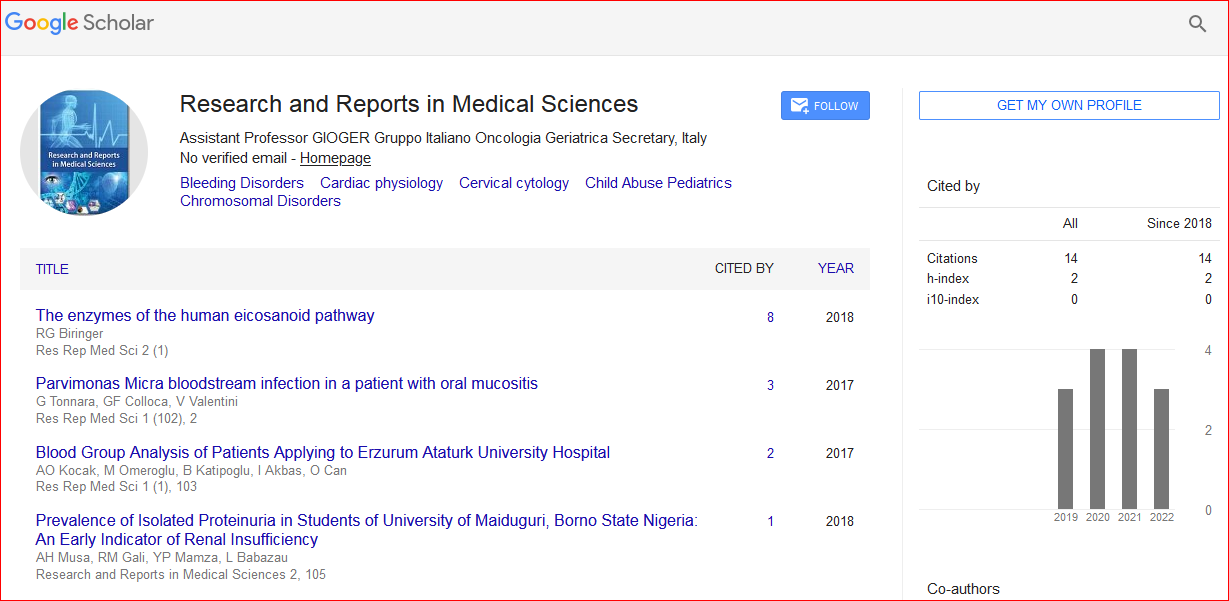
Research and Reports in Medical Sciences received 13 citations as per Google Scholar report