Opinion - (2025) Volume 16, Issue 6
Received: 01-Dec-2025, Manuscript No. jbmbs-26-183418;
Editor assigned: 03-Dec-2025, Pre QC No. P-183418;
Reviewed: 17-Dec-2025, QC No. Q-183418;
Revised: 22-Dec-2025, Manuscript No. R-183418;
Published:
29-Dec-2025
, DOI: 10.37421/2155-6180.2025.16.303
Citation: Munoz, Andrés. ”Time-Series Analysis For Health Monitoring And Disease.” J Biom Biosta 16 (2025):303.
Copyright: © 2025 Munoz A. This is an open-access article distributed under the terms of the Creative Commons Attribution License, which permits unrestricted use, distribution and reproduction in any medium, provided the original author and source are credited.
The application of time-series analysis techniques to physiological and biometric signals is a rapidly evolving field, offering profound insights into human health and performance. This domain focuses on extracting meaningful information from the temporal dynamics of signals such as heart rate, blood pressure, and gait patterns, with the ultimate goal of improving health monitoring, disease detection, and performance assessment. Key methodologies encompass signal processing, feature extraction, and sophisticated statistical modeling to identify trends, seasonality, anomalies, and correlations within complex biological data [1].
Statistical and machine learning methods are increasingly being employed to analyze the time-varying nature of biometric data. This approach allows researchers to uncover patterns indicative of stress, fatigue, or specific physiological states, paving the way for personalized health interventions and more accurate risk stratification. Addressing the inherent challenges of noisy biological signals and the need for robust modeling are central to this research [2].
Advanced signal processing techniques are crucial for extracting relevant features from physiological time series. These methods often involve filtering, decomposition, and feature selection to effectively capture dynamic physiological changes. The insights derived from these analyses are vital for developing real-time health monitoring systems that can facilitate the early detection of deviations from normal physiological function [3].
Predictive capabilities of time-series models are being leveraged to forecast future physiological states or events, such as the onset of cardiac arrhythmias or the risk of falls. A variety of forecasting models are being explored, with ongoing research focused on understanding their respective strengths and limitations when applied to complex biological signals [4].
Machine learning, particularly deep learning, offers powerful tools for analyzing intricate patterns within physiological time series. Techniques like recurrent neural networks (RNNs) and convolutional neural networks (CNNs) are adept at learning temporal dependencies and identifying subtle anomalies in signals such as ECG or EEG, often outperforming traditional statistical methods [5].
Handling noisy and incomplete physiological data presents a significant challenge in time-series analysis. Robust statistical and signal processing methods are being developed to effectively clean data and extract reliable features. This is essential for building more accurate and dependable health monitoring systems, even when data acquisition conditions are suboptimal [6].
The identification of anomalies or unusual patterns in physiological signals is a critical application of time-series analysis, particularly for the early detection of diseases or adverse events. Comparative studies of different anomaly detection algorithms are being conducted to assess their effectiveness on specific biometric datasets [7].
Feature extraction from various biometric modalities, including voice and movement data, is another key area where time-series analysis plays a significant role. The temporal features extracted can be utilized for applications such as person identification, emotion recognition, and activity monitoring, with ongoing discussions about the trade-offs between different feature extraction methodologies [8].
Wearable sensors, combined with time-series analysis, are enabling continuous physiological monitoring in daily life. Metrics like heart rate variability, sleep patterns, and physical activity are being tracked, providing valuable data for promoting healthy lifestyles and managing chronic conditions effectively [9].
Developing sophisticated models to understand complex, non-linear relationships within physiological time series is an ongoing endeavor. Advanced statistical methods and hybrid deep learning approaches are being explored to capture intricate patterns that simpler techniques might miss, thereby enhancing diagnostic accuracy and predictive power [10].
The application of time-series analysis to physiological and biometric signals is fundamentally concerned with interpreting the temporal dynamics of biological data. This approach aims to derive actionable insights for health monitoring, disease identification, and performance evaluation by employing techniques such as signal processing, feature extraction, and statistical modeling. The objective is to uncover trends, seasonal patterns, anomalies, and inter-signal correlations within these complex datasets [1].
Research in this field extensively utilizes statistical and machine learning methodologies to scrutinize the time-varying characteristics of biometric information. The analysis seeks to reveal patterns that may indicate states such as stress or fatigue, thereby informing personalized health strategies and risk stratification. A significant challenge involves managing noisy biological signals and implementing robust modeling approaches to ensure reliability [2].
Sophisticated signal processing techniques are paramount for discerning pertinent features from physiological time series. These techniques, which include filtering, signal decomposition, and judicious feature selection, are designed to capture the nuances of dynamic physiological changes. The insights gained are instrumental in the development of real-time health monitoring systems capable of early detection of functional deviations [3].
The predictive capacity of time-series models is a central focus, particularly in forecasting future physiological states or critical health events. This involves evaluating a range of forecasting models, assessing their performance, and understanding their limitations when applied to the complexities of biological signals for applications like predicting cardiac arrhythmias or fall risks [4].
Deep learning techniques have emerged as powerful tools for analyzing complex physiological time series, excelling at identifying temporal dependencies and subtle anomalies in signals like ECG and EEG. Models such as RNNs and CNNs often demonstrate superior performance compared to conventional statistical methods in pattern recognition within biological data [5].
A significant area of investigation involves addressing the challenges posed by noisy and incomplete physiological data within time-series analyses. The development and application of robust statistical and signal processing methods are key to data cleaning and reliable feature extraction, ensuring the dependability of health monitoring systems even under adverse data acquisition conditions [6].
The identification of anomalies and unusual patterns in physiological time series is a critical aspect for early disease detection and the recognition of adverse health events. Methodologies for anomaly detection are continuously being compared and refined for their effectiveness on diverse biometric datasets [7].
Time-series analysis is also crucial for feature engineering from various biometric modalities, such as voice and motion data. The extracted temporal features contribute to applications like personal identification, emotion recognition, and activity monitoring, with an ongoing emphasis on optimizing feature extraction strategies [8].
The integration of wearable sensors with time-series analysis facilitates continuous physiological monitoring in everyday settings. Key metrics such as heart rate variability, sleep quality, and physical activity levels are tracked, providing valuable data for promoting well-being and managing chronic conditions [9].
Efforts are dedicated to constructing advanced models capable of deciphering complex, non-linear relationships within physiological time series. This includes the exploration of advanced statistical methods and hybrid deep learning architectures to capture subtle patterns, thereby enhancing diagnostic accuracy and predictive capabilities in healthcare [10].
This collection of research highlights the critical role of time-series analysis in interpreting physiological and biometric signals for health monitoring and disease detection. Advanced techniques including signal processing, machine learning, and deep learning are employed to extract meaningful patterns from temporal data. Challenges such as noisy signals and incomplete data are being addressed through robust modeling and feature extraction methods. The research emphasizes the development of predictive models for health events and the application of wearable sensors for continuous monitoring. Overall, these studies contribute to a deeper understanding of biological dynamics and the advancement of personalized healthcare solutions.
None
None
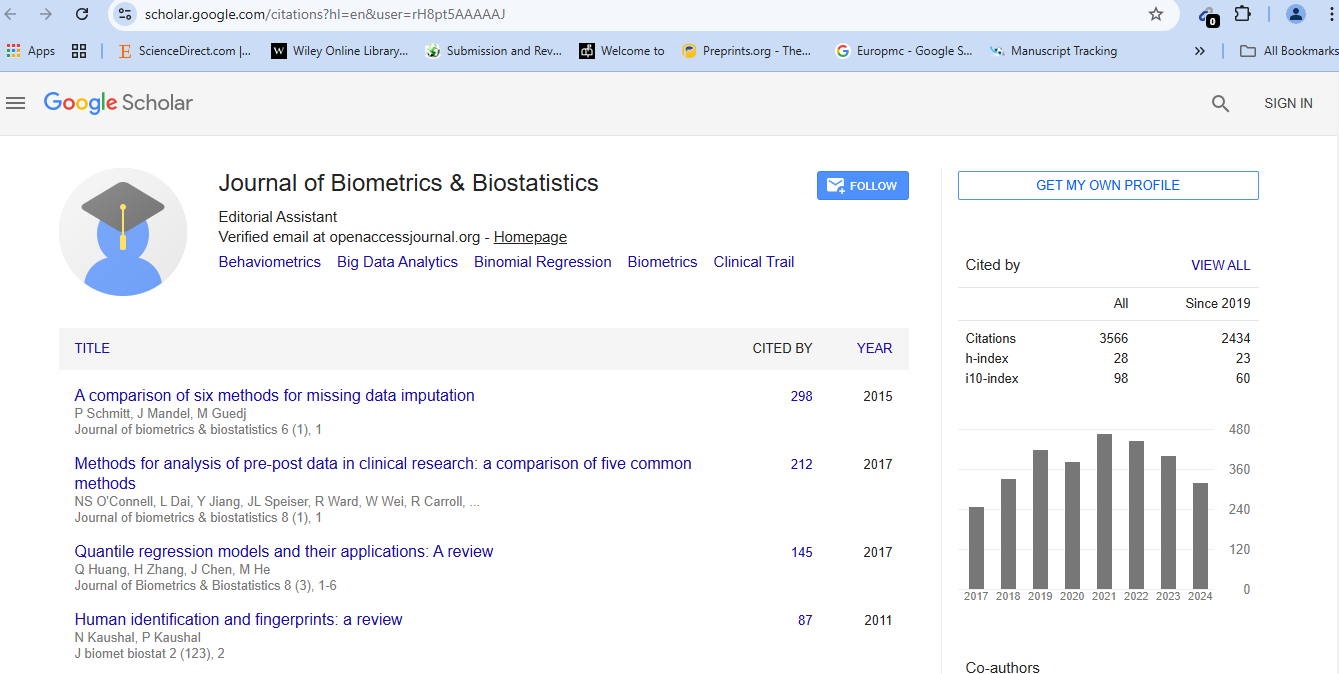
Journal of Biometrics & Biostatistics received 3496 citations as per Google Scholar report