Perspective - (2025) Volume 14, Issue 4
Received: 01-Aug-2025, Manuscript No. jme-26-185220;
Editor assigned: 04-Aug-2025, Pre QC No. P-185220;
Reviewed: 18-Aug-2025, QC No. Q-185220;
Revised: 22-Aug-2025, Manuscript No. R-185220;
Published:
29-Aug-2025
, DOI: 10.37421/2169-0022.2025.14.737
Citation: Rossi, Mateo. ”Thermal Barrier Coatings: Advanced
Materials, Performance, Durability.” J Material Sci Eng 14 (2025):737.
Copyright: © 2025 Rossi M. This is an open-access article distributed under the terms of the Creative Commons Attribution License, which permits unrestricted use, distribution
and reproduction in any medium, provided the original author and source are credited.
The field of thermal barrier coatings (TBCs) is undergoing continuous evolution, driven by the demand for higher operating temperatures and enhanced durability in critical applications such as aerospace and power generation. Advanced ceramic materials form the cornerstone of this progress, with a specific focus on compositions like yttria-stabilized zirconia (YSZ) and novel alternatives. The intricate design of their microstructure and the inherent phase stability are paramount in achieving superior high-temperature performance under severe operational stresses. Furthermore, the development of state-of-the-art fabrication techniques and advanced characterization methods is crucial for a profound understanding and optimization of TBC behavior, paving the way for next-generation thermal protection systems [1].
Understanding the degradation mechanisms of TBCs is a critical area of research, particularly concerning their response to thermal cycling and oxidative environments. The formation, growth, and eventual spallation of the thermally grown oxide (TGO) layer are primary concerns, alongside the influence of internal pore structures on overall performance. Employing sophisticated analytical techniques to pinpoint failure origins and devising effective strategies to extend the cyclic life of these coatings are key objectives in this domain [2].
The fabrication of TBCs with tailored microstructures relies heavily on novel processing techniques. Methods such as electron beam physical vapor deposition (EB-PVD) and atmospheric plasma spraying (APS) offer significant control over coating morphology. Variations in processing parameters directly impact coating density, porosity, and consequently, their thermal insulation capabilities, underscoring the importance of understanding the process-structure-property relationships for optimal performance [3].
Beyond traditional YSZ, research is actively exploring next-generation ceramic materials for advanced TBCs. Lanthanum zirconate (LZ) and hafnium zirconate (HZ) based ceramics are showing immense promise due to their superior phase stability and lower thermal conductivity. While challenges related to their processing and adhesion persist, these advanced materials hold the potential to dramatically extend the service life of high-temperature components in gas turbines and jet engines [4].
The environmental resilience of TBCs is a significant consideration, as they are frequently exposed to harsh conditions including erosion and oxidation. Investigating the inherent resistance of coating compositions and microstructures to these aggressive environments is vital. The development of top coats with enhanced erosion resistance and bond coats offering improved oxidation protection are among the strategies being explored to mitigate these effects and ensure long-term functionality [5].
The interface between the TBC and the underlying substrate plays a pivotal role in the overall system's integrity. The bond coat acts as a crucial intermediary, accommodating the thermal expansion mismatch between the ceramic top coat and the metallic substrate, while simultaneously providing a barrier against oxidation. Evaluating different bond coat materials and microstructures is essential for enhancing the adhesion and durability of the entire TBC system, preventing premature failure [6].
Defects such as porosity and microcracks within TBCs can have a detrimental impact on their thermal conductivity and mechanical robustness. Employing advanced imaging techniques to meticulously characterize these defects and understanding their specific influence on heat transfer and fracture behavior is imperative. Concurrently, the development of processing routes aimed at minimizing defect formation is a key focus for improving TBC reliability [7].
Functionally graded materials (FGMs) represent an innovative approach to TBC design, offering a continuous variation in composition across the coating thickness. This graded nature allows for the optimization of properties, such as thermal insulation and mechanical compatibility, throughout the entire layer. Research into the fabrication and performance of FGMs, incorporating both ceramic and metallic phases with tailored gradients, is advancing the capabilities of TBC systems [8].
A comprehensive understanding of TBC performance is underpinned by robust characterization techniques. A wide array of methods are employed to analyze microstructural evolution, phase transformations, mechanical properties, and thermal conductivity under realistic service conditions. Emphasizing in-situ characterization is particularly important for gaining insights into dynamic processes occurring within the coating during operation, leading to more accurate performance predictions [9].
The environmental stability of TBCs, especially their resistance to molten salt corrosion and water vapor attack, is crucial for applications operating in aggressive atmospheres. Identifying the formation of detrimental phases and assessing the impact of corrosive environments on thermal insulation and structural integrity are key research areas. Strategies such as incorporating rare earth elements into the TBC composition are being investigated as protective measures against such degradation pathways [10].
Advanced ceramic materials, including yttria-stabilized zirconia (YSZ) and novel compositions, are fundamental to the development of high-temperature thermal barrier coatings (TBCs) [1].
Their efficacy is deeply intertwined with meticulous microstructural design and the achievement of robust phase stability, attributes that are critical for maintaining performance under demanding operational conditions. The continuous refinement of fabrication techniques and the application of sophisticated characterization methods are essential for a deeper comprehension and subsequent optimization of TBC behavior, particularly within the stringent requirements of aerospace and power generation industries [1].
Investigating the degradation mechanisms inherent to TBCs, particularly under conditions of thermal cycling and oxidative exposure, is a paramount area of research. A significant focus lies on understanding the formation and propagation of the thermally grown oxide (TGO) layer, alongside the phenomena of spallation. The intricate relationship between the pore structure within the TBC and its overall performance is also a key consideration. The application of advanced analytical tools to precisely identify the root causes of failure and the subsequent proposal of strategies aimed at enhancing the cyclic durability of TBCs are vital contributions to the field [2].
The fabrication of TBCs with precisely engineered microstructures is significantly influenced by the adoption of innovative processing techniques. Electron beam physical vapor deposition (EB-PVD) and atmospheric plasma spraying (APS) are prominent examples that enable fine control over coating architecture. The influence of specific processing parameters on critical characteristics such as coating density, porosity, and the resulting thermal insulation properties is a subject of ongoing investigation, highlighting the indispensable connection between processing, structure, and final performance [3].
The pursuit of next-generation TBC materials involves exploring ceramics beyond traditional YSZ. Lanthanum zirconate (LZ) and hafnium zirconate (HZ) based ceramics are emerging as highly promising candidates due to their inherent superior phase stability and notably lower thermal conductivity. Although challenges related to their manufacturing processes and ensuring adequate adhesion to the substrate remain, these advanced materials offer substantial potential for significantly extending the operational lifespan of critical hot-section components [4].
The impact of environmental factors, such as high-velocity particle impacts causing erosion and pervasive oxidation, on the performance of TBCs is a critical aspect of their long-term reliability. This research delves into how the specific composition and microstructure of the coating influence its inherent resistance to these deleterious environmental conditions. Furthermore, the exploration of remedial strategies, including the integration of top coats engineered for superior erosion resistance and bond coats designed for enhanced oxidation protection, is a key focus for mitigating these degradation pathways [5].
The interface between the TBC and the underlying metallic substrate is a critical area, with the bond coat playing an indispensable role. This layer is responsible for accommodating the thermal expansion differentials between the ceramic top coat and the metal substrate, thereby preventing stresses that could lead to delamination. It also serves as a vital barrier against oxidation. Therefore, the evaluation of various bond coat materials and their distinct microstructural characteristics is fundamental to improving the overall adhesion and ensuring the long-term durability of the entire TBC system [6].
The presence of internal defects, such as voids and microcracks, within TBCs can significantly compromise their thermal insulation capabilities and their mechanical integrity. The utilization of advanced imaging techniques is essential for the precise characterization of these defects and for understanding their specific influence on heat transfer phenomena and fracture propagation mechanisms. Alongside defect characterization, the development and implementation of processing strategies designed to minimize defect formation are crucial for enhancing the reliability and performance of TBCs [7].
Functionally graded materials (FGMs) offer a sophisticated approach to TBC design by enabling a gradual, continuous variation in material composition across the thickness of the coating. This graded architecture allows for the optimization of properties, such as thermal insulation and mechanical compatibility, along the entire coating profile. The study and development of FGMs, which incorporate carefully tailored gradients of both ceramic and metallic phases, represent a significant advancement in enhancing the overall performance and functionality of TBC applications [8].
A comprehensive review of the characterization techniques employed for assessing TBC performance is essential for advancing the field. This includes methods for analyzing microstructural changes over time, identifying phase transformations, evaluating mechanical properties under stress, and measuring thermal conductivity under operational conditions. The emphasis on in-situ characterization is particularly noteworthy, as it provides invaluable insights into the dynamic processes that occur within TBCs during their service life, leading to a more accurate understanding of their behavior [9].
The environmental stability of TBCs, specifically their resilience against corrosive agents such as molten salts and water vapor, is a critical factor for their longevity in demanding operational environments. This research investigates the mechanisms leading to the formation of deleterious phases and quantifies the impact of these corrosive conditions on the coating's thermal insulation properties and structural integrity. The exploration of protective measures, such as the strategic addition of rare earth elements to the TBC formulation, is a key avenue for enhancing resistance in such aggressive atmospheres [10].
This compilation of research explores various facets of thermal barrier coatings (TBCs), essential for high-temperature applications. It delves into advanced ceramic materials, including YSZ and next-generation options like LZ and HZ, emphasizing microstructural design and phase stability for enhanced performance. The studies address critical degradation mechanisms such as TGO formation and spallation, alongside the impact of environmental factors like oxidation and erosion. Processing techniques like EB-PVD and APS are highlighted for tailoring TBC microstructures, while the role of bond coats in ensuring adhesion and preventing oxidation is investigated. The influence of defects on TBC performance and the potential of functionally graded materials are also examined. Furthermore, a review of characterization techniques and strategies for improving environmental stability in corrosive atmospheres are discussed, collectively contributing to the advancement of durable and efficient TBC systems.
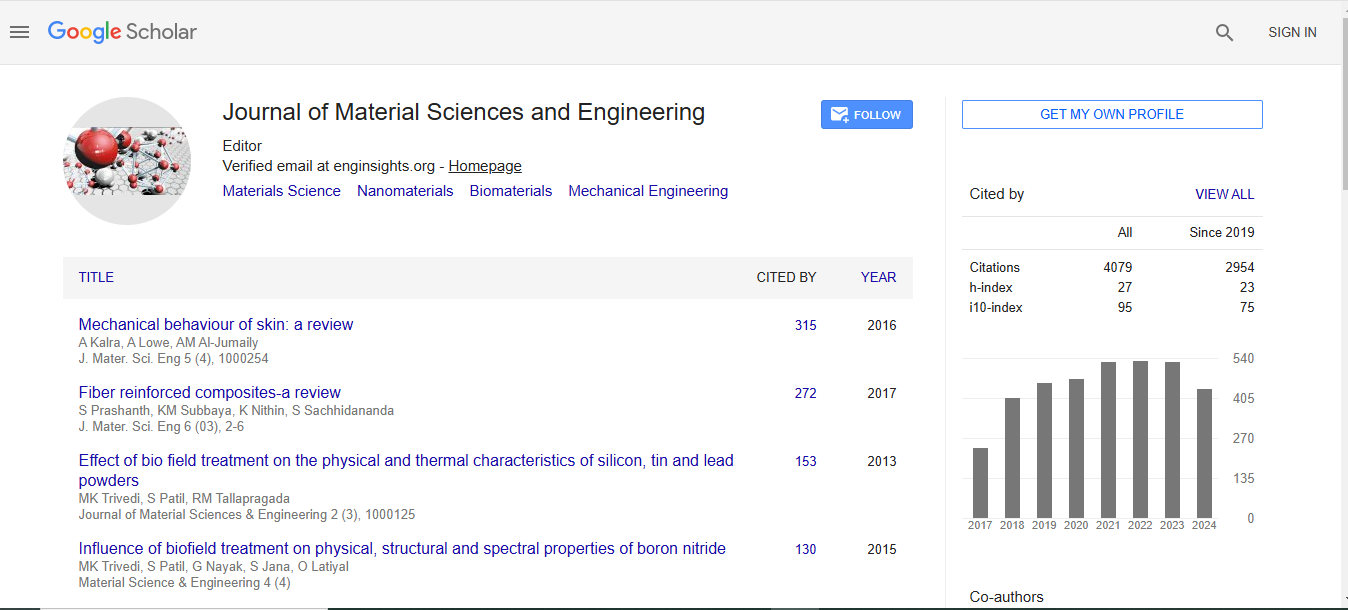
Journal of Material Sciences & Engineering received 3677 citations as per Google Scholar report