Short Communication - (2025) Volume 16, Issue 1
Received: 03-Jan-2025, Manuscript No. jnmrt-25-172715;
Editor assigned: 06-Jan-2025, Pre QC No. P-172715;
Reviewed: 20-Jan-2025, QC No. Q-172715;
Revised: 24-Jan-2025, Manuscript No. R-172715;
Published:
31-Jan-2025
, DOI: 10.37421/2155-9619.2025.16.633
Citation: Lopes, Maria C.. ”Theranostics: Personalizing Cancer Diagnosis and Therapy.” J Nucl Med Radiat Ther 16 (2025): 633.
Copyright: © 2025 Lopes C. Maria This is an open-access article distributed under the terms of the Creative Commons Attribution License, which permits unrestricted use,
distribution and reproduction in any medium, provided the original author and source are credited.
Theranostic biomarkers are fundamentally changing how we approach cancer care, offering a unified and highly integrated strategy for both precise diagnosis and effective therapy. This innovative approach moves significantly beyond traditional methods, aiming squarely at truly personalized patient management across a broad spectrum of oncological conditions. This article explores theranostic biomarkers for lung cancer, specifically focusing on the early stages. It highlights how these markers can bridge diagnostic and therapeutic strategies, offering a personalized approach to patient management. The discussion covers various molecular targets and imaging modalities, emphasizing their potential for improving prognosis and treatment efficacy by guiding therapeutic decisions and monitoring responses [1].
Here's the thing about triple-negative breast cancer (TNBC): it's aggressive and lacks conventional targets. This review examines theranostic biomarkers that are crucial for guiding targeted therapies and immunotherapies in TNBC. It delves into the molecular characteristics that can serve as both diagnostic indicators and predictors of treatment response, opening avenues for more effective and individualized patient care [2].
Let's break down the role of theranostic biomarkers in colorectal cancer (CRC). This article provides a comprehensive overview of the latest advancements and future directions. It explores how these markers can refine diagnosis, predict therapeutic outcomes, and facilitate personalized treatment strategies, ultimately aiming to improve patient prognosis and reduce treatment resistance in CRC [3].
What this really means for gastric cancer is a move towards more personalized therapy through theranostic biomarkers. This paper reviews the various markers being investigated for their potential to diagnose gastric cancer earlier, stratify patients for specific treatments, and monitor therapy effectiveness, which is crucial for a disease with high mortality rates [4].
This systematic review looks at theranostic biomarkers for melanoma, a serious skin cancer. It identifies and synthesizes current knowledge on markers that can help both diagnose the disease and guide therapy decisions, offering insights into how to better manage patients with melanoma and improve their outcomes [5].
Here's what's emerging in pancreatic cancer: new theranostic biomarkers. This review highlights promising candidates that could revolutionize the diagnosis and treatment of this particularly challenging cancer. It covers various molecular targets and their potential to serve as both diagnostic tools and therapeutic targets, ultimately paving the way for more effective, patient-specific interventions [6].
Let's talk about hepatocellular carcinoma (HCC), a primary liver cancer. This review delves into the current status and future prospects of theranostic biomarkers for HCC. It examines how these markers are being used to improve early detection, predict disease progression, and personalize treatment regimens, offering a clearer path to better patient management [7].
Here's the situation for ovarian cancer: there are significant challenges in diagnosis and treatment. This article discusses theranostic biomarkers that hold promise in overcoming these hurdles. It outlines current research and future directions for these markers to improve early detection, enable more precise treatment selection, and enhance monitoring of therapeutic responses [8].
Let's explore the advances in theranostic biomarkers for prostate cancer. This paper focuses on how these markers are improving both diagnosis and treatment strategies. It highlights key molecular and imaging biomarkers that offer a pathway to more accurate disease staging, personalized therapeutic interventions, and better patient stratification [9].
This comprehensive review dives into theranostic biomarkers for glioma, a complex brain tumor. It details the various molecular and cellular markers that are crucial for improving diagnostic accuracy, monitoring disease progression, and guiding targeted therapies, offering a roadmap for future research and clinical applications in glioma management [10].
Theranostic biomarkers are transforming cancer management by integrating diagnosis with therapy. They are pivotal in tailoring patient care, as seen in early-stage lung cancer, where these markers bridge diagnostic and therapeutic strategies to enhance prognosis and treatment efficacy by guiding decisions and monitoring responses [1]. For triple-negative breast cancer (TNBC), an aggressive form lacking conventional targets, theranostic biomarkers are crucial for steering targeted therapies and immunotherapies, identifying molecular characteristics that serve as both diagnostic indicators and reliable predictors of treatment response [2]. In colorectal cancer (CRC), these markers refine diagnosis, predict therapeutic outcomes, and facilitate personalized strategies to improve patient prognosis and reduce resistance [3]. What this really means for gastric cancer is a direct move toward more personalized therapy, using markers to diagnose earlier, stratify patients, and monitor treatment effectiveness, which is vital for a disease with high mortality rates [4].
Beyond these specific contexts, the application of theranostic biomarkers extends to other challenging malignancies. A systematic review on melanoma, a serious skin cancer, identifies markers that aid both diagnosis and therapy decisions, providing insights into better patient management and improved outcomes [5]. Here's what's emerging in pancreatic cancer: promising new theranostic biomarkers that could revolutionize its diagnosis and treatment. These candidates cover various molecular targets, serving as both precise diagnostic tools and viable therapeutic targets, ultimately paving the way for more effective, patient-specific interventions [6]. Let's talk about hepatocellular carcinoma (HCC), a primary liver cancer. This review comprehensively delves into the current status and exciting future prospects of theranostic biomarkers for HCC, examining how they are being utilized to improve early detection, accurately predict disease progression, and personalize treatment regimens [7].
The situation for ovarian cancer highlights significant challenges in both diagnosis and treatment. Theranostic biomarkers offer considerable promise in effectively overcoming these hurdles, with current research outlining future directions for these markers to significantly improve early detection, enable more precise treatment selection, and enhance the monitoring of therapeutic responses [8]. Let's explore the notable advances in theranostic biomarkers for prostate cancer. This paper specifically focuses on how these markers are consistently improving both diagnostic capabilities and treatment strategies, highlighting key molecular and imaging biomarkers that offer a clear pathway to more accurate disease staging, truly personalized therapeutic interventions, and better patient stratification [9]. Finally, this comprehensive review dives into theranostic biomarkers for glioma, which is known as a complex and challenging brain tumor. It meticulously details the various molecular and cellular markers that are crucial for improving diagnostic accuracy, effectively monitoring disease progression, and guiding targeted therapies, offering a robust roadmap for future research and clinical applications in comprehensive glioma management [10].
Across these diverse cancer types, the consistent theme is the power of theranostic biomarkers to enable precision medicine. They provide a deeper understanding of disease mechanisms, facilitate earlier and more accurate diagnosis, allow for the selection of the most effective therapies, and offer real-time monitoring of treatment efficacy. This integrated approach not only enhances patient prognosis but also works to minimize unnecessary treatments and mitigate resistance, marking a significant evolution in oncology. The ongoing research and development in this field promise a future where cancer care is increasingly tailored, effective, and patient-centric, moving us closer to overcoming some of the most persistent challenges in cancer treatment.
Theranostic biomarkers are a big deal in cancer care, driving personalized approaches from diagnosis to therapy. They help pinpoint lung cancer early, bridging detection with treatment strategies to improve patient outcomes. For aggressive cancers like triple-negative breast cancer, these markers are key to guiding targeted and immunotherapies, tailoring care to individual patients. In colorectal cancer, theranostics refine diagnosis, predict how well treatments will work, and reduce resistance. Gastric cancer, with its high mortality, also benefits from these markers for earlier diagnosis, patient stratification, and monitoring therapy. Melanoma management improves by identifying markers for diagnosis and guiding treatment decisions. New theranostic biomarkers in pancreatic cancer hold promise for revolutionizing diagnosis and making treatments more specific. For hepatocellular carcinoma, they're improving early detection, predicting disease progression, and personalizing treatment plans. Ovarian cancer also sees a path forward with these biomarkers, helping overcome diagnosis and treatment challenges through better detection and precise therapy selection. In prostate cancer, theranostics advance both diagnosis and treatment, leading to better staging and patient stratification. Finally, for complex brain tumors like glioma, these markers are vital for accurate diagnosis, monitoring, and guiding targeted therapies. They represent a significant step towards more effective, patient-specific interventions across a wide range of cancers.
None
None
Indexed at, Google Scholar, Crossref
Indexed at, Google Scholar, Crossref
Indexed at, Google Scholar, Crossref
Indexed at, Google Scholar, Crossref
Indexed at, Google Scholar, Crossref
Indexed at, Google Scholar, Crossref
Indexed at, Google Scholar, Crossref
Indexed at, Google Scholar, Crossref
Indexed at, Google Scholar, Crossref
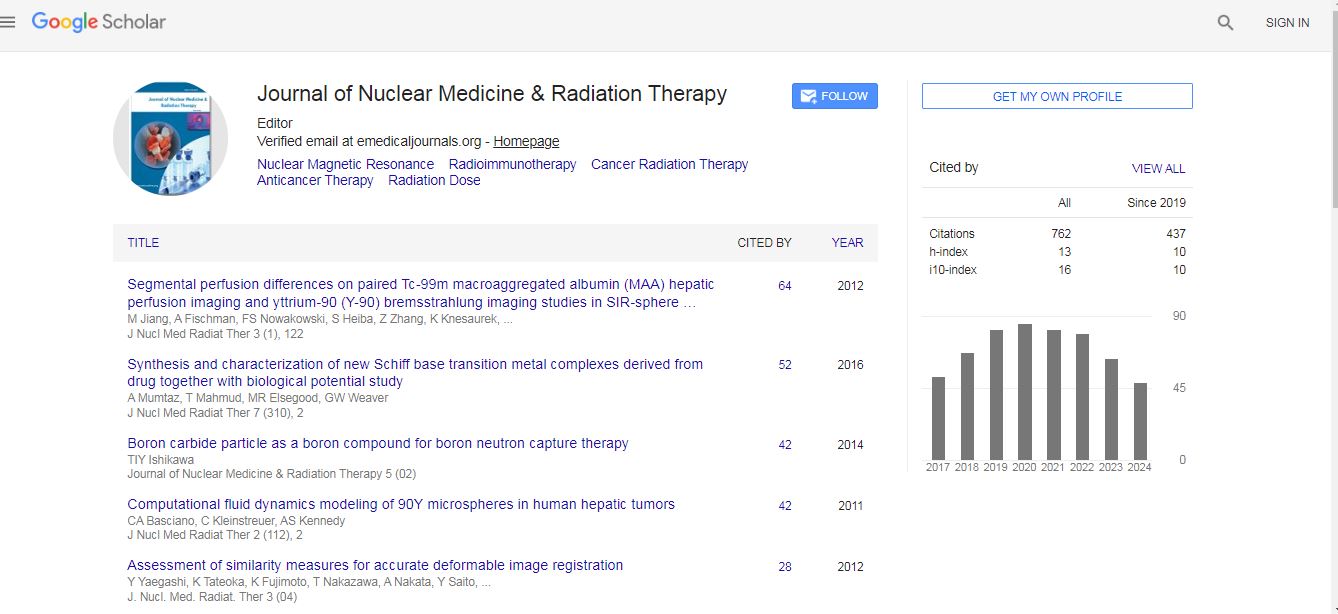
Nuclear Medicine & Radiation Therapy received 706 citations as per Google Scholar report