Opinion - (2025) Volume 14, Issue 3
Received: 02-Jun-2025, Manuscript No. jnc-25-171663;
Editor assigned: 04-Jun-2025, Pre QC No. P-171663;
Reviewed: 16-Jun-2025, QC No. Q-171663;
Revised: 23-Jun-2025, Manuscript No. R-171663;
Published:
30-Jun-2025
, DOI: 10.37421/2167-1168.2025.14.713
Citation: Massaro, Dorina. “The Role of Neonatal Nurses in Managing Congenital Anomalies: From Birth to Surgery.” J Nurs Care 14 (2025): 713.
Copyright: © 2025 Massaro D. This is an open-access article distributed under the terms of the Creative Commons Attribution License, which permits unrestricted use, distribution and reproduction in any medium, provided the original author and source are credited.
Management of congenital anomalies requires a multidisciplinary approach involving neonatologists, pediatric surgeons, genetic counselors and nurses. Neonatal nurses serve as vital links among the healthcare team, family and infant, ensuring timely recognition, stabilization and preparation for surgical correction. At birth, neonatal nurses are responsible for thorough assessments to identify visible anomalies or signs of internal malformations. Immediate recognition is critical for anomalies such as Tracheoesophageal Fistula (TEF), Congenital Diaphragmatic Hernia (CDH), or neural tube defects, which require urgent attention. Nurses monitor vital signs, respiratory effort, feeding difficulties and skin color and initiate emergency protocols when needed.Stabilizing neonates with congenital anomalies often involves respiratory support, thermoregulation, fluid and electrolyte balance and prevention of infection. Neonatal nurses insert and manage intravenous lines, orogastric tubes and oxygen delivery systems while closely monitoring for deterioration. Their expertise in neonatal resuscitation and life support plays a crucial role during this fragile period [2].
Preparing an infant for surgery involves a comprehensive approach that addresses both physical and emotional needs. This includes ensuring the infant is physically ready by maintaining nil per os (NPO) status to prevent aspiration, administering prescribed antibiotics and other medications to reduce the risk of infection and optimize physiological stability and closely monitoring vital parameters such as blood glucose levels and arterial blood gases to detect and manage metabolic or respiratory imbalances. Additionally, coordinating necessary diagnostic imaging, including echocardiograms and X-rays, ensures accurate assessment of the infantâ??s condition and aids the surgical team in planning and delivering safe, effective care. These actions ensure the neonate is in optimal condition for surgical intervention. Neonatal nurses act as the bridge between the NICU and surgical teams. They participate in interdisciplinary rounds, share vital information and help develop individualized perioperative plans. Their meticulous documentation and communication support seamless transitions to the operating theatre and back to intensive care [3].
Following surgery, neonatal nurses provide continuous monitoring in the NICU. They manage ventilatory support, monitor for signs of surgical complications (e.g., infection, hemorrhage, wound dehiscence) and promote gradual feeding initiation. Pain management, fluid balance and thermoregulation are maintained with precision. Regular assessments of abdominal girth, surgical site integrity, urine output and neurobehavioral responses guide clinical decisions. Nurses also reinforce sterile techniques and monitor for late complications such as anastomotic leaks or bowel obstruction. The diagnosis of a congenital anomaly can be devastating for parents. Neonatal nurses offer emotional support, explain care procedures and help families understand treatment plans and surgical options. They facilitate parental bonding through skin-to-skin contact when feasible and encourage active participation in care, which is crucial for long-term adjustment [4].
Education for parents of infants undergoing surgery encompasses pre- and post-surgical expectations, feeding techniques such as gastrostomy care, proper medication administration at home and guidance on follow-up and rehabilitation needs. By providing clear instruction and support, nurses build parental confidence, easing the transition from hospital to home care. Caring for infants with severe congenital anomalies also involves sensitive ethical decision-making, especially when prognosis is poor; nurses advocate for the infantâ??s best interests while respecting family values and cultural beliefs, ensuring that discussions about palliative care, life-sustaining interventions, or surgical risks are conducted with compassion and clarity. Advancements in neonatal imaging, telemedicine and minimally invasive surgery have transformed the management of these conditions and nurses receive ongoing training in advanced monitoring systems, portable ventilators and point-of-care testing to enhance responsiveness and outcomes. Furthermore, neonatal nursing research continues to inform best practices in thermoregulation, infection prevention and pain management in surgical neonates, highlighting the essential role of evidence-based practice in improving survival rates and reducing long-term complications [5].
Google Scholar Cross Ref Indexed at
Google Scholar Cross Ref Indexed at
Google Scholar Cross Ref Indexed at
Google Scholar Cross Ref Indexed at
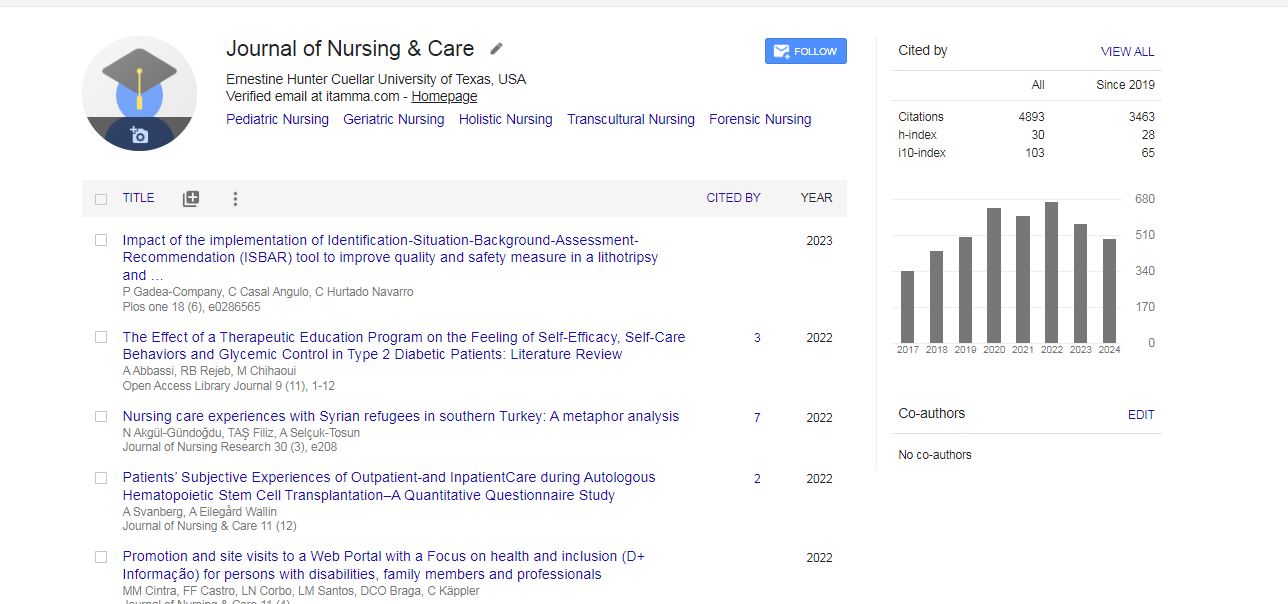
Journal of Nursing & Care received 4230 citations as per Google Scholar report