Opinion - (2025) Volume 10, Issue 1
Received: 01-Feb-2025, Manuscript No. arwm-25-165531;
Editor assigned: 03-Feb-2025, Pre QC No. P-165531;
Reviewed: 14-Feb-2025, QC No. Q-165531;
Revised: 19-Feb-2025, Manuscript No. R-165531;
Published:
26-Feb-2025
, DOI: 10.37421/2475-7675.2025.10.384
Citation: Senthil, Esalas. “The Future of Fossil Fuels: Challenges and Opportunities.’’ Adv Recycling Waste Manag 10 (2025): 384.
Copyright: © 2025 Senthil E. This is an open-access article distributed under the terms of the Creative Commons Attribution License, which permits unrestricted use, distribution and reproduction in any medium, provided the original author and source are credited.
The future of fossil fuels is one of the most pressing and contentious topics in the global conversation on energy, environment, and economics. As the world grapples with the dual challenge of meeting growing energy demands while combating climate change, the role of fossil fuels coal, oil, and natural gas sits at the heart of a complex transition. Despite a growing push for renewable energy and decarburization, fossil fuels continue to supply more than 75% of the world's primary energy. This paradox underscores both the challenges and opportunities that lie ahead.
The primary challenge facing fossil fuels is environmental. Burning fossil fuels is the largest contributor to greenhouse gas emissions, which are driving global warming and its associated impacts rising sea levels, extreme weather events, biodiversity loss, and disruptions to agriculture and human health. The science is unequivocal: to avoid the worst consequences of climate change, global emissions must be drastically reduced. This imperative is reinforced by international agreements such as the Paris Accord, which aims to limit global temperature rise to well below 2 â?? above pre-industrial levels. Achieving this goal requires a dramatic reduction in the use of fossil fuels, particularly coal, which is the most carbon-intensive [1].
This environmental imperative has led to an increasing societal and policy-driven push toward decarbonization. Many countries are setting ambitious net-zero emissions targets, and the energy policies of major economies are beginning to reflect this shift. Subsidies and incentives for fossil fuel exploration are being phased out in some regions, while investments in renewable energy, electric vehicles, and energy efficiency are on the rise. Financial institutions are also under pressure to divest from fossil fuel companies, redirecting capital toward greener technologies. These trends suggest a shrinking space for fossil fuels in the future energy mix, posing existential challenges for industries that have historically depended on their extraction and sale [2]. However, the situation is more nuanced than a straightforward phasing out of fossil fuels. One of the significant obstacles to an immediate transition away from them is the sheer scale and inertia of the current energy system. Fossil fuels are deeply embedded in global infrastructure, from power plants and transportation systems to petrochemical industries and heating networks [3].
Replacing these systems with low-carbon alternatives requires time, capital, and innovation. Developing economies, in particular, often lack the financial and technological resources to rapidly transition and still rely heavily on fossil fuels for economic development, energy access, and poverty alleviation [4]. Moreover, fossil fuels possess certain advantages that are difficult to replicate in the short term. They are energy-dense, easily transportable, and capable of providing reliable baseload power. These attributes are especially valuable in sectors where alternatives remain technically or economically unfeasible, such as heavy industry, aviation, and shipping. Natural gas, in particular, is seen by some as a "bridge fuel"-less polluting than coal and oil and able to provide backup power for intermittent renewable energy sources like wind and solar.
As such, the future of fossil fuels may not lie in outright elimination but in transformation. One opportunity lies in the development and deployment of Carbon Capture, Utilization, And Storage (CCUS) technologies. These systems aim to capture carbon dioxide emissions at the source such as power plants or industrial facilities and either store them underground or repurpose them into useful products. While CCUS has yet to be proven at scale and faces economic and technical hurdles, it offers a pathway to mitigate emissions without entirely abandoning fossil fuels [5]. Cytogenetic analysis can also be used to detect numerical chromosomal abnormalities. One of the most well-known examples of a numerical abnormality is Down syndrome, which is caused by the presence of an extra copy of chromosome 21. This condition, known as trisomy 21, leads to developmental delays and characteristic physical features. Other chromosomal abnormalities, such as trisomy 18 (Edwards syndrome) and trisomy 13 (Patau syndrome), are also associated with severe developmental and physical abnormalities.
Another potential avenue is the integration of fossil fuel infrastructure into a broader clean energy ecosystem. For example, depleted oil and gas fields can be repurposed for carbon storage or even for geothermal energy production. The skills, knowledge, and supply chains developed by the fossil fuel industry can be redirected toward emerging clean technologies. In this way, fossil fuel companies have an opportunity to evolve rather than become obsolete, becoming energy companies rather than fossil fuel companies. Furthermore, geopolitical considerations complicate the future of fossil fuels. Countries rich in oil and gas resources many of which are economically dependent on their exports face significant challenges in adapting to a decarbonizing world. For them, the energy transition is not just a technical or environmental issue but a question of national survival. On the other hand, countries that are net importers of fossil fuels may see the transition as a chance to enhance energy security and reduce reliance on volatile international markets. This divergence creates a complex global dynamic where the pace and nature of the fossil fuel phase-out will vary significantly by region.
In the private sector, fossil fuel companies are at a crossroads. Some are doubling down on traditional operations, betting that demand will persist longer than the most aggressive climate scenarios suggest. Others are diversifying their portfolios, investing in renewables, hydrogen, and battery storage, or exploring low-carbon fuels such as bioenergy. The decisions these companies make in the coming years will shape the global energy landscape. Investors and shareholders are increasingly demanding that these companies articulate clear strategies for navigating the energy transition and those that fail to adapt may find themselves losing relevance and value.
Google Scholar Cross Ref Indexed at
Google Scholar Cross Ref Indexed at
Google Scholar Cross Ref Indexed at
Google Scholar Cross Ref Indexed at
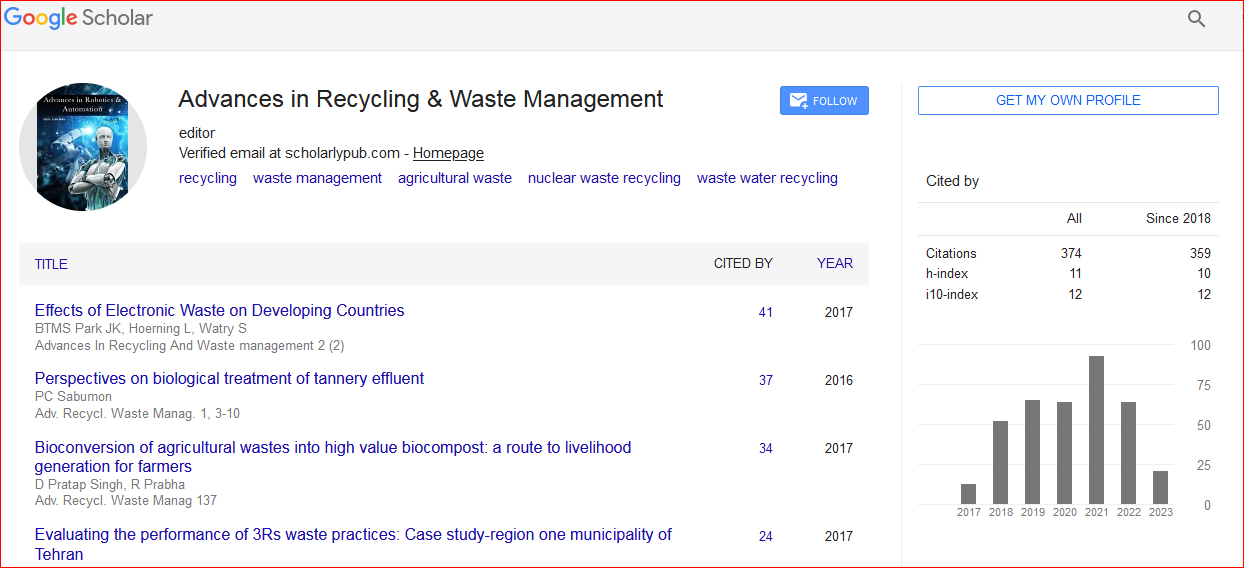
Advances in Recycling & Waste Management received 438 citations as per Google Scholar report