Commentary - (2025) Volume 17, Issue 5
Received: 01-Sep-2025, Manuscript No. jcst-25-176298;
Editor assigned: 03-Sep-2025, Pre QC No. P-176298;
Reviewed: 17-Sep-2025, QC No. Q-176298;
Revised: 22-Sep-2025, Manuscript No. R-176298;
Published:
29-Sep-2025
, DOI: 10.37421/1948-5956.2025.17.723
Citation: Svensson, Anita. ”T-cell Immunotherapies: Progress,
Challenges, Future.” J Cancer Sci Ther 17 (2025):723.
Copyright: © 2025 Svensson A. This is an open-access article distributed under the terms of the Creative Commons Attribution License, which permits unrestricted use,
distribution and reproduction in any medium, provided the original author and source are credited.
T-cell based immunotherapies are transforming the landscape of cancer treatment, offering hope for patients with previously limited options. One significant area of progress is CAR T-cell therapy for relapsed/refractory multiple myeloma, a challenging blood cancer [1].
This approach has shown impressive response rates, even as researchers tackle key hurdles like target antigen escape, managing cytokine release syndrome, and addressing neurotoxicity. The field is actively refining CAR T-cell constructs, identifying novel targets, and developing combination therapies to improve both durability and safety [1].
Parallel advancements are seen in CAR T-cell therapies for lymphoma, moving past initial successes to confront resistance mechanisms and toxicity [2].
Here, innovations include next-generation CAR designs, the exploration of new target antigens beyond CD19, and strategies focused on improving T-cell persistence and modulating the tumor microenvironment. The goal is to broaden the applicability of CAR T-cells, enhance their therapeutic window, and deliver more durable responses for patients with aggressive lymphomas [2].
Beyond CAR T-cells, T-cell receptor (TCR) gene therapy for cancer marks another critical area of development [3].
A distinct advantage of TCR-T cell therapy is its ability to target intracellular antigens, which are often inaccessible to CAR T-cells. Current strategies focus on identifying high-affinity TCRs, optimizing gene transfer methods, and carefully mitigating potential off-target toxicities, aiming to develop more potent and specific TCR-T cell therapies to expand the range of treatable cancers [3].
Here's the thing about CAR T-cells for solid tumors: it's incredibly challenging [4].
Major roadblocks include the highly immunosuppressive tumor microenvironment, poor T-cell trafficking to the tumor site, and antigen heterogeneity, which frequently leads to relapse. Promising strategies are being investigated, such as novel CAR designs, combination therapies, and localized delivery methods, all designed to improve efficacy and overcome these significant hurdles [4].
This complexity is further explored in discussions around persistent challenges like physical barriers preventing T-cell infiltration, the profoundly immunosuppressive tumor microenvironment, and the common issue of antigen loss [7].
To address these, innovative strategies are proposed, including engineering CARs for enhanced signal transduction, utilizing combination therapies, and employing local delivery methods to improve T-cell engagement and efficacy [7].
For specific and notoriously aggressive tumors like glioblastoma, a difficult-to-treat brain cancer, T-cell based immunotherapies, encompassing both CAR T and TCR-T cell approaches, are under review [5].
The central nervous system presents unique challenges, notably the blood-brain barrier and the brain's inherent immunosuppressive environment. Researchers are actively discussing various strategies to enhance T-cell infiltration, persistence, and anti-tumor activity within this hostile microenvironment, aiming to improve patient outcomes [5].
Let's break down allogeneic CAR T-cell therapy, also known as "off-the-shelf" treatments [6].
These treatments hold a real advantage due to their potential to offer a more accessible and cost-effective alternative to patient-specific autologous therapies for hematologic malignancies. The discussion covers strategies to overcome significant hurdles like graft-versus-host disease (GvHD), potential rejection, and ensuring the long-term persistence of these donor-derived T-cells [6].
Off-the-shelf CAR T-cells represent a compelling advancement, directly addressing the logistical and manufacturing complexities of personalized autologous treatments [8].
Innovative genetic engineering techniques are used to create these universal T-cells, with a focus on minimizing alloreactivity and enhancing persistence. Current progress in clinical trials and remaining challenges are detailed, all aiming for broader accessibility and rapid deployment of CAR T-cell therapies [8].
What this really means is that T-cell therapy isn't just for cancer [9].
The successful application of adoptive T-cell therapy in managing severe viral infections, especially in immunocompromised patients, such as those undergoing hematopoietic stem cell transplantation, highlights its broader utility. Antigen-specific T-cells play a crucial role in restoring protective immunity against viruses like CMV, EBV, and adenovirus, preventing life-threatening complications and improving patient survival [9].
Finally, this article explores a fascinating angle: enhancing T-cell cancer immunotherapy by specifically targeting their metabolism [10].
Manipulating metabolic pathways can significantly improve the function, persistence, and survival of T-cells within the nutrient-deprived and immunosuppressive tumor microenvironment. It's about optimizing T-cell 'fuel' to make them more effective fighters against cancer, ultimately leading to more robust and durable anti-tumor responses [10].
T-cell based immunotherapies are rapidly evolving, offering groundbreaking potential in oncology and beyond. Chimeric Antigen Receptor (CAR) T-cell therapy, for example, has demonstrated remarkable efficacy in specific hematologic malignancies. For relapsed/refractory multiple myeloma, significant progress has been made, with impressive response rates reported [1]. However, this therapy is not without its challenges; managing target antigen escape, cytokine release syndrome (CRS), and neurotoxicity are critical considerations. Current research focuses on refining CAR T-cell constructs, identifying novel target antigens, and developing combination strategies to enhance durability and safety [1]. Similarly, in lymphoma, CAR T-cell therapies continue to evolve, addressing mechanisms of resistance and managing toxicities effectively. Innovations include next-generation CAR designs, exploring targets beyond the common CD19, and developing methods to improve T-cell persistence within the body and modulate the tumor microenvironment for better outcomes [2].
A significant area of focus is expanding T-cell immunotherapies to solid tumors, which present unique and formidable challenges. The tumor microenvironment in solid tumors is often highly immunosuppressive, creating a hostile environment for T-cells [4, 7]. Poor T-cell trafficking to the tumor site and antigen heterogeneity are common problems leading to treatment relapse. To counter these, researchers are exploring novel CAR designs, combination therapies that pair T-cells with other agents, and localized delivery methods to ensure T-cells reach and engage effectively with tumor cells [4, 7]. Glioblastoma, an aggressive brain tumor, introduces additional complexities due to the blood-brain barrier and the unique immunosuppressive properties of the central nervous system. Efforts here concentrate on strategies to enhance T-cell infiltration, improve their persistence, and boost anti-tumor activity within this particularly challenging environment [5].
T-cell receptor (TCR) gene therapy offers a distinct yet complementary approach to CAR T-cells. Unlike CAR T-cells, TCR-T cells are capable of targeting intracellular antigens, thereby expanding the range of treatable cancers [3]. Identifying high-affinity TCRs and optimizing gene transfer methods are crucial steps in this process. A key concern is mitigating potential off-target toxicities to ensure the specificity and safety of these therapies. The objective is to develop more potent and precise TCR-T cell therapies that can address a broader spectrum of malignancies, leveraging their ability to recognize peptide fragments presented on the cell surface by MHC molecules [3].
Innovations in T-cell therapy also include the development of allogeneic, or "off-the-shelf," CAR T-cells. These represent a major step forward, as they offer a more accessible and potentially cost-effective alternative to personalized autologous therapies, particularly for hematologic malignancies [6, 8]. The ability to rapidly deploy these therapies without waiting for patient-specific manufacturing is a significant advantage. However, overcoming hurdles such as graft-versus-host disease (GvHD), potential rejection by the recipient's immune system, and ensuring the long-term persistence of these donor-derived T-cells are active areas of research. Genetic engineering techniques are being refined to minimize alloreactivity and enhance the therapeutic life of these universal T-cells in clinical trials [6, 8].
Beyond cancer, the versatility of adoptive T-cell therapy extends to managing severe viral infections, especially in immunocompromised individuals, such as those undergoing hematopoietic stem cell transplantation [9]. Antigen-specific T-cells are vital for restoring protective immunity against common and dangerous viruses like Cytomegalovirus (CMV), Epstein-Barr Virus (EBV), and adenovirus, thereby preventing life-threatening complications and improving patient survival. Furthermore, a fascinating avenue for enhancing T-cell cancer immunotherapy involves metabolic reprogramming [10]. By specifically targeting and manipulating metabolic pathways, researchers aim to improve the function, persistence, and survival of T-cells within the nutrient-deprived and immunosuppressive tumor microenvironment, essentially optimizing their 'fuel' to make them more effective and durable fighters against cancer cells [10].
T-cell based immunotherapies, notably CAR T-cell therapy, show significant promise in treating challenging cancers. For multiple myeloma, CAR T has achieved impressive response rates despite obstacles like antigen escape and toxicity such as cytokine release syndrome and neurotoxicity. Efforts are ongoing to refine CAR constructs and develop combination therapies to improve safety and durability. In lymphoma, CAR T-cell therapies are evolving to address resistance and toxicity through next-generation designs, novel targets, and strategies to improve T-cell persistence. Targeting solid tumors with CAR T-cells presents distinct challenges, including the immunosuppressive tumor microenvironment, poor T-cell trafficking, and antigen heterogeneity. Innovative strategies like novel CAR designs, combination therapies, and localized delivery are being explored to overcome these hurdles. T-cell receptor (TCR) gene therapy offers a complementary approach by targeting intracellular antigens, often inaccessible to CAR T-cells, with ongoing work to identify high-affinity TCRs and optimize gene transfer while mitigating off-target effects. For brain tumors like glioblastoma, T-cell immunotherapies face unique obstacles like the blood-brain barrier and the brain's immunosuppressive environment. Research focuses on enhancing T-cell infiltration and anti-tumor activity in this hostile setting. Allogeneic, or "off-the-shelf," CAR T-cell therapies are emerging as a more accessible alternative for hematologic malignancies, with efforts to address graft-versus-host disease and ensure long-term T-cell persistence. Beyond cancer, T-cell therapy successfully manages severe viral infections in immunocompromised patients. Further enhancement of T-cell function in cancer immunotherapy involves metabolic reprogramming, optimizing T-cell 'fuel' for improved persistence and anti-tumor responses within the harsh tumor microenvironment. This holistic approach highlights the diverse and expanding applications of T-cell therapies.
Indexed at, Google Scholar, Crossref
Indexed at, Google Scholar, Crossref
Indexed at, Google Scholar, Crossref
Indexed at, Google Scholar, Crossref
Indexed at, Google Scholar, Crossref
Indexed at, Google Scholar, Crossref
Indexed at, Google Scholar, Crossref
Indexed at, Google Scholar, Crossref
Indexed at, Google Scholar, Crossref
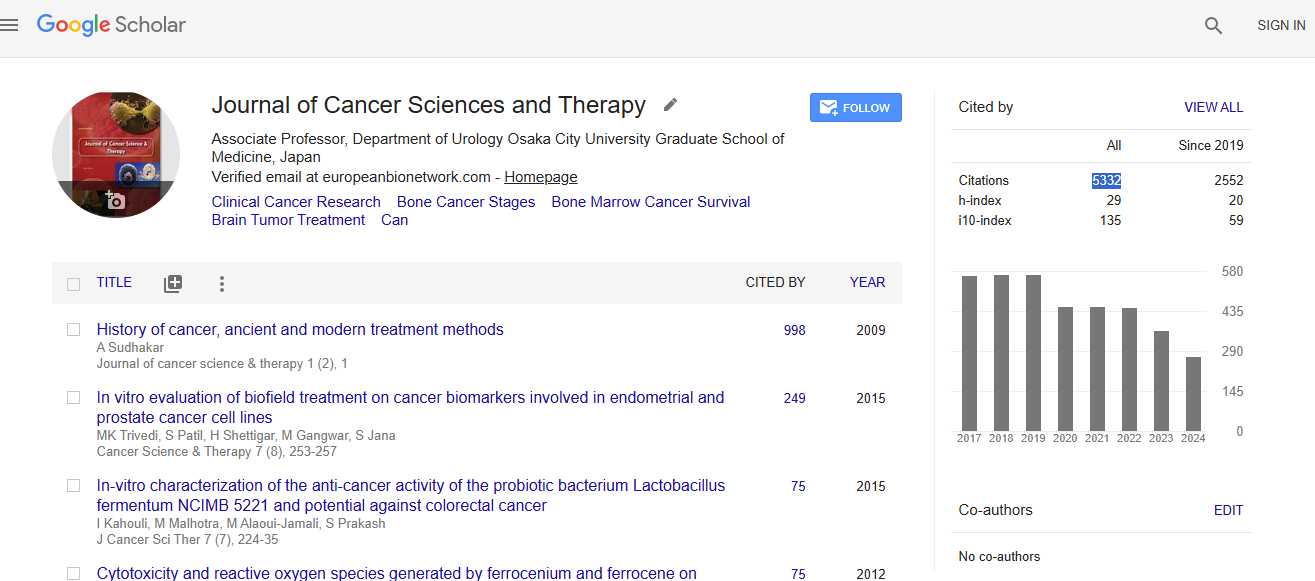
Cancer Science & Therapy received 5332 citations as per Google Scholar report