Short Communication - (2025) Volume 11, Issue 3
Received: 02-Jun-2025, Manuscript No. icoa-25-173591;
Editor assigned: 04-Jun-2025, Pre QC No. P-173591;
Reviewed: 18-Jun-2025, QC No. Q-173591;
Revised: 23-Jun-2025, Manuscript No. R-173591;
Published:
30-Jun-2025
, DOI: 10.37421/2469-9756.2025.11.306
Citation: Kim, Jason R.. ”T/B Cell Signaling: Regulation, Disease, Therapy.” Immunochem Immunopathol 11 (2025):306.
Copyright: © 2025 Kim R. Jason This is an open-access article distributed under the terms of the Creative Commons Attribution License, which permits unrestricted use,
distribution and reproduction in any medium, provided the original author and source are credited.
This paper delves into how T-cell receptors, in conjunction with co-receptors like CD4 and CD8, finely tune their sensitivity to peptide-MHC complexes. It highlights the intricate molecular interactions that govern T-cell activation, emphasizing the structural basis for cooperative binding and the implications for immune responses [1].
This review explores the molecular underpinnings of B-cell anergy, a state of functional unresponsiveness crucial for maintaining self-tolerance. It dissects how persistent antigen stimulation leads to specific alterations in BCR signaling pathways, ultimately preventing autoimmune reactions and shaping the B-cell repertoire [2].
This paper provides a historical overview of immune checkpoint pathways, which are critical regulators of T-cell activation and tolerance. It traces the discovery and development of our understanding of molecules like PD-1 and CTLA-4, highlighting their profound impact on cancer immunotherapy and autoimmune disease research [3].
This review discusses the critical role of B-cell receptor signaling in the pathogenesis of various B-cell lymphomas. It explores how dysregulated BCR pathways drive uncontrolled proliferation and survival of malignant B cells, detailing current therapeutic strategies that target these specific signaling components [4].
This paper reframes T-cell exhaustion not just as a failure, but as an adaptable state with distinct transcriptional and epigenetic programs. It explores the signaling pathways that drive T cells into exhaustion during chronic infections and cancer, providing insights into strategies to reverse this state for therapeutic benefit [5].
This review focuses on the complex landscape of cytokine signaling in lymphoid cells, including T cells, and its role in dictating immune cell differentiation, proliferation, and function. It elucidates how various cytokines, through specific receptor-ligand interactions and downstream cascades, shape adaptive immunity and discusses their therapeutic potential in immune-mediated diseases [6].
This article details the intricate process of T helper cell-dependent B-cell activation, a cornerstone of adaptive humoral immunity. It outlines the sequential signaling events, including antigen presentation, co-stimulation, and cytokine exchange, that lead to robust antibody production and the formation of memory B cells, crucial for long-term protection [7].
This review highlights the critical interplay between T-cell metabolism and signaling, demonstrating how metabolic reprogramming dictates T-cell activation, differentiation, and effector functions. It describes how pathways like glycolysis and oxidative phosphorylation are integrated with TCR and co-stimulatory signals to support the energetic demands of an immune response [8].
This article outlines the evolution and impact of Chimeric Antigen Receptor (CAR) T-cell therapy, focusing on the engineered signaling domains that drive their potent anti-tumor activity. It explores how modifications to costimulatory and activation motifs within the CAR construct influence T-cell persistence, efficacy, and safety profiles, shaping the future of cancer treatment [9].
This comprehensive review details the adaptive immune responses, particularly T-cell and B-cell signaling, evoked by SARS-CoV-2 infection. It elucidates how the virus triggers specific antigen recognition, leading to the development of neutralizing antibodies and effector T cells, crucial for protection and recovery, and informs vaccine design [10].
Immune cell function hinges on precise signaling mechanisms, profoundly influencing activation and regulation. T-cell receptors (TCRs), in conjunction with co-receptors like CD4 and CD8, finely tune their sensitivity to peptide-MHC complexes. This intricate molecular interaction governs T-cell activation, revealing the structural basis for cooperative binding and its implications for immune responses [1]. Metabolic control is also crucial, as metabolic reprogramming dictates T-cell activation, differentiation, and effector functions. Pathways such as glycolysis and oxidative phosphorylation integrate with TCR and co-stimulatory signals to support the energetic demands of an immune response [8]. On the B-cell side, mechanisms like B-cell anergy represent a state of functional unresponsiveness essential for maintaining self-tolerance. Here, persistent antigen stimulation leads to specific alterations in B-cell receptor (BCR) signaling pathways, preventing autoimmune reactions and shaping the B-cell repertoire [2]. These foundational signaling events are critical for the immune system's balance and effectiveness.
The immune system employs sophisticated regulatory mechanisms to prevent autoimmunity and manage chronic threats. Immune checkpoint pathways are critical regulators of T-cell activation and tolerance. A historical perspective traces the discovery and development of our understanding of molecules like PD-1 and CTLA-4, highlighting their profound impact on cancer immunotherapy and autoimmune disease research [3]. Furthermore, T-cell exhaustion, previously considered a state of terminal dysfunction, is now reframed as an adaptable state with distinct transcriptional and epigenetic programs. Research exploring the signaling pathways driving T cells into exhaustion during chronic infections and cancer provides insights into strategies to reverse this state for therapeutic benefit [5]. Understanding these regulatory 'brakes' and adaptable states is key to manipulating immune responses for therapeutic gain.
Adaptive immunity relies on extensive communication between different immune cell types. The intricate process of T helper cell-dependent B-cell activation is a cornerstone of adaptive humoral immunity. It outlines sequential signaling events, including antigen presentation, co-stimulation, and cytokine exchange, that lead to robust antibody production and the formation of memory B cells, crucial for long-term protection [7]. Beyond direct cell-to-cell contact, cytokine signaling plays a complex and pervasive role in lymphoid cells, including T cells. This signaling dictates immune cell differentiation, proliferation, and function. Various cytokines, through specific receptor-ligand interactions and downstream cascades, shape adaptive immunity and discuss their therapeutic potential in immune-mediated diseases [6]. These interconnected networks illustrate how coordinated signaling directs the overall immune response.
When immune signaling pathways become dysregulated, it can lead to severe pathologies, particularly in cancer. The critical role of B-cell receptor signaling in the pathogenesis of various B-cell lymphomas is well-established. Dysregulated BCR pathways drive uncontrolled proliferation and survival of malignant B cells, detailing current therapeutic strategies that target these specific signaling components [4]. A significant therapeutic breakthrough is Chimeric Antigen Receptor (CAR) T-cell therapy. This approach outlines the evolution and impact of CAR T-cell therapy, focusing on the engineered signaling domains that drive their potent anti-tumor activity. Modifications to costimulatory and activation motifs within the CAR construct influence T-cell persistence, efficacy, and safety profiles, shaping the future of cancer treatment [9]. These advancements showcase the power of targeting and engineering immune signaling for medical benefit.
Insights into adaptive immune responses are vital for confronting global health challenges. A comprehensive review details the adaptive immune responses, particularly T-cell and B-cell signaling, evoked by SARS-CoV-2 infection. This research elucidates how the virus triggers specific antigen recognition, leading to the development of neutralizing antibodies and effector T cells, crucial for protection and recovery, and importantly, informs vaccine design [10]. These studies collectively highlight the fundamental importance of understanding immune signaling, from basic molecular interactions to therapeutic applications and responses to infectious agents.
This collection of papers explores the intricate world of T-cell and B-cell biology, emphasizing the crucial role of signaling pathways in immune regulation and therapeutic interventions. Research delves into how T-cell receptors (TCRs) finely tune sensitivity to peptide-MHC complexes with co-receptors, highlighting the structural basis of cooperative binding. It also covers the metabolic reprogramming's influence on T-cell activation, differentiation, and effector functions, integrating pathways like glycolysis and oxidative phosphorylation with TCR and co-stimulatory signals. The dynamic nature of T-cell exhaustion is reframed as an adaptable state, with insights into therapeutic reversal in chronic infections and cancer. For B-cells, studies reveal mechanisms of anergy, a functional unresponsiveness vital for self-tolerance, detailing how persistent antigen stimulation alters B-cell receptor (BCR) signaling to prevent autoimmunity. Dysregulated BCR signaling is also linked to B-cell lymphomas, driving uncontrolled proliferation and survival, prompting targeted therapeutic strategies. The interdependence of immune cells is underscored by T helper cell-dependent B-cell activation, a core process for robust antibody production and memory B-cell formation. Broader themes encompass immune checkpoint pathways and their profound impact on cancer immunotherapy and autoimmune disease. Cytokine signaling in lymphoid cells, including T-cells, shapes adaptive immunity and holds therapeutic potential. Finally, the collection highlights adaptive immune responses to SARS-CoV-2 infection, crucial for vaccine design, and the revolutionary advancements in Chimeric Antigen Receptor (CAR) T-cell therapy, showcasing engineered signaling domains for potent anti-tumor activity.
None
None
1. Olle MS, Evan CMC, Jeffrey DS. "Co-receptor sensing of peptide-MHC by the TCR complex".Science 379 (2023 Feb 10):eabo5395.
Indexed at, Google Scholar, Crossref
2. Emilie C, Laura MR, Silvia CEMvdJ. "B cell anergy: from antigen recognition to signaling deregulation".Immunol Rev 311 (2023 Jan):15-32.
Indexed at, Google Scholar, Crossref
3. Arlene HS, Sumita B, William EP. "Immune checkpoint pathways: a historical perspective".Immunity 55 (2022 Dec 13):2274-2287.
Indexed at, Google Scholar, Crossref
4. Ronald MY, Michael SSL, Louis MS. "Targeting B-cell receptor signaling in B-cell lymphoma".Blood 139 (2022 Apr 14):2294-2306.
Indexed at, Google Scholar, Crossref
5. E. JW, Arlene HS, Rafi A. "T cell exhaustion: from dysfunctional responses to functional states".Nat Immunol 22 (2021 Jul):801-809.
Indexed at, Google Scholar, Crossref
6. John JO, Warren JL, Tadatsugu T. "Cytokine signaling in lymphoid cells: new insights and clinical implications".Nat Rev Immunol 20 (2020 Mar):149-163.
Indexed at, Google Scholar, Crossref
7. David CP, Robert JS, Michael JS. "Helper T cell-dependent B cell activation".Ann Rev Immunol 38 (2020 Apr 26):157-183.
Indexed at, Google Scholar, Crossref
8. Neil JM, Erin MB, Benjamin AW. "Metabolic control of T-cell activation and fate".Ann Rev Immunol 38 (2020 Apr 26):595-621.
Indexed at, Google Scholar, Crossref
9. Rosamaria CS, Michael CM, Carl HJ. "CAR T cell therapy: development, successes, and future challenges".Blood Rev 45 (2021 Jan):100645.
Indexed at, Google Scholar, Crossref
10. Alessandro S, Shane C, Daniela W. "Immunology of COVID-19: T and B cell responses".Cell 184 (2021 Mar 18):1462-1479.
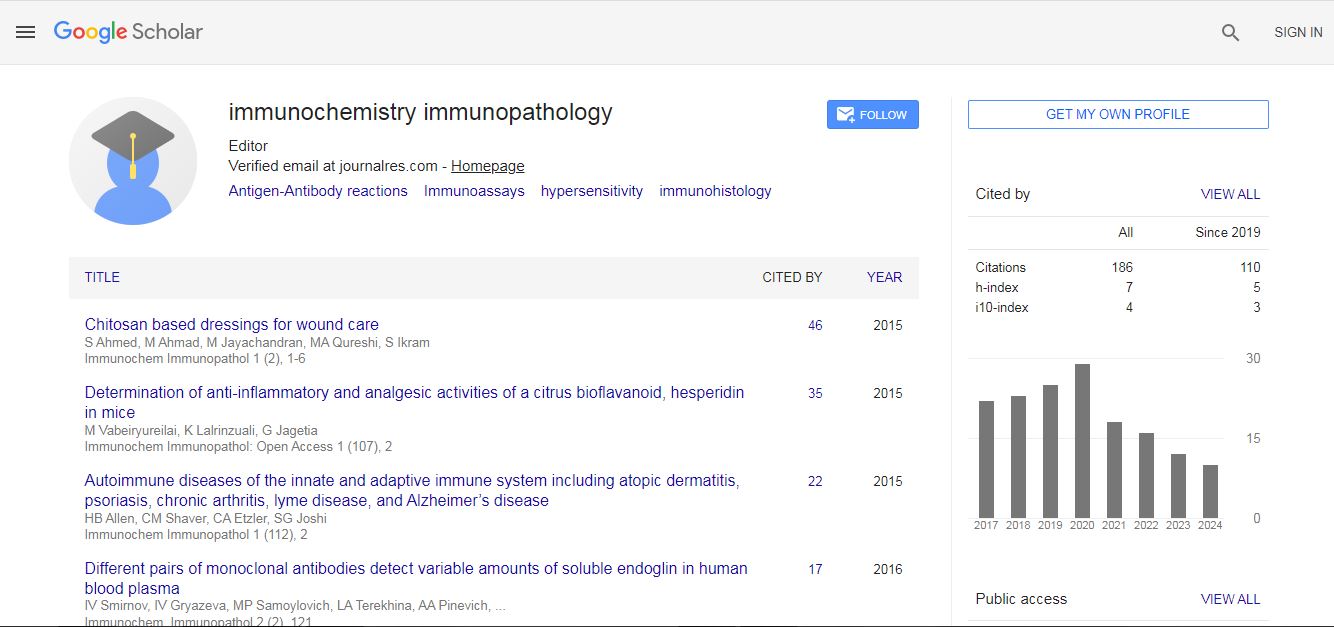
Immunochemistry & Immunopathology received 174 citations as per Google Scholar report