Opinion - (2025) Volume 15, Issue 3
Received: 01-Sep-2025, Manuscript No. jpdbd-25-174977;
Editor assigned: 03-Sep-2025, Pre QC No. P-174977;
Reviewed: 17-Sep-2025, QC No. Q-174977;
Revised: 22-Sep-2025, Manuscript No. R-174977;
Published:
29-Sep-2025
, DOI: 10.37421/2153-0769.2025.15.424
Citation: Meinhardt, Tobias. ”Targeted Metabolomics: A Versatile Analytical Tool.” Metabolomics 15 (2025):424.
Copyright: © 2025 Meinhardt T. This is an open-access article distributed under the terms of the Creative Commons Attribution License, which permits unrestricted use,
distribution and reproduction in any medium, provided the original author and source are credited.
This review highlights how targeted metabolomics is advancing precision medicine, showing its current uses in disease diagnosis, prognosis, and therapeutic monitoring. It discusses the key analytical strategies and points to future directions for integrating metabolomics into personalized healthcare, emphasizing its potential for tailored treatments[1].
This study uses targeted metabolomics to identify specific metabolic biomarkers for early diagnosis of hepatocellular carcinoma and to distinguish it from liver cirrhosis. The findings suggest a panel of metabolites could significantly improve diagnostic accuracy, offering a less invasive approach for identifying at-risk patients and guiding clinical decisions[2].
This research introduces a highly sensitive targeted metabolomics platform designed for detecting amino acids, acylcarnitines, and biogenic amines in various clinical samples. The method aims to improve the quantification of these critical metabolites, which is essential for biomarker discovery and understanding disease mechanisms with greater precision[3].
This study employed targeted metabolomics to identify new serum biomarkers for diagnosing Alzheimer's disease. The research uncovered a panel of metabolites that demonstrate potential for early and accurate detection of AD, offering insights into its pathogenesis and facilitating timely intervention strategies to slow disease progression[4].
This review examines the application of targeted metabolomics in the field of personalized nutrition and health. It discusses how precise metabolic profiling can help tailor dietary recommendations, monitor nutritional interventions, and ultimately promote individual well-being and prevent diet-related diseases effectively[5].
This paper discusses the utility of targeted metabolomics in identifying specific metabolic alterations induced by drug treatments. It highlights how this approach can help in understanding drug mechanisms, predicting efficacy, and detecting potential toxicities, making it valuable for preclinical and clinical drug development by providing critical insights[6].
This study utilized targeted metabolomics to uncover significant metabolic shifts in plants exposed to various abiotic stresses. The findings identify crucial metabolites and pathways involved in plant stress responses, offering insights that could lead to improved crop resilience and productivity in challenging environmental conditions, which is vital for agriculture[7].
This research applies targeted metabolomics to investigate the complex interactions between the host and gut microbiota in the context of inflammatory bowel disease. It aims to identify specific metabolic signatures that mediate these interactions, potentially revealing new therapeutic targets and diagnostic markers for IBD, offering a pathway to better patient care[8].
This study applied targeted metabolomics to discover new metabolic biomarkers associated with healthy aging in human populations. The findings provide a clearer understanding of the metabolic pathways that contribute to longevity and successful aging, offering potential targets for interventions to promote healthier lives as we age[9].
This study successfully applied targeted metabolomics to discover new biomarkers crucial for the early detection of cardiovascular disease. The research highlights specific metabolic pathways perturbed in the early stages of CVD, providing promising avenues for improved risk assessment and preventive strategies that can save lives[10].
Targeted metabolomics stands as a pivotal tool, driving significant advancements in the field of precision medicine. It demonstrates broad utility across disease diagnosis, prognosis, and the vigilant monitoring of therapeutic interventions. This powerful analytical approach offers essential strategies for its integration into personalized healthcare paradigms, highlighting its profound potential to deliver highly tailored treatments that align precisely with individual patient needs and unique metabolic profiles[1]. For instance, it has been effectively employed to identify distinct metabolic biomarkers critical for the early and accurate diagnosis of hepatocellular carcinoma, simultaneously providing a means to differentiate it from liver cirrhosis. The compelling evidence suggests that a carefully curated panel of metabolites can dramatically improve diagnostic accuracy, thus offering a less invasive diagnostic pathway for identifying at-risk patients and guiding precise clinical decisions[2]. Furthermore, the application of targeted metabolomics has led to the groundbreaking discovery of novel serum biomarkers specifically for diagnosing Alzheimer's disease. Comprehensive research has uncovered a specific panel of metabolites exhibiting significant potential for the early and highly accurate detection of AD. This provides invaluable insights into the disease's pathogenesis, thereby facilitating the implementation of timely intervention strategies designed to effectively slow down its progression[4]. Similarly, the technique proves invaluable in uncovering new biomarkers essential for the early detection of cardiovascular disease. Studies pinpoint specific metabolic pathways that are conspicuously perturbed even in the nascent stages of CVD, laying robust foundations for enhanced risk assessment and the development of proactive preventive strategies capable of saving countless lives[10].
On the methodological front, the development of ultra-sensitive targeted metabolomics platforms marks a significant leap forward. These advanced systems are meticulously designed for the precise detection and quantification of crucial metabolites, including amino acids, acylcarnitines, and biogenic amines, across a diverse array of clinical samples. The core objective behind such innovations is to achieve superior quantification of these vital biological molecules, a prerequisite for accelerated biomarker discovery and fostering a deeper, more accurate understanding of underlying disease mechanisms[3]. Beyond its diagnostic and mechanistic roles, targeted metabolomics holds immense promise in the burgeoning domain of personalized nutrition and health. Exhaustive reviews underscore how precise metabolic profiling can empower practitioners to tailor dietary recommendations with unprecedented accuracy. This enables more effective monitoring of nutritional interventions and ultimately contributes significantly to enhancing individual well-being while proactively preventing a spectrum of diet-related diseases with heightened efficacy[5].
The utility of targeted metabolomics extends critically into pharmaceutical research and development, particularly in identifying specific metabolic alterations induced by various drug treatments. This sophisticated approach offers invaluable assistance in elucidating complex drug mechanisms of action, predicting their therapeutic efficacy with greater precision, and reliably detecting potential toxicities. Such comprehensive insights are indispensable for streamlining both preclinical and clinical drug development processes, furnishing essential data for well-informed decision-making throughout the pipeline[6]. Moreover, this research technique is skillfully applied to delve into the intricate host-microbiota interactions, especially within the challenging context of inflammatory bowel disease (IBD). The overarching aim is to meticulously identify specific metabolic signatures that mediate these complex biological interactions. This endeavor holds the exciting potential to reveal novel therapeutic targets and robust diagnostic markers for IBD, thereby charting a clear pathway towards significantly improved patient care and management strategies[8].
In the sphere of agricultural science, targeted metabolomics has proven instrumental by revealing significant metabolic shifts occurring in plants when they are subjected to a range of abiotic stresses. The crucial discoveries arising from this research pinpoint vital metabolites and intricate pathways directly involved in plant stress responses. This furnishes valuable, actionable insights that can directly lead to the enhancement of crop resilience and a boost in agricultural productivity under increasingly challenging environmental conditions, an outcome of paramount importance for global food security[7]. Finally, human health research has leveraged targeted metabolomics to uncover novel metabolic biomarkers intricately associated with healthy aging in human populations. These findings collectively provide a much clearer and more nuanced understanding of the metabolic pathways that actively contribute to both longevity and successful aging. Consequently, this research presents promising potential targets for future interventions specifically designed to promote healthier and more fulfilling lives as individuals progress through their later years[9].
Targeted metabolomics is a powerful analytical approach significantly advancing various fields, from precision medicine to agricultural science. This method is crucial for disease diagnosis, offering insights into conditions like hepatocellular carcinoma and Alzheimer's disease by identifying specific metabolic biomarkers. It is also instrumental in monitoring disease progression and guiding therapeutic strategies. The technique contributes to personalized nutrition, enabling tailored dietary recommendations and effective management of diet-related diseases through precise metabolic profiling. In drug development, targeted metabolomics helps understand drug mechanisms, predict efficacy, and detect toxicities, providing critical insights for new therapies. Furthermore, its applications extend to environmental studies, revealing key metabolic shifts in plants under abiotic stress to improve crop resilience. It also sheds light on complex biological interactions, such as those between host and gut microbiota in inflammatory bowel disease, and identifies biomarkers associated with healthy aging and the early detection of cardiovascular disease. These diverse applications underscore targeted metabolomics as a versatile tool for uncovering metabolic changes, enhancing diagnostic accuracy, and fostering advancements in health, medicine, and beyond.
None
None
Mengying C, Linjie L, Shuyu Z. "Targeted metabolomics in precision medicine: Current applications and future perspectives".J Pharm Biomed Anal 226 (2023):115228.
Indexed at, Google Scholar, Crossref
Min Z, Jiao L, Yue Z. "Targeted metabolomics for early diagnosis of hepatocellular carcinoma and its differentiation from liver cirrhosis".Cancer Med 12 (2023):15309-15322.
Indexed at, Google Scholar, Crossref
Jian Y, Zongwei C, Li Z. "An ultra-sensitive targeted metabolomics platform for the analysis of amino acids, acylcarnitines, and biogenic amines in clinical samples".Anal Biochem 615 (2021):114068.
Indexed at, Google Scholar, Crossref
Hongyan Z, Yi C, Xiang L. "Targeted metabolomics reveals novel biomarkers in serum for Alzheimer's disease diagnosis".Clin Chem Lab Med 60 (2022):e21-e28.
Indexed at, Google Scholar, Crossref
Jie S, Qingyu W, Yali L. "Targeted metabolomics for personalized nutrition and health: A review".Food Funct 14 (2023):9021-9037.
Indexed at, Google Scholar, Crossref
Yan L, Bin L, Xiao-Bin J. "Targeted metabolomics for identifying drug-induced metabolic changes".Acta Pharm Sin B 11 (2021):1530-1541.
Indexed at, Google Scholar, Crossref
Lei W, Yuwei C, Huimin Q. "Targeted metabolomics reveals key metabolic changes in plants under abiotic stress".Plant Physiol Biochem 196 (2023):543-552.
Indexed at, Google Scholar, Crossref
Ling L, Yuanyuan L, Jiajing S. "Targeted metabolomics for studying host-microbiota interactions in inflammatory bowel disease".J Gastroenterol Hepatol 38 (2023):1297-1306.
Indexed at, Google Scholar, Crossref
Meng L, Xiaobo Z, Xiaoli Z. "Targeted metabolomics reveals novel metabolic biomarkers for healthy aging in humans".Clin Transl Med 12 (2022):e1016.
Indexed at, Google Scholar, Crossref
Jian L, Xiaofei W, Peng G. "Targeted metabolomics identifies novel biomarkers for early detection of cardiovascular disease".Atherosclerosis 326 (2021):59-67.
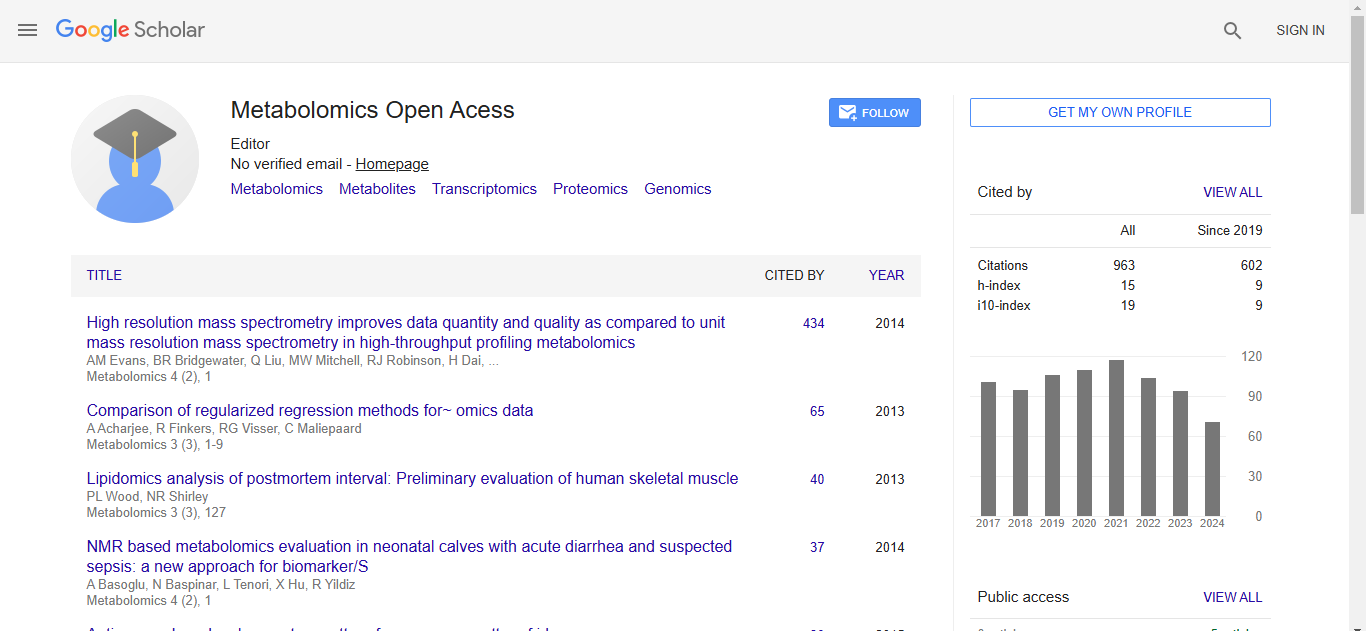
Metabolomics:Open Access received 895 citations as per Google Scholar report