Brief Report - (2025) Volume 10, Issue 6
Received: 01-Dec-2025, Manuscript No. jcct-26-183276;
Editor assigned: 03-Dec-2025, Pre QC No. P-183276;
Reviewed: 17-Dec-2025, QC No. Q-183276;
Revised: 22-Dec-2025, Manuscript No. R-183276;
Published:
29-Dec-2025
, DOI: 10.37421/2577-0535.2025.9.339
Citation: Harper, Nicholas J.. ”Tailoring Cancer Trials for Older Adults: Needs, Ethics, Innovation.” J Cancer Clin Trials 10 (2025):339.
Copyright: © 2025 Harper J. Nicholas This is an open-access article distributed under the terms of the Creative Commons Attribution License, which permits unrestricted use, distribution and reproduction in any medium, provided the original author and source are credited.
Conducting clinical trials for older adults with cancer presents a complex landscape of unique challenges and promising opportunities. The growing demographic of elderly individuals diagnosed with cancer necessitates a specialized approach to research that addresses their distinct biological and social characteristics, ensuring that clinical trial participation is both safe and beneficial. This evolving field requires innovative strategies to effectively enroll and retain participants, thereby yielding robust data that can inform clinical practice and improve outcomes for this vulnerable population. The specific needs of older cancer patients often differ significantly from their younger counterparts, encompassing varying levels of comorbidity, functional status, and cognitive abilities. Traditional trial designs may not adequately capture these nuances, leading to potential underrepresentation or misinterpretation of treatment effects. Therefore, adapting methodologies to suit the geriatric population is paramount for advancing the field of geriatric oncology and delivering personalized care. The exploration of tailored trial designs is a critical step in this process, aiming to maximize the scientific value and clinical relevance of studies involving elderly cancer patients. Enhancing patient recruitment and retention in geriatric oncology trials is a significant hurdle that requires focused attention and strategic planning. Strategies that facilitate access and support participants throughout the trial duration are essential for achieving adequate sample sizes and generating reliable evidence. The integration of patient-centered outcomes and shared decision-making principles can foster a more collaborative and effective research environment, aligning trial objectives with the preferences and goals of older adults. The cornerstone of successful geriatric oncology trials lies in the comprehensive assessment of older adults. This involves a thorough evaluation of their functional status, comorbidities, cognitive function, and psychosocial well-being, which are critical determinants of treatment tolerance and outcomes. By employing comprehensive geriatric assessment (CGA), researchers can gain a deeper understanding of individual patient profiles, enabling more precise participant selection, appropriate dose adjustments, and a more accurate interpretation of treatment efficacy and safety. Ethical considerations are of paramount importance when designing and conducting clinical trials for older adults with cancer. Ensuring informed consent, protecting against potential coercion, and promoting the fair inclusion of diverse elderly populations are ethical imperatives. Robust ethical frameworks are necessary to safeguard the rights and well-being of vulnerable participants while simultaneously facilitating their access to potentially life-saving novel therapies. Developing innovative clinical trial designs tailored for older adults with cancer is an ongoing area of research. Approaches such as adaptive designs and biomarker-driven strategies hold the potential to increase trial efficiency and relevance. These novel designs aim to better accommodate the inherent heterogeneity within the elderly population, leading to more precise and impactful research findings that can be translated into improved clinical care. Incorporating patient-reported outcomes (PROs) is a crucial component of geriatric oncology trials. PROs provide invaluable insights into aspects of health that are particularly important to older adults, including quality of life, functional status, and symptom burden. By capturing these subjective experiences, researchers can gain a more comprehensive understanding of the true impact of treatments beyond traditional clinical endpoints. Pharmacokinetic and pharmacodynamic (PK/PD) studies in older cancer patients present unique challenges due to age-related physiological changes. Developing age-specific PK/PD models and investigating altered drug metabolism and excretion in this population are essential for optimizing dosing strategies and minimizing treatment-related toxicities, thereby enhancing both efficacy and safety. The application of artificial intelligence (AI) and machine learning (ML) is emerging as a powerful tool in geriatric oncology trials. These advanced technologies can significantly aid in patient stratification, prediction of treatment response, and the identification of optimal therapeutic strategies for older adults. Leveraging AI and ML can lead to more personalized and effective treatment approaches for this complex patient group. Assessing frailty is another critical factor in optimizing outcomes for older patients participating in oncology clinical trials. The incorporation of frailty metrics can significantly improve risk prediction and guide treatment decisions, ultimately leading to better overall survival and a reduction in treatment-related toxicity. This proactive approach ensures that interventions are tailored to the individual's resilience and capacity to withstand therapy.
The unique challenges encountered in geriatric oncology clinical trials necessitate tailored approaches to trial design and execution. These trials often involve older adults who may have multiple comorbidities, altered physiological functions, and a higher risk of treatment-related toxicities, requiring careful consideration of safety and efficacy. The need for specialized methodologies to accurately assess treatment benefits and risks in this population is a central theme in current research. Researchers are actively exploring ways to adapt existing trial frameworks and develop new ones that are better suited to the complexities of aging and cancer. Enhancing patient recruitment and retention in geriatric oncology research is a critical objective, given the potential for older adults to face barriers such as transportation issues, limited social support, and concerns about treatment burden. Strategies that address these barriers and promote participant engagement are vital for ensuring the success of clinical trials. The involvement of patients in the design and conduct of trials, through mechanisms like patient advisory boards, can also improve relevance and adherence. The fundamental role of comprehensive geriatric assessment (CGA) in the context of clinical trials for older adults with cancer cannot be overstated. CGA provides a holistic understanding of a patient's health status, encompassing physical, functional, cognitive, and psychosocial domains. This detailed assessment is instrumental in identifying potential vulnerabilities, predicting treatment response, and tailoring interventions to individual needs, thereby improving the safety and validity of trial outcomes. Ethical considerations are paramount in geriatric oncology trials, particularly concerning issues of informed consent, autonomy, and the potential for undue influence. Ensuring that older adults fully understand the risks and benefits of trial participation and are making voluntary decisions is a core ethical obligation. Efforts to promote equitable access to clinical trials for all older adults, regardless of their socioeconomic status or background, are also crucial. Innovative clinical trial designs are being developed to better accommodate the heterogeneity of the older adult cancer population. Adaptive designs, which allow for modifications to trial parameters based on accumulating data, and biomarker-driven approaches, which target specific molecular pathways, are examples of such innovations. These designs aim to increase the efficiency and precision of research, leading to more timely and relevant findings. The incorporation of patient-reported outcomes (PROs) is essential for capturing the subjective experiences of older adults participating in clinical trials. PROs provide insights into quality of life, functional status, and symptom burden, which are often of greater importance to older patients than traditional clinical endpoints. By including PROs, researchers can obtain a more complete picture of treatment benefit and the overall impact of interventions on patients' well-being. Understanding the pharmacokinetic and pharmacodynamic (PK/PD) behavior of drugs in older adults with cancer is crucial for optimizing treatment. Age-related changes in drug absorption, distribution, metabolism, and excretion can significantly affect drug efficacy and toxicity. Developing age-specific PK/PD models and conducting targeted studies are necessary to ensure safe and effective drug use in this population. Artificial intelligence (AI) and machine learning (ML) are emerging as transformative tools in geriatric oncology trials. These technologies can analyze vast amounts of complex data to identify patterns, predict treatment responses, and stratify patients based on their individual characteristics. AI and ML hold the potential to personalize treatment strategies and improve outcomes for older adults with cancer. Frailty assessment is increasingly recognized as a critical component in the evaluation of older patients undergoing cancer treatment and participating in clinical trials. Identifying and quantifying frailty can help predict treatment-related risks, guide treatment decisions, and ultimately improve patient outcomes, including survival and reduction in toxicities. Phase I/II clinical trials in geriatric oncology face unique design and execution challenges. Dose optimization based on geriatric assessments and careful monitoring for specific toxicities in older adults are essential. These early-phase trials lay the groundwork for subsequent efficacy studies by establishing safety and preliminary activity of novel agents in this population.
Clinical trials for older adults with cancer require specialized approaches due to their unique needs and vulnerabilities. Key areas of focus include developing tailored trial designs, improving patient recruitment and retention strategies, and emphasizing comprehensive geriatric assessment (CGA). Ethical considerations, such as informed consent and fair inclusion, are paramount. Innovative methodologies like adaptive designs and biomarker-driven approaches are being explored to enhance trial efficiency. The integration of patient-reported outcomes (PROs) and advanced technologies like artificial intelligence (AI) are crucial for a holistic understanding of treatment effects and personalized care. Pharmacokinetic and pharmacodynamic (PK/PD) studies, along with frailty assessment, are vital for optimizing drug dosing and predicting treatment outcomes, ultimately aiming to improve the safety, efficacy, and relevance of clinical research for this growing patient population.
None
None
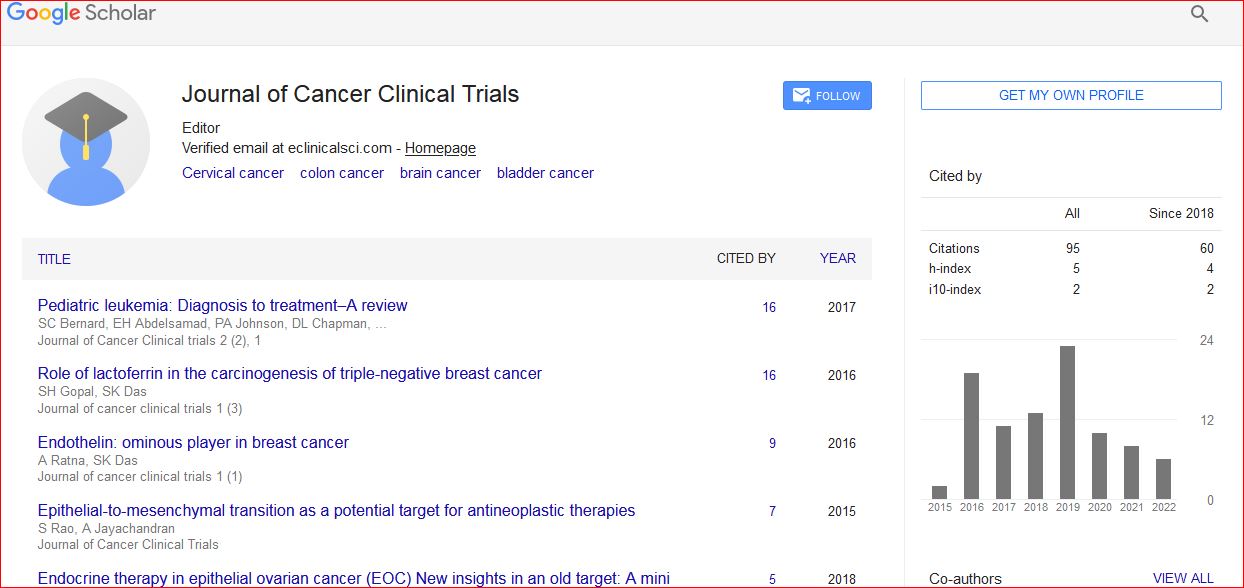
Journal of Cancer Clinical Trials received 95 citations as per Google Scholar report