Perspective - (2025) Volume 9, Issue 5
Received: 01-Oct-2025, Manuscript No. jmp-26-190052;
Editor assigned: 03-Oct-2025, Pre QC No. P-190052;
Reviewed: 17-Oct-2025, QC No. Q-190052;
Revised: 23-Oct-2025, Manuscript No. R-190052;
Published:
29-Oct-2025
, DOI: 10.37421/2684-4931.2025.9.275
Citation: Silva, Bernardo. ”Systems Biology Unraveling Host-Pathogen Interactions in Infection.” J Microb Path 09 (2025):275.
Copyright: © 2025 Silva B. This is an open-access article distributed under the terms of the Creative Commons Attribution License, which permits unrestricted use, distribution and reproduction in any medium, provided the original author and source are credited.
The intricate molecular interplay between host and pathogen during acute infections represents a critical area of research in infectious disease biology. Systems biology approaches are increasingly vital for deciphering the complex dynamic interactions within host-pathogen interactomes, offering insights into how these relationships govern infection outcomes and therapeutic targets [1].
The rapid advancements in omics technologies, encompassing genomics, transcriptomics, proteomics, and metabolomics, have revolutionized our ability to map the host-pathogen interface. Integrating these diverse data layers provides a comprehensive view of cellular responses to infection, uncovering novel regulatory mechanisms and potential biomarkers essential for understanding pathogen virulence and host defense strategies [2].
Computational modeling and network analysis are powerful tools for understanding the dynamic nature of host-pathogen interactions. By constructing interaction networks, researchers can predict critical nodes and pathways involved in disease pathogenesis, thereby aiding in the identification of potential therapeutic targets and capturing the temporal evolution of infection [3].
The host immune system plays a pivotal role in shaping pathogen behavior during acute infection. Systems biology perspectives reveal how immune signaling pathways are modulated by microbial factors, leading to specific host responses and influencing pathogen adaptation, underscoring the reciprocal nature of this complex relationship [4].
Single-cell technologies offer an unprecedented ability to resolve cellular heterogeneity within host-pathogen interactions. Analyzing individual cell responses allows for the identification of distinct cell populations critical to the infection process, providing a granular understanding necessary for developing targeted therapies that account for cellular variability [5].
Metabolic reprogramming is a central phenomenon in both host and pathogen cells during acute infections. Altered metabolic pathways are integral to host defense mechanisms and pathogen survival strategies, and understanding these metabolic shifts presents opportunities for disrupting pathogen growth and supporting host resilience [6].
Extracellular vesicles (EVs) emerge as significant mediators in host-pathogen communication. These vesicles act as vehicles for transferring molecules that can influence host immune responses and pathogen virulence, suggesting that targeting EV-mediated communication could represent a novel therapeutic strategy [7].
Identifying host factors essential for pathogen replication and survival during acute infections is a key objective. Systems biology approaches have pinpointed critical host proteins and pathways that can be targeted to inhibit pathogen growth, complementing direct antimicrobial therapies [8].
The evolutionary dynamics of host-pathogen interactions during acute infections are crucial for understanding adaptation, resistance, and virulence. Systems biology methodologies are instrumental in illuminating these co-evolutionary processes and their impact on disease progression [9].
Advanced imaging techniques, when integrated with systems biology, provide invaluable spatial and temporal insights into the dynamics of infection and host response. These modalities allow for the visualization of host-pathogen interactions at both molecular and cellular levels, enhancing our understanding of disease mechanisms [10].
Systems biology provides a crucial framework for dissecting the complex molecular crosstalk between host and pathogen during acute infections. By examining host-pathogen interactomes, researchers can identify key molecular players and pathways that dictate infection outcomes, paving the way for novel therapeutic interventions [1].
Omics technologies, including genomics, transcriptomics, proteomics, and metabolomics, are instrumental in mapping the host-pathogen interface. The integration of these multi-omics data layers offers a holistic view of cellular responses to infection, revealing novel regulatory mechanisms and potential biomarkers that are vital for understanding pathogen virulence and host defense strategies [2].
Computational modeling and network analysis are indispensable for understanding the dynamic nature of host-pathogen interactions. The construction of interaction networks allows for the prediction of critical nodes and pathways involved in disease pathogenesis, thereby facilitating the identification of therapeutic targets and providing insights into the temporal evolution of infection dynamics [3].
The host immune system's modulation by microbial factors during acute infection is a key area of investigation. A systems biology perspective highlights how immune signaling pathways are altered, leading to specific host responses and influencing pathogen adaptation, emphasizing the reciprocal and dynamic nature of the host-pathogen relationship [4].
Single-cell technologies are revolutionizing our understanding of host-pathogen interactions by resolving cellular heterogeneity. By analyzing individual cell responses, researchers can identify distinct cell populations that are critical to the infection process, enabling the development of targeted therapies that acknowledge and address cellular variability [5].
Metabolic reprogramming in both host and pathogen cells during acute infections is a fundamental aspect of the interaction. Understanding the altered metabolic pathways that underpin host defense mechanisms and pathogen survival strategies offers promising avenues for disrupting pathogen growth and enhancing host resilience [6].
Extracellular vesicles (EVs) play a significant role in mediating communication between host and pathogen. As carriers of molecules that influence immune responses and virulence, EVs represent a potential target for novel therapeutic strategies aimed at disrupting host-pathogen communication [7].
The identification of host dependency factors that are essential for pathogen replication and survival during acute infections is a major focus. Systems biology approaches are key to pinpointing critical host proteins and pathways that can be targeted to inhibit pathogen growth, thus offering a complementary strategy to conventional antimicrobial therapies [8].
The evolutionary trajectory of host-pathogen interactions during acute infections is a critical aspect of disease dynamics. By examining adaptation and co-evolutionary processes, researchers can gain a deeper understanding of resistance and virulence, with systems biology providing the tools to illuminate these complex evolutionary scenarios [9].
Advanced imaging techniques, when combined with systems biology approaches, provide essential spatial and temporal resolution for visualizing host-pathogen interactions. These imaging modalities offer critical insights into the dynamics of infection and host response at the molecular and cellular levels [10].
This collection of research explores the multifaceted interactions between hosts and pathogens during acute infections. It highlights the critical role of systems biology in dissecting these complex relationships, employing advanced omics technologies, computational modeling, and network analysis. The immune system's dynamic modulation, cellular heterogeneity revealed by single-cell analysis, and metabolic reprogramming are key areas of focus. The communication mediated by extracellular vesicles and the identification of host dependency factors offer novel therapeutic avenues. Furthermore, the evolutionary dynamics of these interactions and advanced imaging techniques provide a comprehensive understanding of infectious disease processes. The research collectively emphasizes the intricate and reciprocal nature of host-pathogen engagement, aiming to identify targets for improved therapeutic interventions.
None
None
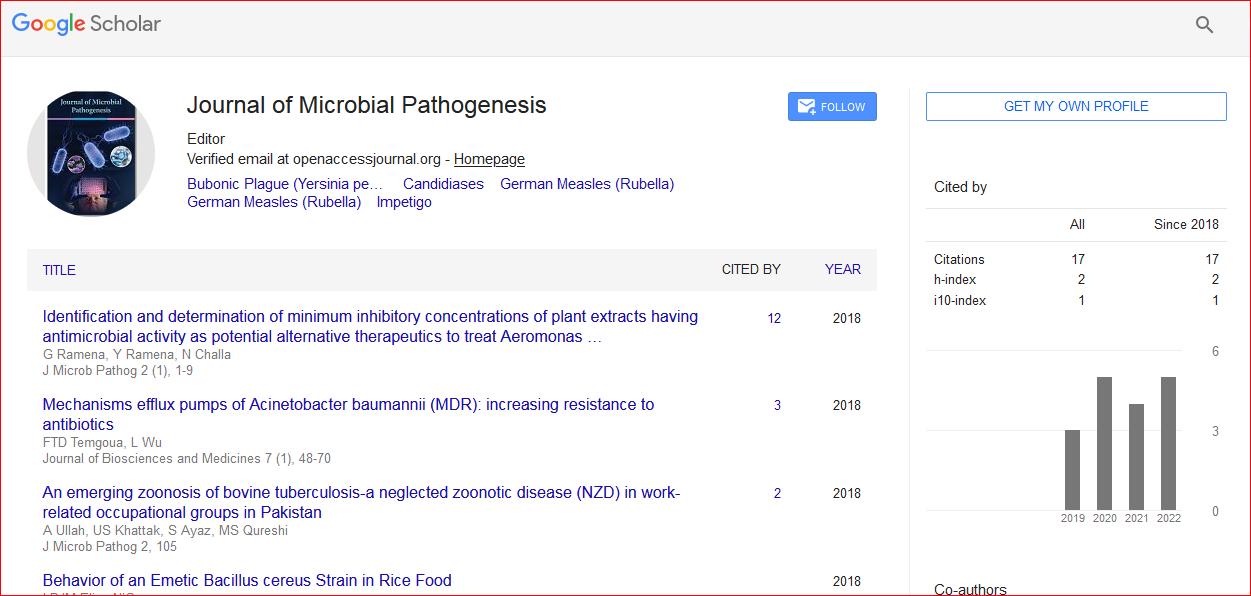
Journal of Microbial Pathogenesis received 17 citations as per Google Scholar report