Brief Report - (2025) Volume 19, Issue 6
Received: 01-Dec-2025, Manuscript No. jmgm-26-188400;
Editor assigned: 03-Dec-2025, Pre QC No. P-188400;
Reviewed: 17-Dec-2025, QC No. Q-188400;
Revised: 22-Dec-2025, Manuscript No. R-188400;
Published:
29-Oct-2025
, DOI: 10.37421/1747-0862.2025.19.753
Citation: Johansen, Erik. ”Systems Biology Powers Precision Medicine: Data to Treatment.” J Mol Genet Med 19 (2025):753.
Copyright: © 2025 Johansen E. This is an open-access article distributed under the terms of the Creative Commons Attribution License, which permits unrestricted use, distribution and reproduction in any medium, provided the original author and source are credited.
Systems biology approaches are fundamental to the advancement of precision medicine, enabling the integration of diverse and complex datasets. This interdisciplinary field leverages computational and experimental methods to understand biological systems as a whole, moving beyond the study of individual components to explore their interactions and emergent properties. In precision medicine, this means combining high-throughput omics data, such as genomics, transcriptomics, proteomics, and metabolomics, with clinical information, imaging data, and lifestyle factors. The goal is to construct predictive models that can accurately stratify patients based on their unique biological profiles and disease characteristics. These sophisticated models are crucial for identifying optimal therapeutic targets, which may differ significantly between individuals or patient subgroups. By understanding the underlying molecular mechanisms driving disease in specific patients, treatments can be tailored to maximize efficacy and minimize adverse effects. Ultimately, the application of systems biology principles in precision medicine aims to revolutionize patient care by enabling personalized treatment strategies. This tailored approach promises to improve treatment outcomes, enhance patient quality of life, and optimize the use of healthcare resources. The integration of multi-omics data with clinical phenotypes represents a cornerstone of modern precision medicine. This comprehensive data integration allows for a deeper understanding of disease heterogeneity and individual patient responses to therapy. Sophisticated computational frameworks are indispensable for analyzing these heterogeneous data sources effectively. These frameworks are designed to handle the complexity and volume of multi-omics data, facilitating the identification of disease subtypes and the prediction of drug responses. This integrated approach allows for the development of highly targeted therapies. By understanding the specific molecular drivers of a patient's disease, treatments can be designed to address these drivers directly, leading to more effective patient management and improved therapeutic success. The application of artificial intelligence and machine learning in systems biology is rapidly accelerating progress in precision medicine. These advanced computational tools are essential for analyzing complex biological networks and extracting meaningful insights from vast datasets. AI and machine learning algorithms can predict disease progression with greater accuracy and identify novel biomarkers that may not be discernible through traditional methods. This leads to more personalized diagnostics and therapeutics, allowing for earlier detection and more effective treatment. Single-cell technologies are revolutionizing systems biology by enabling the detailed dissection of cellular heterogeneity within tissues and tumors. Applying these cutting-edge technologies to patient samples provides an unprecedented level of detail regarding individual cellular responses to disease and therapeutic interventions. This granular understanding of cellular behavior is paving the way for highly refined precision medicine strategies. By characterizing the unique cellular landscape of each patient, treatments can be optimized at the cellular level, further enhancing therapeutic efficacy and minimizing off-target effects. Patient-derived organoids, often referred to as 'mini-organs,' are emerging as a powerful tool within systems biology platforms for precision medicine. These complex three-dimensional cell cultures mimic the architecture and cellular composition of patient tumors with remarkable fidelity. Their integration into systems biology workflows offers a robust method for personalized drug screening and disease modeling. This allows clinicians to test the efficacy of various treatment regimens in vitro on a patient's own cells before administering them clinically. The human microbiome, a complex ecosystem of microorganisms residing in and on the body, plays a significant role in both health and disease. Systems biology approaches are increasingly being employed to study these intricate interactions between the host and its microbial communities. Understanding the composition and function of these microbial communities is essential for developing personalized interventions. This is particularly relevant for areas such as infectious diseases, where microbial imbalances can predispose individuals to infection, and metabolic disorders, where the microbiome influences nutrient processing and energy balance. Network biology, a fundamental component of systems biology, provides a framework for representing and analyzing the complex molecular interactions within biological systems. By mapping these interactions, researchers can gain a holistic view of cellular processes and disease mechanisms. Applying network approaches to patient data helps in identifying key molecular pathways that are dysregulated in disease pathogenesis. These pathways can then serve as potential targets for therapeutic intervention in precision medicine, offering novel avenues for drug development. The integration of pharmacogenomics into systems biology frameworks is crucial for optimizing drug selection and dosing in precision medicine. Pharmacogenomics investigates how an individual's genetic makeup influences their response to medications, including efficacy and potential side effects. By understanding an individual's genetic predispositions, clinicians can prescribe medications that are more likely to be effective and less likely to cause adverse drug reactions. This personalized approach minimizes trial-and-error prescribing and improves patient safety. The development of advanced computational tools and comprehensive databases for systems biology is critical for managing the immense volume and complexity of data generated in precision medicine research. These resources are essential for data standardization, integration, and analysis. Such computational resources facilitate seamless data sharing among researchers and clinicians, promoting collaborative efforts and accelerating the translation of research findings from the laboratory to the clinical setting. This ensures that the benefits of precision medicine are realized efficiently. Finally, the ethical, legal, and social implications (ELSI) associated with the implementation of systems biology for precision medicine are paramount and require careful consideration. These aspects are critical for ensuring the responsible and equitable application of these advanced technologies. Ensuring robust data privacy protections, promoting equitable access to personalized therapies, and establishing guidelines for the responsible use of genetic and biological information are crucial for the successful and just implementation of precision medicine strategies in patient care.
Systems biology approaches are crucial for integrating the vast and complex datasets generated in the field of precision medicine. This integration involves combining high-throughput omics data, including genomics, transcriptomics, proteomics, and metabolomics, with comprehensive clinical information, advanced imaging data, and detailed lifestyle factors. The ultimate goal of this integration is to construct predictive models that can accurately stratify patients based on their unique biological profiles and disease characteristics. These models serve as powerful tools for identifying optimal therapeutic targets, which may vary significantly among individuals or patient subgroups, thereby enabling the development of personalized treatment strategies that promise to improve patient care and clinical outcomes. Integrating multi-omics data with clinical phenotypes is a fundamental pillar of precision medicine, allowing for a more nuanced understanding of disease. This approach necessitates the development and application of sophisticated computational frameworks designed to effectively analyze these heterogeneous data sources. These frameworks are essential for identifying distinct disease subtypes, predicting individual patient responses to various drugs, and ultimately enabling the development of highly targeted therapies. This ultimately leads to more effective patient management and improved therapeutic success rates. The application of artificial intelligence and machine learning within the domain of systems biology is significantly accelerating the progress of precision medicine. These powerful computational tools are adept at analyzing intricate biological networks and can predict disease progression with remarkable accuracy. Furthermore, they can identify novel biomarkers from large-scale datasets that might otherwise remain undiscovered through conventional methods. This capability is leading to the development of more personalized diagnostics and therapeutics, offering earlier detection and more effective treatment options for patients. Single-cell technologies are profoundly revolutionizing systems biology and, consequently, precision medicine by enabling the detailed dissection of cellular heterogeneity. Applying these advanced technologies to patient samples allows for a deeper and more granular understanding of individual cellular responses to disease processes and therapeutic interventions. This level of insight is paving the way for the development and implementation of highly granular precision medicine strategies, where treatments can be tailored to the specific cellular characteristics of each patient. The development of patient-derived organoids and their subsequent integration into systems biology platforms offers a potent tool for personalized drug screening and disease modeling. These 'mini-organs' are capable of capturing the complex biological characteristics of individual patient tumors with high fidelity. This allows for the in vitro testing of treatment efficacy on a patient's own cells before clinical application, thereby reducing the risks associated with empirical treatment selection and potentially improving treatment outcomes. The human microbiome plays a significant role in maintaining health and influencing the development of various diseases. Its complex interactions with the host are increasingly being studied through the lens of systems biology. Understanding these intricate microbial communities is essential for developing personalized interventions, particularly in areas such as infectious diseases, where microbial dysbiosis can increase susceptibility, and metabolic disorders, where the microbiome influences nutrient metabolism and overall health. Network biology represents a fundamental component of systems biology, providing a robust framework for the representation and analysis of complex molecular interactions within biological systems. Applying network-based approaches to patient data facilitates the identification of key pathways that are critically involved in disease pathogenesis. This understanding can reveal potential points for therapeutic intervention, offering new strategies for precision medicine where treatments are designed to modulate specific disease-related networks. The integration of pharmacogenomics into systems biology frameworks is essential for optimizing drug selection and dosing in the context of precision medicine. Pharmacogenomics studies how an individual's genetic makeup influences their response to medications. By understanding these genetic variations, clinicians can prescribe drugs that are more likely to be effective and less likely to cause adverse side effects, thereby improving patient safety and treatment efficacy. The development of sophisticated computational tools and comprehensive databases for systems biology is critical for effectively handling the sheer volume and complexity of data generated in precision medicine research. These resources are vital for data standardization, integration, and analysis, enabling researchers and clinicians to extract meaningful insights from diverse datasets. This facilitates the translation of research findings into clinical practice more efficiently. Finally, the ethical, legal, and social implications (ELSI) associated with the implementation of systems biology for precision medicine are of paramount importance and demand careful consideration. Ensuring robust data privacy, promoting equitable access to personalized therapies, and establishing clear guidelines for the responsible use of genetic and other biological information are crucial for the successful and just application of these advanced technologies in patient care.
Precision medicine is significantly advancing through the integration of complex biological data using systems biology approaches. This involves combining omics data with clinical, imaging, and lifestyle information to create predictive models for patient stratification, identifying therapeutic targets, and personalizing treatments. Advanced computational frameworks and AI are essential for analyzing heterogeneous multi-omics data to understand disease subtypes and predict drug responses. Single-cell technologies provide granular insights into cellular heterogeneity, enabling highly personalized strategies. Patient-derived organoids offer a platform for in vitro drug screening and disease modeling. The human microbiome's role in health and disease is being explored via systems biology for targeted interventions. Network biology helps identify key disease pathways for therapeutic targeting. Pharmacogenomics, integrated within systems biology, optimizes drug selection and dosing based on individual genetics. The development of computational tools and databases is critical for data management and translation of research into practice. Addressing ethical, legal, and social implications, including data privacy and equitable access, is paramount for the responsible implementation of precision medicine.
None
None
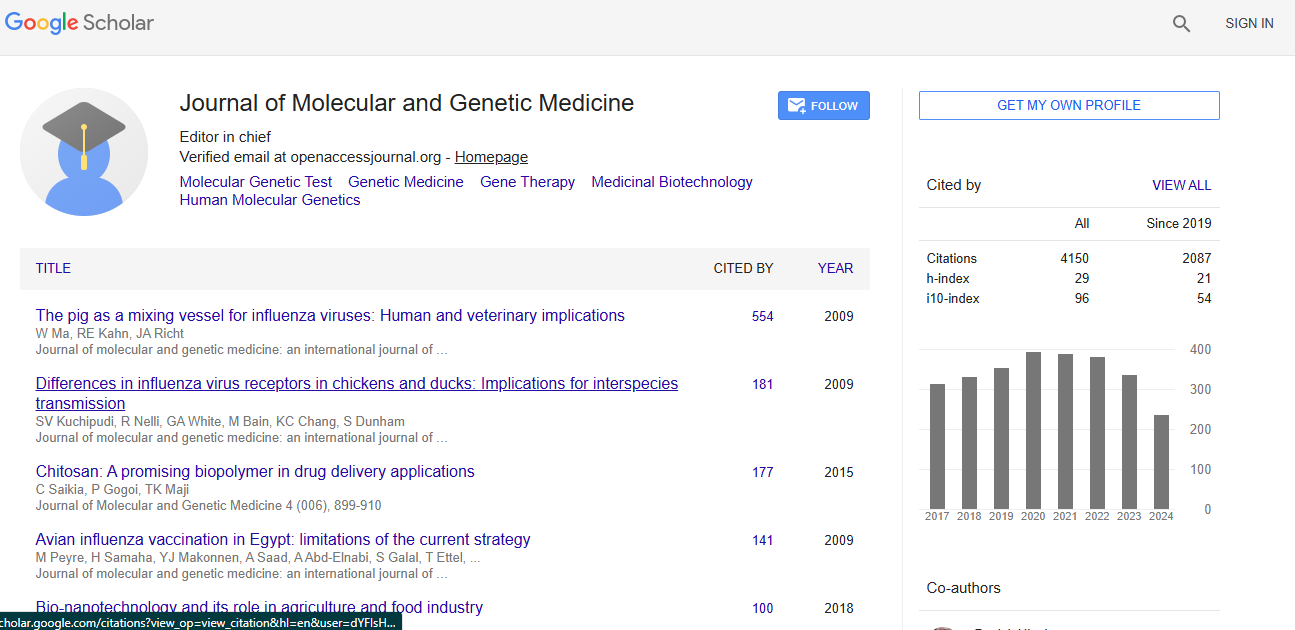
Molecular and Genetic Medicine received 3919 citations as per Google Scholar report