Short Communication - (2025) Volume 12, Issue 2
Received: 01-Apr-2025, Manuscript No. jreac-26-185792;
Editor assigned: 03-Apr-2025, Pre QC No. P-185792;
Reviewed: 17-Apr-2025, QC No. Q-185792;
Revised: 22-Apr-2025, Manuscript No. R-185792;
Published:
29-Apr-2025
, DOI: 10.37421/2380-2391.2025.12.426
Citation: El-Sayed, Omar. ”Synergistic FTIR and XRF for Environmental Analysis.” J Environ Anal Chem 12 (2025):426.
Copyright: © 2025 El-Sayed O. This is an open-access article distributed under the terms of the Creative Commons Attribution License, which permits unrestricted use, distribution and reproduction in any medium, provided the original author and source are credited.
Fourier-Transform Infrared (FTIR) spectroscopy and X-ray Fluorescence (XRF) spectroscopy represent powerful analytical tools that have found widespread application in environmental science for the characterization of various matrices. These techniques offer complementary information, with FTIR primarily identifying organic compounds and functional groups, and XRF excelling in elemental analysis. Their synergistic application allows for a more comprehensive understanding of environmental contamination and its sources, crucial for effective remediation and risk assessment. The analysis of environmental samples, whether solid, liquid, or gaseous, necessitates robust methodologies capable of identifying and quantifying a diverse range of chemical species. In this context, FTIR spectroscopy has emerged as a pivotal technique for elucidating the molecular structure and functional group composition of organic matter present in environmental samples. Its ability to detect subtle changes in chemical bonds makes it invaluable for tracking transformations and identifying specific organic pollutants. For instance, FTIR has been employed to monitor the changes in the molecular structure of organic matter within wastewater treatment processes, providing insights into the effectiveness of advanced oxidation processes in pollutant removal [2].
Complementing FTIR's organic analysis capabilities, XRF spectroscopy provides critical insights into the elemental composition of environmental samples. This technique is particularly adept at detecting heavy metals and other inorganic contaminants that pose significant risks to ecosystems and human health. Its non-destructive nature and ability to perform in-situ measurements make it a highly practical tool for rapid screening and assessment. One significant application of XRF is in the rapid, non-destructive screening of heavy metal contamination in urban soils, enabling immediate data acquisition on hazardous elements like lead, cadmium, and arsenic, thus informing public health advisories [3].
The combined application of FTIR and XRF spectroscopy offers a potent approach to comprehensively characterize complex environmental samples. This integrated methodology has been successfully employed in the characterization of airborne particulate matter, where FTIR identifies organic components such as soot and secondary organic aerosols, while XRF quantifies elemental constituents, including trace metals. Such a combined approach is instrumental in pinpointing emission sources and evaluating the health implications of air pollution [4].
Beyond the direct analysis of pollutants, FTIR spectroscopy plays a crucial role in understanding the materials used for environmental remediation. For example, its application in analyzing the surface functional groups of biochar before and after pollutant adsorption provides direct evidence of pollutant binding mechanisms, thereby aiding in the design of more efficient biochar-based remediation systems for contaminated water [5].
Similarly, XRF spectroscopy is indispensable for the elemental profiling of environmental matrices that have been impacted by anthropogenic activities. In river sediments, for instance, XRF has been used to determine the concentration of critical elements, directly linking elevated metal levels to industrial discharge and providing quantitative data for environmental impact assessments [6].
The advancements in spectroscopic techniques have also enabled their application in more complex environmental scenarios, such as the detailed spatial characterization of microplastic pollution. The integration of FTIR imaging with XRF mapping allows for the identification of polymer types by FTIR and the pinpointing of elemental additives or adsorbed metals by XRF on microplastic surfaces, offering a more complete understanding of their environmental fate and impact [7].
Furthermore, FTIR spectroscopy is a valuable tool for assessing the quality of soil organic matter and its relationship with soil health parameters. By analyzing the functional groups present in soil organic matter, researchers can correlate these molecular signatures with indicators like carbon content and microbial activity, helping to evaluate the impact of land management practices on soil quality and promote sustainable agriculture [8].
XRF spectroscopy has also found significant utility in monitoring the presence of potentially toxic elements (PTEs) in marine biota. The ability of XRF to analyze different tissues of marine organisms allows for the identification of bioaccumulation patterns of PTEs, such as mercury and arsenic, providing critical data for food safety assessments and the management of marine ecosystems [9].
Finally, FTIR spectroscopy extends its utility to the characterization of pollutants in challenging matrices like landfill leachate. By identifying and quantifying specific pollutants such as hydrocarbons and organic acids, FTIR spectral data offers detailed insights into the chemical composition, which is crucial for designing effective treatment systems and managing landfill operations to prevent groundwater contamination [10].
In summary, the diverse applications of FTIR and XRF spectroscopy underscore their critical importance in modern environmental analysis, offering complementary information that is essential for addressing complex environmental challenges from pollution characterization to remediation strategy development. These techniques, individually and synergistically, provide the detailed molecular and elemental insights required for informed environmental stewardship and the protection of ecosystems and human health.
Fourier-Transform Infrared (FTIR) spectroscopy and X-ray Fluorescence (XRF) spectroscopy are advanced analytical techniques extensively utilized for the comprehensive characterization of environmental samples. FTIR spectroscopy is renowned for its ability to identify and quantify organic compounds and their associated functional groups. This capability provides valuable insights into the sources of pollution and the detailed composition of solid environmental matrices, such as soils and sediments. Its application allows for a deep understanding of the organic components contributing to environmental contamination [1].
XRF spectroscopy, conversely, offers powerful elemental analysis, enabling the precise detection of heavy metals and other inorganic contaminants. This is particularly critical in environmental monitoring, where the presence of such elements in soils, water bodies, and airborne particulates can have severe ecological and health consequences. The synergy between these two techniques provides a holistic approach to understanding the chemical and elemental makeup of environmental samples, which is fundamental for effective risk assessment and the development of targeted remediation strategies [1].
In the realm of wastewater treatment, FTIR spectroscopy has been employed to monitor the dynamic changes in the molecular structure of organic matter. By tracking the evolution of specific functional groups, researchers can gain a deeper understanding of the mechanisms at play during different treatment stages. This detailed molecular-level information is vital for optimizing operational parameters and enhancing the efficiency of pollutant removal processes [2].
For the rapid assessment of environmental contamination, XRF spectroscopy stands out due to its portability and non-destructive analytical capabilities. Its application in the in-situ assessment of heavy metal contamination in urban soils is a prime example, allowing for immediate on-site measurements of hazardous elements like lead, cadmium, and arsenic. This rapid data generation is crucial for identifying pollution hotspots and informing timely public health advisories in densely populated areas [3].
The integrated use of FTIR and XRF spectroscopy has also proven highly effective in characterizing airborne particulate matter. This combined approach allows for the identification of organic functional groups, such as soot and secondary organic aerosols, using FTIR, while XRF quantifies the elemental composition, including various trace metals. This comprehensive characterization aids significantly in identifying emission sources and assessing the potential health impacts associated with air pollution [4].
FTIR spectroscopy also plays a critical role in evaluating the effectiveness of materials used in environmental remediation. For instance, its use in analyzing the surface functional groups of biochar before and after the adsorption of pollutants from contaminated water provides direct evidence of pollutant binding. Changes observed in spectral peaks indicate the mechanisms of interaction, facilitating the design of more efficient biochar-based remediation systems [5].
Elemental analysis of environmental matrices affected by industrial activities is another key area where XRF spectroscopy excels. In river sediments, for example, XRF has been utilized for elemental profiling, successfully identifying elevated levels of specific metals like copper and zinc. This data directly links pollution to industrial discharge, providing quantitative evidence essential for robust environmental impact assessments [6].
Advanced applications of these techniques include the spatial characterization of microplastic pollution. The integration of FTIR imaging with XRF mapping enables a detailed understanding of microplastic distribution and composition in environmental samples. FTIR identifies the polymer types, while XRF can precisely locate elemental additives or adsorbed metals on the microplastic surfaces, offering a more complete picture of their environmental fate and ecological impact [7].
In soil science, FTIR spectroscopy serves as a powerful tool for assessing the quality of soil organic matter. By analyzing the molecular signatures and functional groups present, correlations can be established with key soil health indicators, such as carbon content and microbial activity. This understanding is instrumental in evaluating the impact of different land management practices and developing strategies for sustainable agriculture [8].
Furthermore, XRF spectroscopy is vital for assessing the presence of potentially toxic elements (PTEs) in marine organisms. Its application in determining the concentration of PTEs like mercury and arsenic in various tissues of fish and shellfish helps in identifying bioaccumulation patterns. This data is crucial for food safety evaluations and the effective management of marine ecosystems impacted by pollution [9].
Finally, FTIR spectroscopy is employed to characterize pollutants in challenging environmental matrices like landfill leachate. By identifying and quantifying specific pollutants such as hydrocarbons and organic acids, FTIR provides detailed chemical composition information. This knowledge is critical for designing appropriate treatment systems and implementing effective management strategies to prevent groundwater contamination from landfill operations [10].
Fourier-Transform Infrared (FTIR) and X-ray Fluorescence (XRF) spectroscopy are indispensable analytical techniques for environmental sample characterization. FTIR excels at identifying organic compounds and functional groups, providing insights into pollution sources and matrix composition. XRF is powerful for elemental analysis, detecting heavy metals and inorganic contaminants in various environmental media. Their combined application offers a comprehensive approach to understanding environmental chemistry. FTIR is used to monitor organic matter transformations in wastewater treatment, analyze biochar adsorption mechanisms, assess soil organic matter quality, and characterize pollutants in landfill leachate. XRF is vital for screening heavy metals in urban soils, elemental profiling of river sediments, detecting potentially toxic elements in marine biota, and contributing to the spatial characterization of microplastics. The synergistic use of FTIR and XRF provides detailed information crucial for environmental risk assessment, remediation, and pollution source identification.
None
None
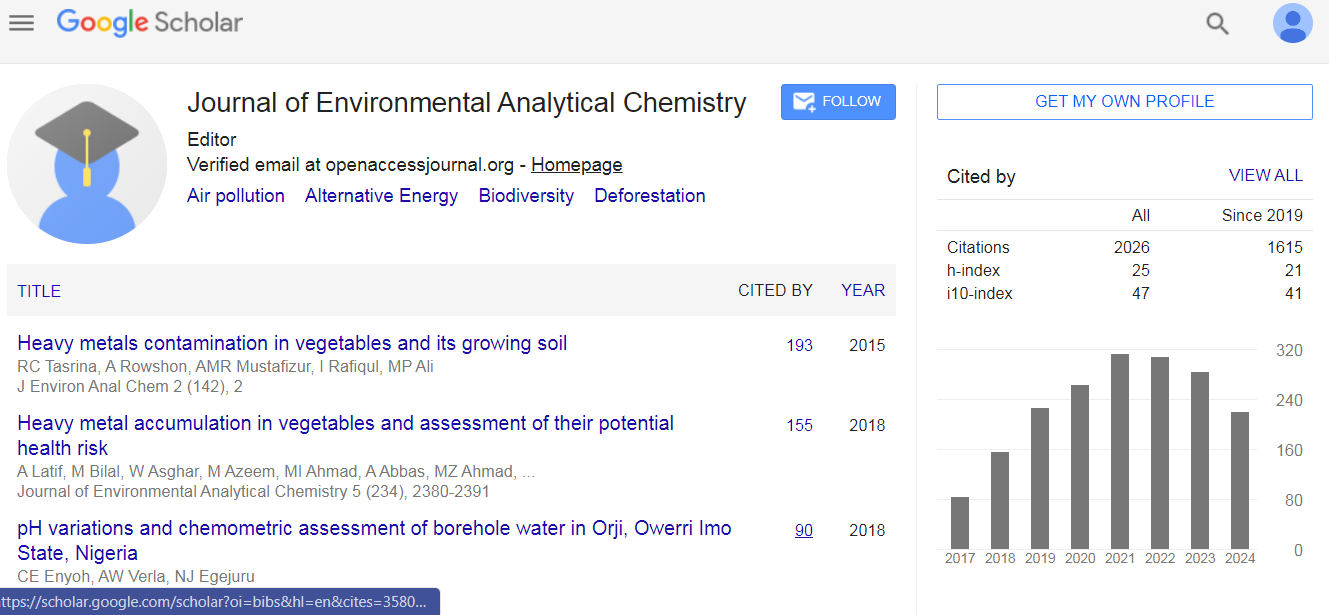
Journal of Environmental Analytical Chemistry received 1781 citations as per Google Scholar report