Opinion - (2025) Volume 16, Issue 2
Received: 02-Mar-2025, Manuscript No. jpm-26-179345;
Editor assigned: 04-Mar-2025, Pre QC No. P-179345;
Reviewed: 18-Mar-2025, QC No. Q-179345;
Revised: 24-Mar-2025, Manuscript No. R-179345;
Published:
31-Mar-2025
, DOI: 10.37421/2090-0902.2025.16.523
Citation: Patel, Arun. ”Symmetry and Group Theory: Pervasive Power in Physics.” J Phys Math 16 (2025):523.
Copyright: © 2025 Patel A. This is an open-access article distributed under the terms of the Creative Commons Attribution License, which permits unrestricted use, distribution and reproduction in any medium, provided the original author and source are credited.
The fundamental role of symmetry and group theory in advanced physical mathematics is explored, detailing how these frameworks offer essential tools for understanding symmetries in physical systems, leading to simplified models and enhanced predictive capabilities. Applications in quantum mechanics, particle physics, and condensed matter physics are highlighted, demonstrating how group theory classifies states, predicts interactions, and explains phenomena like phase transitions, underscoring that symmetry is deeply embedded in nature's laws and its formalization unlocks profound physical understanding [1].
Lie groups and Lie algebras are instrumental in describing continuous symmetries in physical models, serving to formulate conservation laws via Noether's theorem and construct gauge theories vital for the Standard Model of particle physics. The structure of these groups inherently dictates fundamental forces and particle properties, providing a sophisticated mathematical language for nature's deepest symmetries [2].
Discrete symmetries, such as parity and time reversal, play a significant role in quantum mechanics and cosmology. These symmetries impose constraints on physical Hamiltonians and influence observable phenomena, including particle decay and the behavior of exotic matter. Violations of these symmetries can indeed signal new physics beyond the Standard Model [3].
The representation theory of finite groups is applied to the classification of quantum states in condensed matter systems. Irreducible representations effectively label degenerate energy levels and predict material behavior under symmetry-breaking perturbations, which is crucial for comprehending phase transitions and topological properties [4].
Symmetry principles are intrinsically linked to the development of renormalization group methods. Concepts like scale invariance are leveraged to understand the behavior of physical systems across various length scales, particularly in critical phenomena and quantum field theory, demonstrating that group-theoretic ideas are indispensable to the renormalization group's mathematical underpinnings [5].
Group theory is pivotal in classifying elementary particles and their interactions within the Standard Model. Specifically, SU(2) and SU(3) symmetry groups and their representations are examined, explaining how these symmetries give rise to quantum numbers and predict particle multiplets, thereby organizing the vast array of subatomic particles [6].
Symmetry transformations in classical mechanics, particularly within Lagrangian and Hamiltonian frameworks, are explored for their role in formulating conservation laws. These transformations, coupled with the Euler-Lagrange equations, lead directly to conserved quantities, offering an elegant and potent approach to complex mechanical problems [7].
The application of group theory in crystallography is crucial for understanding material structures and their physical properties. Space groups and point groups systematically classify crystal symmetries, which in turn determine properties such as optical activity, piezoelectricity, and electronic band structures in solid-state materials, providing critical insights for materials science [8].
Spontaneous symmetry breaking in quantum field theory is a key mechanism for understanding phenomena such as the origin of mass in elementary particles through the Higgs mechanism. This concept provides a fundamental theoretical framework for studying phase transitions, including those that occurred in the early universe [9].
Gauge symmetry is a cornerstone of modern theoretical physics, driving the formulation of fundamental forces like electromagnetism and the nuclear forces. Gauge invariance dictates the structure of these interactions, underpinning the Standard Model and revealing a profound connection between symmetry and the fundamental laws governing the universe [10].
The exploration of symmetry and group theory in advanced physical mathematics reveals their essential function in simplifying complex systems and enhancing predictive power. These mathematical tools are indispensable for analyzing inherent symmetries in physical phenomena, from quantum mechanics to particle physics and condensed matter, enabling the classification of quantum states, prediction of particle interactions, and explanation of emergent behaviors such as phase transitions. The foundational insight is that symmetries are not mere aesthetic qualities but fundamental characteristics of nature, and their formalization through group theory provides deep physical understanding [1].
The utility of Lie groups and Lie algebras in characterizing continuous symmetries within physical models is significant. They facilitate the derivation of conservation laws through Noether's theorem and are crucial for building the gauge theories that form the backbone of the Standard Model of particle physics. The inherent structure of these groups fundamentally shapes the properties of elementary particles and the forces that govern them, offering a sophisticated mathematical language for nature's most fundamental symmetries [2].
Discrete symmetries, including parity and time-reversal invariance, impose critical constraints on physical theories. In quantum mechanics and cosmology, these symmetries shape the form of Hamiltonians and influence observable phenomena, ranging from particle decay characteristics to the behavior of exotic matter. Crucially, the observation of symmetry violations can indicate the presence of physics beyond current established models [3].
In condensed matter physics, the representation theory of finite groups is a powerful tool for categorizing quantum states. By assigning irreducible representations to energy levels, it becomes possible to predict how materials respond to symmetry-breaking perturbations, a vital step in understanding phase transitions and the emergence of topological properties [4].
The development of renormalization group techniques is deeply intertwined with symmetry principles. Exploiting symmetries such as scale invariance allows physicists to analyze the behavior of systems across diverse length scales, particularly in contexts like critical phenomena and quantum field theory. The mathematical framework of the renormalization group relies heavily on these group-theoretic concepts [5].
Within particle physics, group theory provides a robust framework for classifying elementary particles and their interactions, as exemplified by the Standard Model. The application of SU(2) and SU(3) symmetry groups, along with their representations, elucidates the origin of quantum numbers and predicts the existence of particle multiplets, effectively organizing the subatomic particle zoo [6].
In classical mechanics, symmetry transformations are elegantly integrated into Lagrangian and Hamiltonian formulations. These symmetries, when applied through the Euler-Lagrange equations, directly yield fundamental conservation laws, offering a powerful and conceptually rich approach to solving intricate mechanical problems and understanding physical principles [7].
Crystallography heavily relies on group theory to classify crystalline structures and their associated physical properties. The designation of space groups and point groups allows for a systematic understanding of crystal symmetries, which in turn dictate macroscopic properties such as optical activity, piezoelectricity, and the electronic band structures of solid-state materials, making group theory indispensable for materials science [8].
Spontaneous symmetry breaking is a critical concept in quantum field theory, notably explaining the origin of mass for elementary particles via the Higgs mechanism. This phenomenon provides a theoretical foundation for understanding phase transitions, particularly those that characterized the early universe and continue to influence cosmological models [9].
Gauge symmetry plays a paramount role in modern theoretical physics, serving as the foundation for describing fundamental forces like electromagnetism and the strong and weak nuclear forces. The principle of gauge invariance ensures the consistency of physical laws and is central to the mathematical structure of the Standard Model, highlighting the deep connection between symmetry and the fundamental fabric of reality [10].
This collection of research delves into the multifaceted applications of symmetry and group theory across various domains of physics. From fundamental principles in quantum mechanics and particle physics, where symmetries classify particles and dictate interactions, to condensed matter physics, where they explain material properties and phase transitions, the power of these mathematical frameworks is consistently highlighted. Lie groups and algebras are shown to be crucial for continuous symmetries and conservation laws, while discrete symmetries constrain physical models and offer insights into new physics. The role of symmetry in classical mechanics, crystallography, and the development of advanced techniques like renormalization group methods is also emphasized. Furthermore, concepts like spontaneous symmetry breaking and gauge symmetry are presented as fundamental to understanding phenomena such as particle mass and the fundamental forces, underscoring the profound and pervasive influence of symmetry in describing the natural world.
None
None
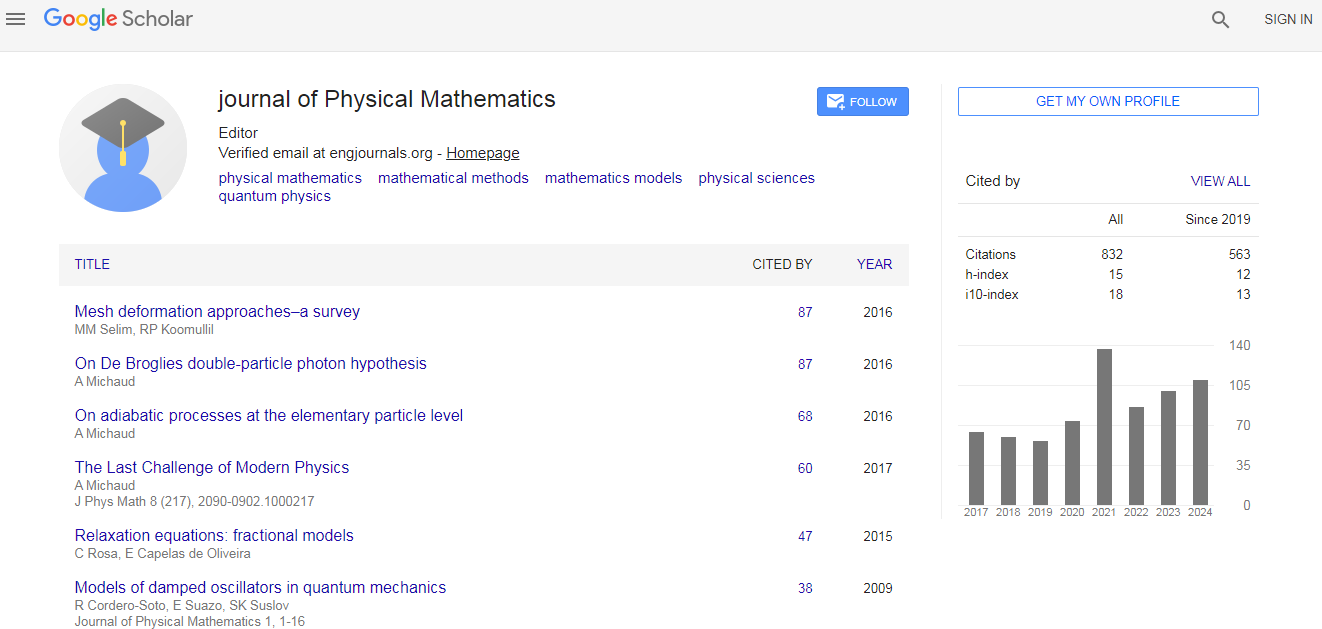
Physical Mathematics received 686 citations as per Google Scholar report