Brief Report - (2025) Volume 16, Issue 3
Received: 01-Apr-2025, Manuscript No. hycr-25-172514;
Editor assigned: 03-Apr-2025, Pre QC No. P-172514;
Reviewed: 17-Apr-2025, QC No. Q-172514;
Revised: 22-Apr-2025, Manuscript No. R-172514;
Published:
29-May-2025
, DOI: 10.37421/2157-7587.2025.16.576
Citation: Fontaine, Aria. ”Sustainable Water: Global Challenges, Innovative Solutions.” Hydrol Current Res 16(2025):576.
Copyright: © 2025 Fontaine A. This is an open-access article distributed under the terms of the Creative Commons Attribution License, which permits unrestricted use,
distribution and reproduction in any medium, provided the original author and source are credited.
This article explores the complex connection between climate change and increasing global water scarcity, emphasizing the urgent need for enduring solutions. It details management strategies such as enhanced water use efficiency, advanced irrigation methods, desalination, and wastewater treatment, all aimed at easing climate-induced water stress and securing water for future generations[1].
Looking at recent advancements, a review meticulously examines new water and wastewater treatment technologies. It covers innovative approaches like membrane filtration, advanced oxidation processes, and biological treatment systems, highlighting their effectiveness in removing emerging contaminants and resolving current water quality issues. This work also outlines paths for future research[2].
A specific investigation focuses on the pervasive problem of microplastics in drinking water, detailing their various origins, movement in the environment, and ultimate fate within water systems. It also critically assesses the possible human health impacts from microplastic ingestion, emphasizing the necessity for strong monitoring and reduction strategies to safeguard public health[3].
Turning to infrastructure, a comprehensive review delves into the quickly evolving field of smart water management systems. It outlines diverse technologies, including Internet of Things (IoT) sensors, Artificial Intelligence (AI), and big data analytics, which are revolutionizing water infrastructure. The piece points out their applications in real-time monitoring, leakage detection, demand forecasting, and optimized resource allocation to improve urban water sustainability[4].
This paper centers on how vital water use efficiency is for achieving sustainable agricultural practices. It discusses various innovations, like precision irrigation, drought-resistant crops, and integrated water management strategies, all geared towards optimizing water consumption in farming. The article also addresses the inherent difficulties in implementing these solutions globally to ensure food security amidst increasing water stress[5].
Moving to ecosystems, another review synthesizes current knowledge concerning the profound effects of climate change on freshwater ecosystems. It covers changes in temperature regimes, precipitation patterns, and extreme weather events, alongside their cascading impacts on aquatic biodiversity, water quality, and ecosystem functions. The article also highlights key areas for future research and adaptive management plans[6].
This article offers a broad overview of municipal wastewater reclamation and reuse, focusing on various advanced treatment technologies that allow for the safe and efficient recovery of water. It also touches on the significant hurdles in widespread implementation, such as public perception, regulatory frameworks, and economic viability, offering views on promoting sustainable water management[7].
Another review article investigates the widespread presence and environmental journey of pharmaceuticals and personal care products (PPCPs) as emerging contaminants in water bodies. It details various advanced removal technologies, including adsorption, membrane processes, and biodegradation, underscoring their effectiveness in reducing environmental risks and ensuring the safety of water resources[8].
A review looks at the complex reality of global water governance, pinpointing main challenges like fragmented policies, conflicting interests, and insufficient enforcement mechanisms. It stresses the essential role of international collaboration, strong institutional structures, and community-led approaches in tackling cross-border water issues and ensuring fair and lasting water resource management worldwide[9].
Finally, a review explores using water footprint assessment as an effective method for evaluating and advancing sustainable water management across different sectors. It explains the methodology, emphasizes its usefulness in pinpointing water-intensive processes, and discusses its part in guiding policy decisions towards cutting overall water consumption and lessening environmental impacts[10].
The complex link between climate change and rising global water scarcity calls for quick, lasting solutions. Strategies include boosting water use efficiency, using advanced irrigation, and implementing desalination and wastewater treatment to lessen climate-related water stress and secure water for future generations [1]. Beyond direct human use, climate change significantly affects freshwater ecosystems. This involves shifts in temperature, rainfall, and more extreme weather, leading to wider impacts on aquatic life, water quality, and how ecosystems function. Research and flexible management plans are key to dealing with these large-scale ecological changes [6].
Major advances in water and wastewater treatment technologies show promise for solving today's water quality problems. New methods, such as membrane filtration, advanced oxidation processes, and biological treatment systems, are crucial for removing new contaminants and preparing for what's ahead [2]. A particularly troubling concern is the widespread presence of microplastics in drinking water. Thorough studies into their sources, how they move through the environment, and where they end up in water systems are vital. What's more, a careful look at their possible health effects means we need solid monitoring and reduction strategies to keep the public safe [3]. Another group of emerging contaminants, pharmaceuticals and personal care products (PPCPs), are often found in water bodies. Knowing where they come from and what happens to them in the environment is essential, as are advanced removal technologies like adsorption, membrane processes, and biodegradation, which are necessary for reducing environmental risks and keeping water resources safe [8].
The rapidly changing field of smart water management systems is transforming water infrastructure. Using tools like Internet of Things (IoT) sensors, Artificial Intelligence (AI), and big data analytics, these systems allow for real-time tracking, precise leak detection, accurate demand predictions, and optimized resource allocation, greatly improving urban water sustainability [4]. In farming, how efficiently water is used is key to sustainable practices and food security. Innovations such as precision irrigation, growing drought-resistant crops, and integrated water management strategies are central to using less water in agriculture. Despite global challenges in putting these solutions into practice, they are critical for ensuring food security as water stress increases [5].
Reclaiming and reusing municipal wastewater offers an extensive look at advanced treatment technologies that enable the safe and efficient recovery of water. While the potential is huge, widespread adoption faces big hurdles, including how the public views it, complicated rules, and financial viability. Overcoming these obstacles is important for promoting sustainable water management [7]. Global water governance faces a complex situation, marked by disconnected policies, conflicting interests, and insufficient enforcement. Tackling these issues needs international teamwork, effective institutional setups, and community involvement to manage shared water problems and ensure fair, long-term water use around the world [9].
To further support sustainable water management across different sectors, assessing the water footprint is a powerful analytical tool. This method helps explain processes that use a lot of water, thereby guiding policy decisions toward cutting overall water consumption and effectively reducing environmental harm [10].
This collection of articles addresses critical aspects of global water management, focusing on sustainability challenges and innovative solutions. It highlights the urgent need to tackle water scarcity intensified by climate change, proposing strategies like enhanced water use efficiency, advanced irrigation, desalination, and wastewater treatment. Concurrently, advancements in water and wastewater treatment technologies, including membrane filtration and advanced oxidation processes, are key to removing emerging contaminants and improving water quality. A significant concern is the presence of microplastics in drinking water, prompting calls for robust monitoring and mitigation efforts, alongside the need to manage pharmaceuticals and personal care products (PPCPs) in water bodies using advanced removal methods. The integration of smart water management systems, leveraging IoT, Artificial Intelligence (AI), and big data analytics, is revolutionizing infrastructure for real-time monitoring and resource optimization. In agriculture, sustainable practices depend on innovations like precision irrigation and drought-resistant crops to boost water use efficiency and ensure food security. The ecological impacts of climate change on freshwater ecosystems also demand adaptive strategies. Furthermore, municipal wastewater reclamation and reuse, despite implementation challenges, are vital for water recovery. Effective global water governance, emphasizing international cooperation, is essential for equitable resource management. Finally, water footprint assessment offers a valuable tool for identifying water-intensive processes and guiding policy toward reduced consumption and environmental protection.
None
None
Indexed at, Google Scholar, Crossref
Indexed at, Google Scholar, Crossref
Indexed at, Google Scholar, Crossref
Indexed at, Google Scholar, Crossref
Indexed at, Google Scholar, Crossref
Indexed at, Google Scholar, Crossref
Indexed at, Google Scholar, Crossref
Indexed at, Google Scholar, Crossref
Indexed at, Google Scholar, Crossref
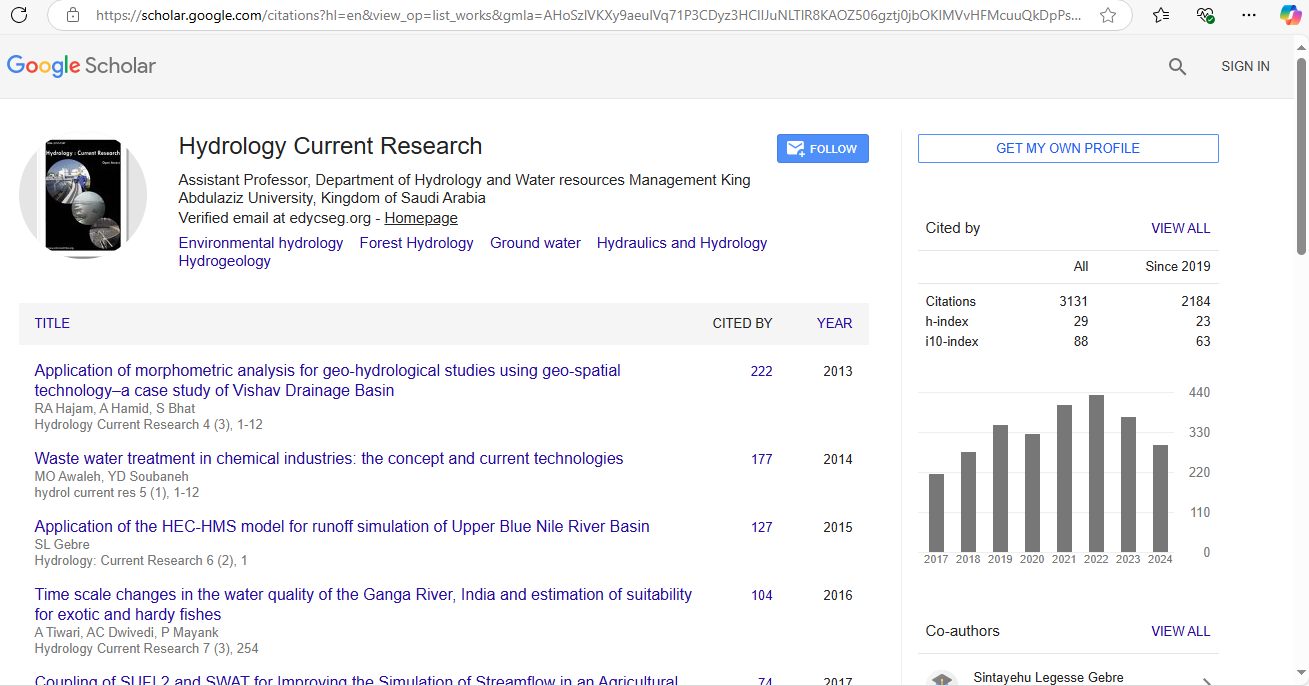
Hydrology: Current Research received 2843 citations as per Google Scholar report