Brief Report - (2025) Volume 9, Issue 6
Received: 03-Nov-2025, Manuscript No. jchd-26-185714;
Editor assigned: 05-Nov-2025, Pre QC No. P-185714;
Reviewed: 19-Nov-2025, QC No. Q-185714;
Revised: 24-Nov-2025, Manuscript No. R-185714;
Published:
01-Dec-2025
, DOI: 10.37421/2684-6020.2024.9.270
Citation: Nowak, Ewa. ”Stress’s Impact on Coronary Heart Disease.”
J Coron Heart Dis 09 (2025):270.
Copyright: © 2025 Nowak E. This is an open-access article distributed under the terms of the Creative Commons Attribution License, which permits unrestricted use,
distribution and reproduction in any medium, provided the original author and source are credited.
The intricate relationship between stress and coronary heart disease (CHD) has garnered significant attention in recent years, underscoring the profound impact of psychological distress on cardiovascular health. Chronic stress, in particular, is increasingly recognized as a key contributor to the pathogenesis of CHD, acting through a complex interplay of physiological and behavioral pathways. The activation of the hypothalamic-pituitary-adrenal (HPA) axis and the sympathetic nervous system is central to this process, promoting inflammation, endothelial dysfunction, and plaque instability within the arterial walls [1].
Evidence suggests that acute psychosocial stress can directly impair endothelial function, a critical marker of vascular health, even in individuals with established coronary artery disease. This impairment appears to be independent of immediate hemodynamic changes, pointing towards a direct vascular effect mediated by neuro-inflammatory mechanisms that foster a pro-atherogenic environment [2].
Furthermore, a meta-analysis of prospective studies has established a significant dose-response relationship between stress levels and the incidence of coronary heart disease, highlighting chronic stress exposure as a potent risk factor. The underlying biological mechanisms involve sustained activation of the HPA axis and sympathetic nervous system, leading to elevated blood pressure, heart rate, and pro-inflammatory markers [3].
The role of inflammation is pivotal in mediating the link between stress and atherosclerosis. Stress hormones such as cortisol and catecholamines are known to stimulate the release of pro-inflammatory cytokines and chemokines, which in turn affect endothelial cells, smooth muscle cells, and macrophages, thereby contributing to the development and progression of atherosclerotic plaques [4].
Beyond physiological responses, behavioral pathways also play a crucial role in how stress exacerbates CHD risk. Individuals experiencing heightened stress often adopt unhealthy behaviors, including smoking, excessive alcohol consumption, poor dietary choices, and reduced physical activity, all of which directly contribute to the development and progression of CHD [5].
The long-term consequences of early life stress on cardiovascular health, including CHD, are also a significant area of concern. Adverse childhood experiences can lead to epigenetic modifications and altered stress reactivity, predisposing individuals to a higher CHD risk in adulthood, emphasizing the importance of addressing stress from a developmental perspective [6].
The hypothalamic-pituitary-adrenal (HPA) axis is a key player in the stress-CHD relationship. Chronic stress disrupts the HPA axis, leading to prolonged exposure to glucocorticoids, which can promote insulin resistance, hypertension, and inflammation â?? all well-established risk factors for coronary heart disease [7].
Similarly, the sympathetic nervous system's contribution to stress-induced cardiovascular events is substantial. Both acute and chronic stress activate this system, increasing heart rate, blood pressure, and cardiac contractility, which over time can lead to imbalances in myocardial oxygen supply and demand, arrhythmias, and plaque rupture [8].
Research has also demonstrated a link between perceived stress and subclinical atherosclerosis. Higher levels of perceived stress have been associated with increased carotid intima-media thickness and coronary artery calcification, even when accounting for traditional cardiovascular risk factors, indicating an independent contribution of psychological stress to early atherosclerotic changes [9].
Given the multifaceted nature of the stress-CHD connection, interventions for stress management in at-risk populations are crucial. Various non-pharmacological approaches, such as mindfulness-based stress reduction, cognitive behavioral therapy, and exercise programs, have shown promise in improving stress levels, cardiovascular risk factors, and potentially reducing cardiac events [10].
The intricate connection between stress and coronary heart disease (CHD) involves a cascade of physiological and behavioral responses that significantly elevate cardiovascular risk. Chronic stress, a pervasive issue in modern life, acts as a potent catalyst for CHD pathogenesis. It triggers the activation of the hypothalamic-pituitary-adrenal (HPA) axis and the sympathetic nervous system, leading to a pro-inflammatory state and promoting the development of atherosclerotic lesions [1].
Experimental evidence highlights the immediate vascular consequences of psychological stress. Studies have shown that acute psychosocial stress can acutely impair endothelial function, a critical indicator of vascular health, in individuals with existing coronary artery disease. This effect appears to be a direct consequence of stress, mediated by pathways that foster an environment conducive to atherosclerosis, independent of changes in blood pressure or heart rate [2].
Further substantiation for the role of chronic stress comes from meta-analyses of prospective studies. These comprehensive reviews have revealed a consistent dose-response relationship, where higher levels of stress are associated with a significantly increased risk of developing coronary heart disease. This underscores the cumulative impact of sustained stress on the cardiovascular system [3].
At the cellular level, the link between stress and atherosclerosis is significantly influenced by inflammatory processes. Stress hormones, including cortisol and catecholamines, have been shown to promote the release of inflammatory mediators such as cytokines and chemokines. These substances play a crucial role in the initiation and progression of atherosclerosis by affecting the cells of the arterial wall [4].
Behavioral adaptations in response to stress also contribute substantially to the increased risk of CHD. Individuals under stress are more prone to engaging in detrimental lifestyle choices. These include increased smoking, higher alcohol consumption, adoption of unhealthy diets, and a decline in physical activity, all of which independently contribute to the development and worsening of cardiovascular disease [5].
The foundational impact of early life stress on long-term cardiovascular health is another critical aspect. Research indicates that adverse experiences during childhood can induce lasting epigenetic changes and alter an individual's stress response system, predisposing them to a higher likelihood of developing CHD in adulthood. This points to the importance of early life interventions [6].
The hypothalamic-pituitary-adrenal (HPA) axis serves as a central mediator in the stress-CHD pathway. Chronic stress dysregulates this axis, leading to sustained elevated levels of glucocorticoids. This hormonal imbalance can contribute to metabolic disturbances such as insulin resistance and hypertension, as well as chronic inflammation, all of which are major risk factors for coronary heart disease [7].
Complementing the HPA axis, the sympathetic nervous system plays an active role in stress-related cardiovascular pathology. Activation of the sympathetic nervous system during stress episodes increases heart rate, blood pressure, and myocardial contractility. Prolonged or frequent activation can compromise the heart's oxygen supply, leading to arrhythmias and increasing the risk of plaque rupture [8].
Even perceived stress, representing an individual's subjective appraisal of stressful situations, is linked to subclinical atherosclerosis. Studies have shown that higher perceived stress levels are associated with early signs of arterial disease, such as increased carotid intima-media thickness and coronary artery calcification, independent of traditional risk factors, highlighting the significance of psychological factors in vascular health [9].
Addressing the multifactorial nature of stress-induced CHD requires comprehensive management strategies. Interventions focused on stress reduction, including mindfulness-based therapies, cognitive behavioral therapy, and structured exercise programs, have demonstrated efficacy in mitigating stress levels, improving cardiovascular risk factors, and potentially preventing adverse cardiac events [10].
This collection of research explores the significant impact of psychological stress on coronary heart disease (CHD). Chronic stress contributes to CHD through physiological pathways involving the HPA axis and sympathetic nervous system, leading to inflammation, endothelial dysfunction, and plaque instability. Behavioral factors like poor diet, reduced activity, and smoking, often exacerbated by stress, further increase risk. Studies show stress impairs endothelial function and is linked to increased CHD incidence. Inflammation plays a key role, with stress hormones promoting pro-inflammatory cytokines. Early life stress and perceived stress also contribute to atherosclerosis. Effective stress management interventions, including mindfulness and CBT, show promise in improving cardiovascular health.
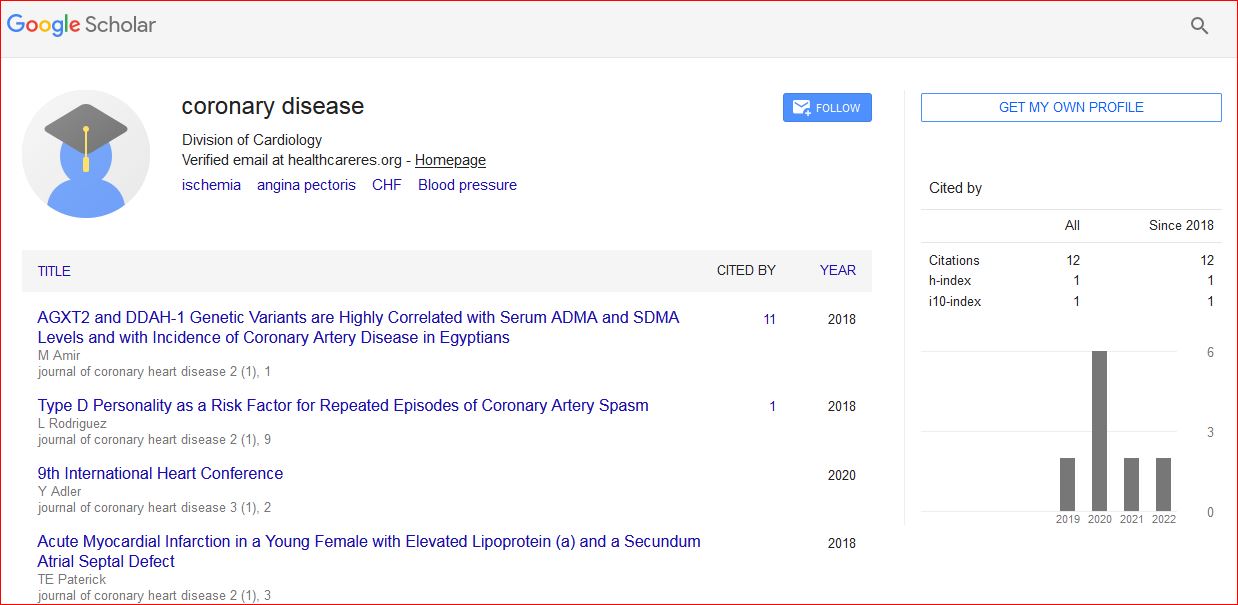
Journal of Coronary Heart Diseases received 15 citations as per Google Scholar report