Brief Report - (2025) Volume 13, Issue 2
Received: 01-Apr-2025, Manuscript No. jaat-26-183146;
Editor assigned: 03-Apr-2025, Pre QC No. P-183146;
Reviewed: 17-Apr-2025, QC No. Q-183146;
Revised: 22-Apr-2025, Manuscript No. R-183146;
Published:
29-Apr-2025
, DOI: 10.37421/2329-6542.2025.13.345
Citation: Tanaka, Hiroshi. ”Stellar Evolution: From Birth to Compact Objects.” J Astrophys Aerospace Technol 13 (2025):345.
Copyright: © 2025 Tanaka H. This is an open-access article distributed under the terms of the Creative Commons Attribution License, which permits unrestricted use, distribution and reproduction in any medium, provided the original author and source are credited.
The intricate processes governing the birth, life, and death of stars are a cornerstone of modern astrophysics, providing fundamental insights into the evolution of the universe. Stellar evolution models, sophisticated theoretical frameworks, are essential for interpreting the vast array of astronomical observations and understanding the physical mechanisms at play within stars. These models have seen remarkable advancements, driven by increased computational power and refined theoretical understanding, enabling more accurate predictions of stellar lifecycles from their initial formation in nebulae to their ultimate demise as compact objects like white dwarfs, neutron stars, and black holes. The implications of these models extend to crucial astrophysical processes such as nucleosynthesis, the mechanisms behind supernova explosions, and the continuous chemical enrichment of galaxies, underscoring a direct connection between theoretical simulations and our comprehension of cosmic phenomena [1].
Massive stars, in particular, offer a dramatic spectacle at the end of their lives through supernova explosions. Detailed modeling of these events focuses on the complex sequence of processes leading to core collapse, the energetic release of neutrinos, and the subsequent explosive ejection of stellar material. These studies are vital for understanding the production of heavy elements via processes like the r-process and for assessing how the mass of the progenitor star influences the characteristics of supernova remnants, thereby shedding light on galactic chemical evolution [2].
Beyond massive stars, the study of white dwarfs, the remnants of low- and intermediate-mass stars, is crucial for understanding certain types of stellar explosions, most notably Type Ia supernovae. Models in this area often explore binary interactions, mass transfer between stars, and the conditions that lead to thermonuclear runaway, which are key to comprehending these cosmic events that serve as invaluable standard candles in cosmological measurements. The cooling rates and observable signatures of white dwarfs are also a significant aspect of this research [3].
The formation and evolution of neutron stars, some of the densest objects in the universe, present another fascinating area of study. Research in this field involves modeling their extreme densities, powerful magnetic fields, and rapid rotation. Investigations into their cooling mechanisms, the behavior of matter under such extreme pressures, and the outcomes of neutron star mergers, such as kilonovae, are central to understanding their astrophysical implications, including the creation of heavy elements and the generation of gravitational waves [4].
A fundamental aspect of stellar evolution is nucleosynthesis, the cosmic process by which elements are created. Detailed models track the intricate pathways within stars, such as the CNO cycle and the triple-alpha process, as well as the neutron-capture processes responsible for synthesizing heavier elements. Different stellar types, including asymptotic giant branch (AGB) stars and supernovae, play distinct roles in contributing to the galactic inventory of elements [5].
The rotation of stars, especially massive ones, can significantly influence their evolutionary paths. Incorporating factors like rotational mixing, angular momentum transport, and magnetic field effects into stellar models reveals how rotation impacts stellar lifetimes, luminosities, surface compositions, and the rates of stellar winds and mass loss. Understanding these effects is particularly important for stars where rotation is a dominant factor [6].
Furthermore, the chemical composition of the interstellar medium, often referred to as metallicity, has a profound effect on stellar evolution. By comparing stellar models with varying initial chemical compositions, astronomers can assess how metallicity influences a star's structure, its evolutionary track, and its eventual fate. This is critical for interpreting stellar populations observed in diverse galactic environments, such as dwarf galaxies and globular clusters [7].
Stellar clusters, both open and globular, provide unique environments where stellar evolution can be studied collectively. Models of these systems examine how the evolution of individual stars within dense stellar populations leads to distinct collections of stars and compact objects. The gravitational interactions between stars and the overall cluster potential also influence their dynamical evolution and ultimate fate [8].
Finally, stellar evolution plays a critical role in the study of exoplanetary systems. The properties of host stars, such as their mass, age, and metallicity, are derived from stellar evolution models and are essential for understanding the formation, characteristics, and potential habitability of exoplanets. Additionally, stellar activity, including flares and stellar winds, can significantly impact the atmospheres of orbiting planets [9].
Stars are not static entities; they undergo continuous transformations throughout their existence, driven by nuclear fusion and gravitational forces. The study of stellar evolution is a broad field that encompasses the entire lifecycle of stars, from their formation in interstellar clouds to their eventual dissipation into compact remnants or explosive events. This understanding is fundamental to unraveling the history and future of the cosmos. The physics governing these processes are complex and involve a delicate balance of forces, nuclear reactions, and radiative transfer, all of which are captured in sophisticated computational models [10].
The sophisticated landscape of stellar evolution models is critical for interpreting astronomical observations, with advancements in computation and theory yielding more accurate predictions of stellar lifecycles, from nebular birth to the formation of compact objects like white dwarfs, neutron stars, and black holes. These models illuminate nucleosynthesis, supernova mechanisms, and galactic chemical enrichment, linking theory to cosmic phenomena [1].
Massive stars undergo spectacular core-collapse supernova explosions, meticulously modeled to understand the intricate processes leading to collapse, neutrino generation, and subsequent explosions. This research provides insights into heavy element production via the r-process and the influence of progenitor mass on supernova remnants, crucial for galactic chemical evolution [2].
The late stages of stellar evolution, specifically the formation and properties of white dwarfs and their potential to trigger Type Ia supernovae, are explored through models that consider binary interactions and thermonuclear runaway. These explosions, significant as cosmological standard candles, are elucidated by these models, which also address white dwarf cooling and observational signatures [3].
Neutron star formation and evolution, characterized by extreme densities, magnetic fields, and rapid rotation, are investigated through models that explain cooling mechanisms, the equation of state of nuclear matter, and neutron star mergers. The astrophysical implications for heavy element production and gravitational wave generation are central to this research [4].
Nucleosynthesis within stars, including processes like the CNO cycle, triple-alpha process, and s- and r-processes, is meticulously detailed in stellar evolution models. These models track element creation from hydrogen to heavier elements, quantifying the contribution of various stellar types, such as AGB stars and supernovae, to the galactic chemical inventory [5].
The impact of stellar rotation on evolution is examined, with models incorporating rotational mixing, angular momentum transport, and magnetic fields. These factors are shown to influence stellar lifetimes, luminosity, surface composition, and mass loss, particularly for massive stars where rotation plays a significant role [6].
Mellicity, or the abundance of elements heavier than helium, profoundly affects stellar evolution. Models that vary initial chemical compositions reveal how metallicity influences stellar structure, evolutionary tracks, and final endpoints, with significant implications for understanding stellar populations in diverse galactic environments [7].
Stellar evolution within dense environments like open and globular clusters is modeled to understand the formation of unique stellar populations and compact objects. The interplay between stellar evolution and the cluster's gravitational potential dictates the dynamical evolution and ultimate fate of these systems [8].
The connection between stellar evolution models and exoplanetary systems is synergistic. Host star properties derived from these models are crucial for understanding exoplanet formation and habitability, while stellar activity such as flares can impact exoplanetary atmospheres [9].
The late stages of low- and intermediate-mass stars, leading to white dwarfs and planetary nebulae, are detailed through models of the AGB phase, mass loss, and envelope ejection. The formation of elements like carbon and s-process elements during these phases is highlighted as a key contribution to interstellar medium enrichment [10].
This collection of research explores various facets of stellar evolution, from advanced modeling techniques and their astrophysical implications to specific end stages like supernova explosions and the formation of compact objects. Key areas of focus include the nucleosynthesis of elements, the influence of rotation and metallicity on stellar lifecycles, and the evolution of stars within clusters. The research also highlights the crucial link between stellar properties and the study of exoplanetary systems. Topics covered range from the core-collapse supernovae of massive stars and thermonuclear explosions of white dwarfs to the formation and properties of neutron stars, white dwarfs, and planetary nebulae. The study of stellar evolution is presented as a fundamental tool for understanding the chemical enrichment of galaxies and the broader cosmic history.
None
None
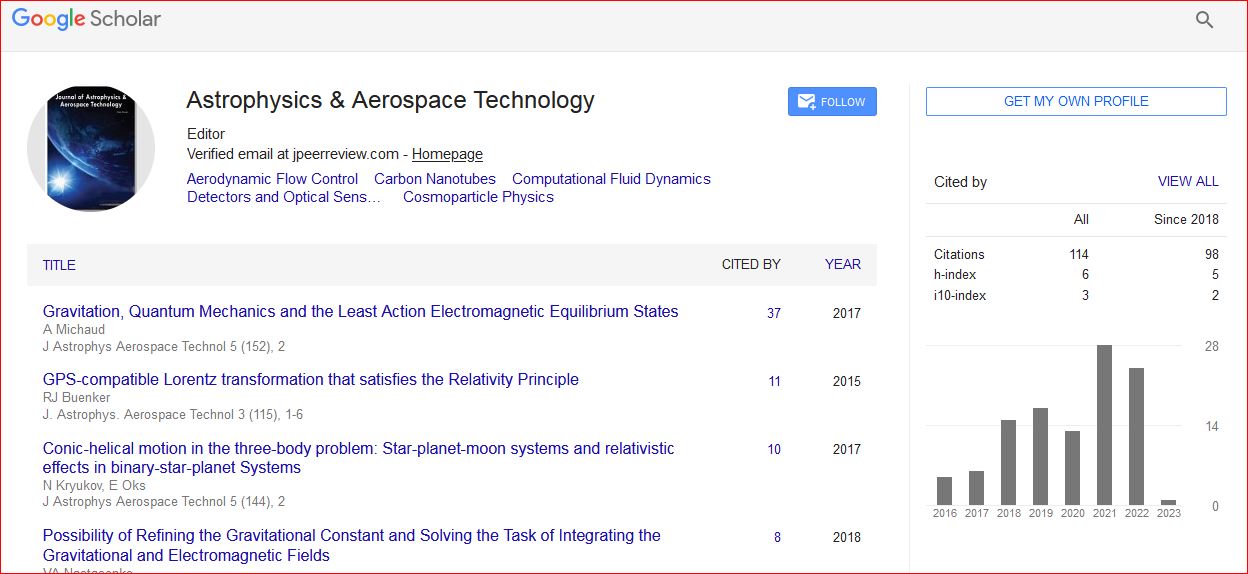
Astrophysics & Aerospace Technology received 114 citations as per Google Scholar report