Perspective - (2025) Volume 18, Issue 4
Received: 30-Jun-2025, Manuscript No. jcsb-25-176412;
Editor assigned: 02-Jul-2025, Pre QC No. P-176412;
Reviewed: 16-Jul-2025, QC No. Q-176412;
Revised: 23-Jul-2025, Manuscript No. R-176412;
Published:
30-Jul-2025
, DOI: 10.37421/0974-7230.2025.18.596
Citation: Torres, Gabriela. ”Statistical Advancements for Complex Health and Environmental Data.” J Comput Sci Syst Biol 18 (2025): 596.
Copyright: © 2025 Torres G. This is an open-access article distributed under the terms of the Creative Commons Attribution License, which permits unrestricted use, distribution
and reproduction in any medium, provided the original author and source are credited.
The landscape of statistical methods in scientific research is continually evolving, driven by the increasing complexity and volume of data across various domains. Here's the thing, researchers are finding innovative ways to apply and adapt these methods to address challenges ranging from genetic risk prediction to environmental data analysis. One area seeing significant advancements is the application of Bayesian networks (BNs) for genetic risk prediction, particularly in diseases like Alzheimer's. These networks offer a powerful framework for integrating diverse genetic and clinical data, helping uncover intricate gene-gene and gene-environment interactions. Understanding how to learn these networks and their practical challenges is key to constructing accurate predictive models in genetic epidemiology [1].
Analyzing high-dimensional data in bioinformatics presents its own set of challenges and advancements. Techniques for dimensionality reduction, feature selection, and robust model building are becoming critical for extracting meaningful insights from complex genomic, proteomic, and transcriptomic datasets. Addressing issues like multicollinearity and small sample sizes relative to the number of features remains a central focus in this field [2].
When it comes to clinical trials, traditional parametric tests might not always fit the data's assumptions, necessitating non-parametric statistical methods. These methods, including rank-based and permutation tests, offer valuable alternatives for comparing treatment effects, especially when data distribution is not normal or variances are heterogeneous. Their application and interpretation in diverse trial designs are crucial [3].
Deep Learning (DL) has also made substantial inroads into healthcare analytics, offering statistical applications for predictive modeling, diagnostic assistance, and treatment optimization. What this really means is that DL models can process complex, high-dimensional healthcare data, and integrating statistical principles with these architectures helps enhance model interpretability, quantify uncertainty, and mitigate bias in clinical decision-making [4].
In statistical genomics, machine learning is moving beyond simple prediction to more robust interpretation of complex genomic data. Techniques such as Deep Learning, ensemble methods, and feature engineering are applied to identify disease-associated genes, understand gene regulatory networks, and predict phenotypic traits. Striking a balance between predictive power and model interpretability is a crucial aspect for biological discovery in this area [5].
Bayesian hierarchical models (BHMs) play a vital role in disease mapping and risk assessment within epidemiology. They effectively tackle issues like spatial autocorrelation and data sparsity by borrowing strength across different regions. BHMs are especially useful for providing smoothed risk estimates and quantifying uncertainty, which is essential for public health decision-making and resource allocation [6].
Deep Learning techniques are also transforming survival analysis in cancer research. Various architectures, including recurrent neural networks and convolutional neural networks, are being adapted for time-to-event data. These applications help with prognosis prediction, treatment response assessment, and biomarker discovery, showing the benefits of Deep Learning in handling complex clinical and genomic data for improved survival modeling [7].
For clinical research involving repeated measurements over time, longitudinal data analysis has seen recent advancements. Methods that account for within-subject correlations and missing data, like generalized linear mixed models, generalized estimating equations, and non-parametric approaches, are vital for understanding disease progression and treatment effects [8].
In observational studies, where randomized controlled trials are often not feasible, causal inference relies on sophisticated statistical methods. Techniques such as propensity score matching, inverse probability weighting, and instrumental variables are critical for mitigating confounding and selection bias across public health and epidemiological contexts [9].
Finally, advances in spatial statistics are specifically tailored for environmental data analysis. These methods model spatial dependence, detect spatial clusters, and perform kriging for interpolation. They are essential for understanding pollutant dispersal, disease outbreaks, and ecological patterns, highlighting the importance of geographical context in environmental risk assessment and policy formulation [10].
At the heart of modern data analysis in healthcare and biological sciences are sophisticated statistical methods designed to tackle complex data structures. When we look at high-dimensional data in bioinformatics, there's a constant drive for techniques that effectively reduce dimensionality, select relevant features, and build models that hold up well. These are vital for extracting meaningful insights from expansive genomic, proteomic, and transcriptomic datasets, especially when common challenges like multicollinearity and small sample sizes relative to the number of features come into play [2]. Similarly, in clinical trials, traditional parametric tests might not always fit the assumptions of the data, which is where non-parametric statistical methods shine. These methods, including rank-based tests and permutation tests, offer valuable alternatives for comparing treatment effects, proving their worth across diverse trial designs where data distribution might not be normal or variances are heterogeneous [3].
For clinical research involving repeated measurements over time, analyzing longitudinal data has seen significant advancements. Methods that can account for within-subject correlations and manage missing data are especially crucial, as these are common hurdles in such studies. Techniques like generalized linear mixed models, generalized estimating equations, and non-parametric approaches are key here, offering clarity in understanding disease progression and the effects of treatments over time [8].
Machine Learning (ML) and Deep Learning (DL) have become indispensable for handling the intricate details of healthcare and genomic data. In healthcare analytics, Deep Learning models are actively deployed for predictive modeling, diagnostic assistance, and treatment optimization, showing a remarkable ability to process vast, complex datasets. Integrating statistical principles with these architectures further helps enhance model interpretability, quantify uncertainty, and reduce bias in critical clinical decisions [4]. Meanwhile, in statistical genomics, Machine Learning has evolved beyond simple prediction to offer deeper interpretation of complex genomic data. Techniques such as Deep Learning, ensemble methods, and feature engineering are used to pinpoint disease-associated genes, map out gene regulatory networks, and predict phenotypic traits. Here, balancing predictive accuracy with model interpretability is paramount for new biological insights [5]. Furthermore, Deep Learning techniques are revolutionizing survival analysis in cancer research, applying architectures like recurrent and convolutional neural networks to time-to-event data, enhancing prognosis prediction, treatment response assessment, and biomarker discovery [7].
Bayesian approaches provide a powerful framework for addressing uncertainty and seamlessly integrating prior knowledge across various applications. Bayesian networks (BNs) are particularly useful for genetic risk prediction, especially for conditions like Alzheimer's disease. They allow for the integration of diverse genetic and clinical data, helping to identify complex interactions between genes and the environment. Learning these networks involves overcoming methodological and practical hurdles to build stable and accurate predictive models in genetic epidemiology [1]. Beyond individual prediction, Bayesian hierarchical models (BHMs) are critical in epidemiology for disease mapping and risk assessment. These models excel at handling spatial autocorrelation and data sparsity by drawing strength from across regions, leading to more refined risk estimates and a better quantification of uncertainty, which directly supports public health decision-making and resource allocation [6].
Understanding causality and geographical context is vital for effective public health and environmental management. In observational studies, where randomized controlled trials aren't always feasible, causal inference methods are essential for minimizing confounding and selection bias. Propensity score matching, inverse probability weighting, and instrumental variables are powerful tools widely applied across public health and epidemiological contexts [9]. Similarly, advances in spatial statistics are specifically tailored for environmental data analysis. These methods are key for modeling spatial dependence, pinpointing spatial clusters, and performing kriging for interpolation. They offer a deeper understanding of phenomena like pollutant dispersal, disease outbreaks, and ecological patterns, making it clear that geographical context plays a crucial role in environmental risk assessment and policy formulation [10].
This collection of reviews highlights significant advancements in statistical methods and their applications across diverse fields, including genetic epidemiology, bioinformatics, clinical research, healthcare analytics, and environmental science. A central theme is the development of sophisticated techniques to manage complex, high-dimensional datasets. Bayesian methods, such as Bayesian networks for genetic risk prediction and Bayesian hierarchical models for disease mapping, are proving instrumental in uncovering complex interactions and providing robust risk assessments. Machine learning and Deep Learning approaches are transforming genomics and healthcare analytics, moving from mere prediction to detailed interpretation, improving diagnostic assistance, treatment optimization, and survival analysis in cancer. The data also emphasize the importance of specialized statistical tools for specific challenges. This includes non-parametric methods for clinical trials when data assumptions are violated, advanced techniques for longitudinal data analysis to account for within-subject correlations, causal inference methods to mitigate bias in observational studies, and spatial statistics for understanding environmental patterns. Overall, these reviews showcase the continuous innovation in statistical methodologies, making them more capable of extracting meaningful insights, quantifying uncertainty, and supporting evidence-based decision-making in critical areas of human health and the environment.
None
None
Yanan L, Yali W, Qiongjie L. "Bayesian Network Learning for Genetic Risk Prediction in Alzheimer's Disease: A Review".Front Genet 12 (2021):708301.
Indexed at, Google Scholar, Crossref
Wei Z, Yuxin L, Qinghua C. "Statistical Methods for High-Dimensional Data Analysis in Bioinformatics: Recent Advances and Challenges".Int J Mol Sci 23 (2022):11956.
Indexed at, Google Scholar, Crossref
Sarah JB, Thomas JJ, Joanna MM. "Non-parametric methods for comparing treatments in clinical trials: a review".Stat Med 42 (2023):4409-4428.
Indexed at, Google Scholar, Crossref
Rahul R, Vinay S, Saurabh S. "Deep Learning for Healthcare Analytics: A Review of Statistical Applications".Artif Intell Med 139 (2023):102534.
Indexed at, Google Scholar, Crossref
Yuanlong X, Fangyuan X, Qianqian S. "Machine Learning Approaches in Statistical Genomics: From Prediction to Interpretation".Int J Mol Sci 22 (2021):7578.
Indexed at, Google Scholar, Crossref
Xin L, Ming L, Jianping W. "Bayesian Hierarchical Models for Disease Mapping and Risk Assessment: A Review".J Healthc Eng 2020 (2020):9062304.
Indexed at, Google Scholar, Crossref
Yuzhen L, Menglu Z, Wei H. "Deep learning-based survival analysis in cancer research: A comprehensive review".Comput Biol Med 154 (2023):106649.
Indexed at, Google Scholar, Crossref
Yu-Fang L, Jen-Hsiang C, Chung-Yi L. "Recent Advances in Statistical Methods for Longitudinal Data Analysis in Clinical Research".Int J Environ Res Public Health 18 (2021):7393.
Indexed at, Google Scholar, Crossref
Rui C, Min H, Xiaohua L. "Causal Inference in Observational Studies: A Review of Statistical Methods and Applications".Front Public Health 10 (2022):969871.
Indexed at, Google Scholar, Crossref
Ming Z, Xiaofei Z, Xiang L. "Advances in Spatial Statistics for Environmental Data Analysis: A Review".J Environ Manage 326 (2023):116747.
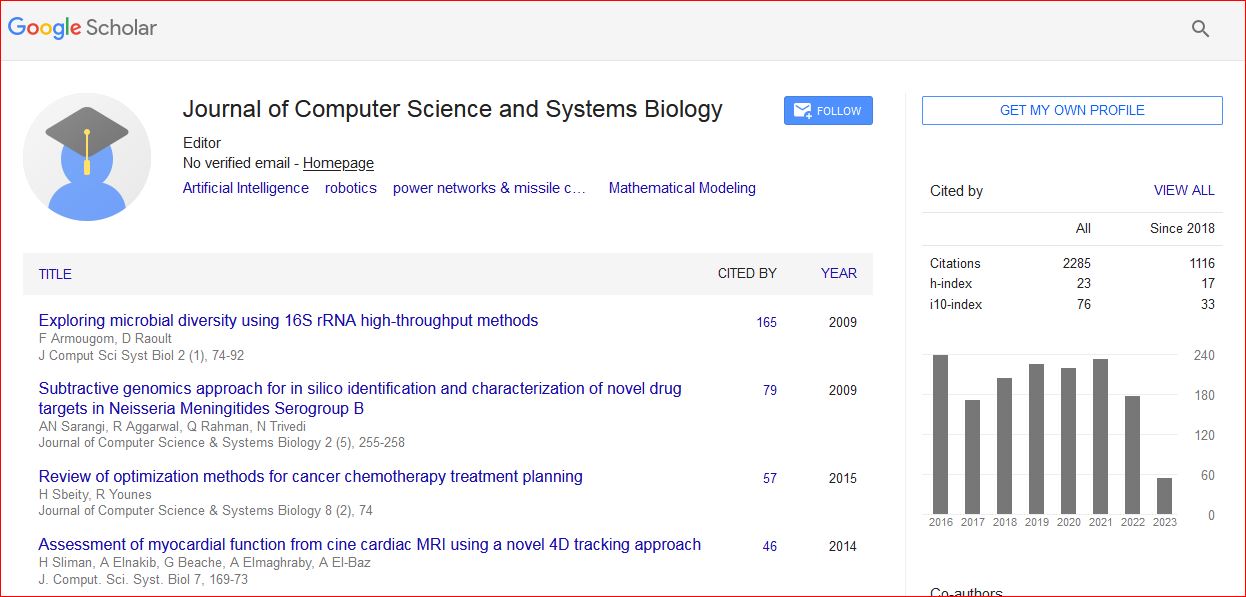
Journal of Computer Science & Systems Biology received 2279 citations as per Google Scholar report