Perspective - (2025) Volume 16, Issue 2
Received: 02-Mar-2025, Manuscript No. jpm-26-179357;
Editor assigned: 04-Mar-2025, Pre QC No. P-179357;
Reviewed: 18-Mar-2025, QC No. Q-179357;
Revised: 24-Mar-2025, Manuscript No. R-179357;
Published:
31-Mar-2025
, DOI: 10.37421/2090-0902.2025.16.528
Citation: Alvarez, Sofia. ”Spectral Methods: Diverse Applications Across Science.” J Phys Math 16 (2025):528.
Copyright: © 2025 Alvarez S. This is an open-access article distributed under the terms of the Creative Commons Attribution License, which permits unrestricted use, distribution and reproduction in any medium, provided the original author and source are credited.
Spectral methods represent a powerful class of numerical techniques that have gained significant traction in various scientific and engineering disciplines due to their inherent accuracy and efficiency, particularly for problems exhibiting smooth solutions. These methods, which employ global basis functions such as Chebyshev or Fourier polynomials, offer a high degree of precision, often surpassing traditional domain-decomposition methods like finite differences or finite elements, especially when dealing with partial differential equations (PDEs). The application of spectral methods to PDEs relevant to fluid dynamics and solid mechanics, for instance, provides a robust framework for computational physics and engineering, enabling detailed simulations with fewer computational resources for problems with smooth solutions [1].
Furthermore, the adaptability of spectral methods extends to complex geometries, where spectral element methods have been developed to handle irregular domains. These methods combine the geometric flexibility of finite elements with the high accuracy of spectral approximations, proving particularly effective for simulating intricate fluid flows, including turbulent regimes and heat transfer phenomena. Their ability to capture fine-scale structures with a reduced number of degrees of freedom makes them invaluable for advanced engineering simulations requiring high fidelity [2].
The utility of spectral methods is not confined to direct simulation but also extends to solving inverse problems, which are often characterized by their ill-posed nature. In fields like geophysics and material science, spectral approaches have been formulated as optimization tasks solved using spectral basis functions, demonstrating robustness and computational advantages in reconstructing material properties or source terms from observed data. Examples include seismic imaging and thermal property estimation, showcasing their effectiveness in challenging scenarios [3].
In the realm of engineering structures, spectral methods have been instrumental in analyzing wave propagation phenomena. By employing Chebyshev spectral approximations, researchers can accurately model acoustic waves and structural vibrations, effectively capturing dispersive effects and wave reflections. This approach offers practical insights for developing efficient numerical schemes tailored for wave simulations in complex media and intricate structures, contributing to advancements in structural dynamics and acoustics [4].
Beyond traditional engineering and physics, spectral methods have found critical applications in specialized fields like plasma physics, specifically in magnetohydrodynamics (MHD). The spectral discretization of MHD equations, coupled with efficient solution strategies on parallel computing architectures, allows for high-fidelity simulations of complex plasma behaviors such as instabilities and turbulence. This capability is vital for research in fusion energy and astrophysical simulations [5].
In condensed matter physics, spectral methods are employed for sophisticated quantum mechanical simulations, particularly for calculating electronic properties. By utilizing spectral expansions for wave functions and operators, these methods enable highly accurate computations of band structures and excitations in materials with periodic potentials and intricate interactions, thereby deepening the understanding of material behavior and properties [6].
The development of spectral collocation methods has also led to significant progress in solving nonlinear evolution equations. These methods excel in the efficient and accurate discretization of nonlinear terms and boundary conditions, resulting in robust numerical schemes that outperform traditional approaches in accuracy and stability for complex nonlinear dynamics, finding applications in fluid mechanics and nonlinear optics [7].
Spectral methods are also a cornerstone in the field of geophysical fluid dynamics, where they are employed for simulating large-scale atmospheric and oceanic circulation. Their inherent global support and high order of accuracy make them adept at representing large-scale phenomena and long-term climate behavior, forming the basis for advanced climate modeling and weather forecasting systems [8].
In the domain of optics and photonics, spectral methods are utilized for solving problems in radiative transfer. By spectrally representing scattering and absorption processes, these techniques facilitate accurate simulations of light propagation through complex optical materials and biological tissues. Their computational efficiency and high resolution are particularly beneficial for modeling phenomena like diffuse reflectance and light transport [9].
Finally, spectral methods are making substantial contributions to numerical relativity, a field concerned with simulating the behavior of spacetime predicted by Einstein's theory of general relativity. Implementing spectral techniques for hyperbolic systems, while challenging, allows for high-accuracy simulations of extreme astrophysical events such as gravitational wave emissions and black hole mergers, pushing the boundaries of our understanding of the universe [10].
Spectral methods represent a sophisticated class of numerical techniques that leverage global basis functions, such as Chebyshev and Fourier polynomials, to approximate solutions to differential equations. Their primary advantage lies in their high order of accuracy, particularly for problems with smooth solutions. In the context of fluid dynamics and solid mechanics, spectral methods offer a compelling alternative to traditional approaches like finite difference and finite element methods. They provide a foundational understanding for researchers in computational physics and engineering, enabling efficient and precise simulations of complex phenomena [1].
The extension of spectral methods into spectral element methods has addressed limitations related to complex geometries. By combining the flexibility of finite elements with the high accuracy of spectral approximations, these methods are adept at simulating intricate fluid flows, including turbulent flows and heat transfer. Their ability to accurately resolve fine-scale structures with a comparatively low number of degrees of freedom positions them as powerful tools for advanced engineering simulations that demand high fidelity [2].
Furthermore, spectral methods have proven to be exceptionally valuable in tackling inverse problems, which are often inherently ill-posed. Within geophysics and material science, these methods are employed within optimization frameworks, utilizing spectral basis functions to reconstruct unknown properties or sources from observational data. Their robustness and computational efficiency have been demonstrated in applications such as seismic imaging and thermal property estimation, highlighting their utility in challenging inverse modeling scenarios [3].
In structural engineering and wave physics, spectral methods, particularly Chebyshev spectral approximations, are utilized for the analysis of wave propagation. This application allows for highly accurate modeling of acoustic waves and structural vibrations, effectively capturing dispersive effects and wave reflection phenomena. The insights gained are crucial for developing efficient numerical schemes for simulating wave behavior in complex environments and intricate structures [4].
The application of spectral methods extends to highly specialized fields like plasma physics, specifically in the domain of magnetohydrodynamics (MHD). By spectrally discretizing the MHD equations and employing efficient parallel computing strategies, researchers can achieve high-fidelity simulations of complex plasma behaviors, including instabilities and turbulence. This capability is essential for advancements in fusion research and astrophysical studies [5].
In the realm of condensed matter physics, spectral methods play a crucial role in quantum mechanical simulations. They facilitate accurate calculations of electronic properties, band structures, and excitations by employing spectral expansions for wave functions and operators. This approach proves particularly advantageous for systems with periodic potentials and complex interactions, leading to a deeper comprehension of material behavior [6].
The development of spectral collocation methods has provided effective solutions for nonlinear evolution equations. These techniques allow for the efficient and accurate discretization of nonlinear terms and boundary conditions, resulting in robust numerical schemes that exhibit superior accuracy and stability compared to conventional methods when dealing with complex nonlinear dynamics in fields like fluid mechanics and nonlinear optics [7].
In geophysical fluid dynamics, spectral methods are indispensable for simulating large-scale phenomena such as atmospheric and oceanic circulation. Their inherent global support and high order of accuracy enable precise representation of long-term climate behavior and large-scale patterns, forming the foundation for sophisticated climate models and weather forecasting systems [8].
Within the field of photonics and radiative transfer, spectral methods are employed to accurately simulate light propagation. These methods spectrally represent scattering and absorption processes, enabling precise simulations in complex optical materials and biological tissues. Their computational efficiency and high resolution are vital for modeling phenomena like diffuse reflectance and light transport [9].
Finally, spectral methods are making significant contributions to numerical relativity, a field focused on simulating spacetime dynamics. The implementation of spectral techniques for hyperbolic systems, despite inherent challenges, allows for high-accuracy simulations of extreme astrophysical events like gravitational wave emissions and black hole mergers, thereby advancing our understanding of fundamental physics [10].
This collection of research highlights the diverse and powerful applications of spectral methods across various scientific disciplines. Spectral techniques, including Chebyshev and Fourier methods, offer high accuracy and efficiency for solving partial differential equations, particularly for problems with smooth solutions. They are employed in fluid dynamics, solid mechanics, and computational physics for precise simulations. Spectral element methods are utilized for complex geometries and fluid flows, while spectral approaches address inverse problems in geophysics and material science. Wave propagation in engineering structures is analyzed using spectral approximations. In plasma physics, spectral methods enable high-fidelity simulations of MHD phenomena. Condensed matter physics benefits from spectral methods for quantum mechanical simulations of electronic structures. Nonlinear evolution equations are effectively solved using spectral collocation, and geophysical fluid dynamics relies on spectral models for climate and weather prediction. Finally, spectral methods contribute to simulations in radiative transfer, photonics, and numerical relativity, including gravitational wave events. These methods consistently demonstrate advantages in accuracy, efficiency, and the ability to resolve fine-scale details, making them indispensable tools in modern scientific research and engineering.
None
None
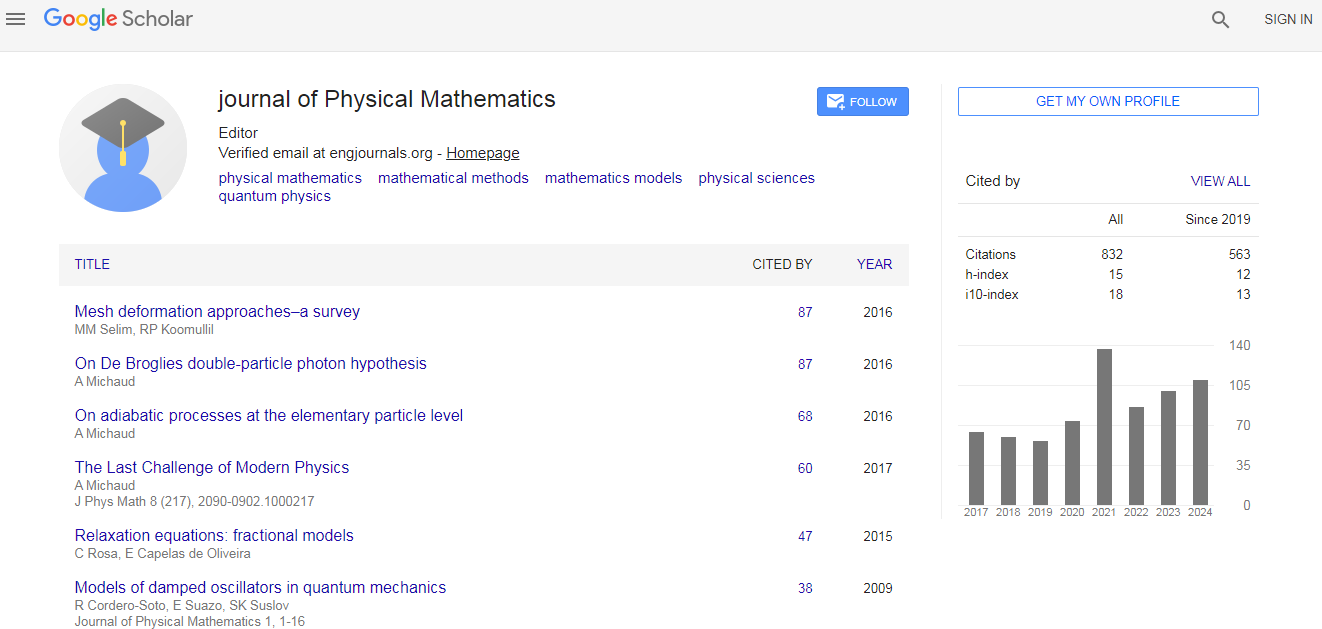
Physical Mathematics received 686 citations as per Google Scholar report