Commentary - (2025) Volume 13, Issue 3
Received: 02-Jun-2025, Manuscript No. jaat-26-183155;
Editor assigned: 04-Jun-2025, Pre QC No. P-183155;
Reviewed: 18-Jun-2025, QC No. Q-183155;
Revised: 23-Jun-2025, Manuscript No. R-183155;
Published:
30-Jun-2025
, DOI: 10.37421/2329-6542.2025.13.354
Citation: Al‑Harbi, Layla. ”Spacecraft Materials: Advancements for Extreme Environments.” J Astrophys Aerospace Technol 13 (2025):354.
Copyright: © 2025 Al‑Harbi L. This is an open-access article distributed under the terms of the Creative Commons Attribution License, which permits unrestricted use, distribution and reproduction in any medium, provided the original author and source are credited.
The extreme conditions encountered in space, including fluctuating temperatures, intense radiation, and a vacuum, pose significant challenges to the longevity and functionality of spacecraft. To address these demanding environments, the development of advanced materials has become a critical area of research and innovation in aerospace engineering. These materials are engineered to withstand the harshness of space, ensuring mission success and enabling longer operational durations [1].
Among the diverse range of materials being explored, high-entropy alloys (HEAs) have garnered considerable attention for their exceptional thermal stability and radiation resistance. Their unique compositions, often involving five or more principal elements in near-equimolar ratios, contribute to outstanding mechanical properties and resilience in extreme conditions, making them suitable for critical spacecraft components [1].
Ceramic matrix composites (CMCs) represent another class of advanced materials crucial for high-temperature applications within spacecraft. Their superior thermal shock resistance, oxidation resistance, and mechanical strength under vacuum conditions make them ideal for components such as engine parts and re-entry shielding, where extreme thermal loads are encountered [2].
The integrity of polymeric materials used in spacecraft construction is significantly impacted by space radiation. Understanding these degradation mechanisms and developing effective mitigation strategies are essential for extending the lifespan of components like insulation, structural elements, and seals, thereby ensuring reliable operation in orbit [3].
Graphene and other two-dimensional (2D) materials are emerging as promising additives for enhancing the performance of aerospace components. Their exceptional properties, including high thermal conductivity and mechanical strength, can be leveraged to create more resilient materials for deep space missions, contributing to lightweighting and improved thermal management [4].
Additive manufacturing (AM) techniques are revolutionizing the production of aerospace materials tailored for extreme space conditions. Methods like selective laser melting and electron beam melting allow for the fabrication of complex geometries with superior material properties, such as high-temperature resistance and radiation tolerance, offering rapid prototyping and customized solutions [5].
Thermal barrier coatings (TBCs) play a vital role in protecting aerospace components from the extreme temperature fluctuations characteristic of space. Advanced ceramic formulations are being developed to provide robust thermal insulation and maintain structural integrity under challenging conditions, such as vacuum and thermal cycling [6].
The development of self-healing materials is a significant advancement aimed at enhancing spacecraft survivability by autonomously repairing damage. These materials, utilizing mechanisms like microcapsule-based systems, can restore structural integrity after micrometeoroid impacts or space debris encounters, reducing maintenance needs and improving mission resilience [7].
Lightweight alloys, particularly titanium and aluminum-based superalloys, are being engineered for critical spacecraft structures and propulsion systems. Their high strength-to-weight ratios, excellent corrosion resistance, and improved performance at elevated temperatures and under vacuum contribute to more efficient and durable spacecraft designs [8].
Transparent conductive films (TCFs) are essential for various spacecraft instruments, including solar cells and optical systems. Research focuses on enhancing the durability and performance of TCFs under harsh space conditions, such as atomic oxygen exposure and UV radiation, to ensure efficient power generation and clear optical functionality for extended missions [9].
Advanced composite materials, including carbon fiber-reinforced polymers (CFRPs) and polymer matrix composites (PMCs), are fundamental to modern spacecraft structures. Their development focuses on improving mechanical properties, thermal stability, and resistance to radiation and vacuum, aiming for lighter yet stronger materials for satellite applications [10].
The critical role of advanced materials in ensuring the longevity and functionality of spacecraft operating in the harsh conditions of space cannot be overstated. These materials must withstand extreme temperatures, radiation, and vacuum. Innovative alloys, ceramics, polymers, and composites are being developed to meet these challenges. High-entropy alloys, for instance, are showing promise for thermal stability and radiation resistance, crucial for long-duration missions [1].
In the realm of high-temperature applications within spacecraft, such as engine components and re-entry shielding, novel ceramic matrix composites (CMCs) are being investigated. These CMCs exhibit superior thermal shock resistance, oxidation resistance, and mechanical strength under vacuum, making them indispensable for future exploration missions requiring sustained operation at extreme temperatures [2].
The impact of space radiation on polymeric materials used in spacecraft construction is a significant concern. Research into degradation mechanisms and mitigation strategies is vital for polymers used in insulation, structural components, and seals. Radiation-hardened polymers and protective coatings are being developed to extend material lifespan in orbit, considering the synergistic effects of radiation and thermal cycling on polymer integrity [3].
The application of graphene and other 2D materials is enhancing the performance of aerospace components for extreme environments. Their use as reinforcing agents in composites, conductive fillers for EMI shielding, and coatings for thermal management and radiation protection offers substantial benefits for deep space missions, improving resilience and thermal dissipation [4].
Additive manufacturing techniques are being employed to produce aerospace materials capable of withstanding extreme space conditions. By utilizing methods like selective laser melting and electron beam melting, complex geometries with superior material properties, such as high-temperature resistance and radiation tolerance, can be fabricated, enabling rapid prototyping and customized material solutions for critical space applications [5].
Thermal barrier coatings (TBCs) are essential for protecting aerospace components from extreme temperature fluctuations in space. Advanced ceramic formulations are being evaluated for their ability to maintain structural integrity and thermal insulation properties under vacuum and thermal cycling. Coating adhesion, phase stability, and resistance to spallation are key factors for long-term performance in space missions with significant temperature gradients [6].
Self-healing materials are being developed to autonomously repair damage to spacecraft caused by micrometeoroid impacts and space debris. Mechanisms like microcapsule-based systems and vascular networks are being explored for their effectiveness in restoring structural integrity and preventing crack propagation in aerospace alloys and composites, enhancing mission survivability [7].
Advanced lightweight alloys, specifically titanium and aluminum-based superalloys, are being developed for spacecraft structures and propulsion systems exposed to extreme space environments. These alloys offer high strength-to-weight ratios, excellent corrosion resistance, and improved performance at elevated temperatures and under vacuum, contributing to more efficient and resilient spacecraft designs [8].
Transparent conductive films (TCFs) are critical for solar cells and optical instruments on spacecraft, and their ability to withstand the harsh space environment is under investigation. Materials like indium tin oxide (ITO) and emerging alternatives are being analyzed for their performance under atomic oxygen, UV radiation, and thermal cycling, with a focus on enhancing durability and longevity for extended missions [9].
Advanced composite materials, including carbon fiber-reinforced polymers (CFRPs) and polymer matrix composites (PMCs), are fundamental for structural applications in spacecraft and satellites. Research focuses on their mechanical properties, thermal stability, and resistance to radiation and vacuum, with strategies to enhance fatigue life and impact resistance being crucial for long-term performance in the space environment [10].
The space environment presents unique challenges to spacecraft materials, including extreme temperatures, radiation, and vacuum. This collection of research highlights advancements in various material classes designed to overcome these obstacles. High-entropy alloys, ceramic matrix composites, and advanced polymers are being developed for enhanced thermal stability, radiation resistance, and high-temperature performance. Graphene and 2D materials offer improved mechanical and thermal properties, while additive manufacturing enables the creation of customized, high-performance components. Thermal barrier coatings are crucial for temperature regulation, and self-healing materials promise increased mission survivability. Lightweight alloys and robust transparent conductive films are also key areas of innovation for spacecraft structures, propulsion systems, and instrumentation. The overarching goal is to achieve greater operational reliability and longer mission durations through superior material science.
None
None
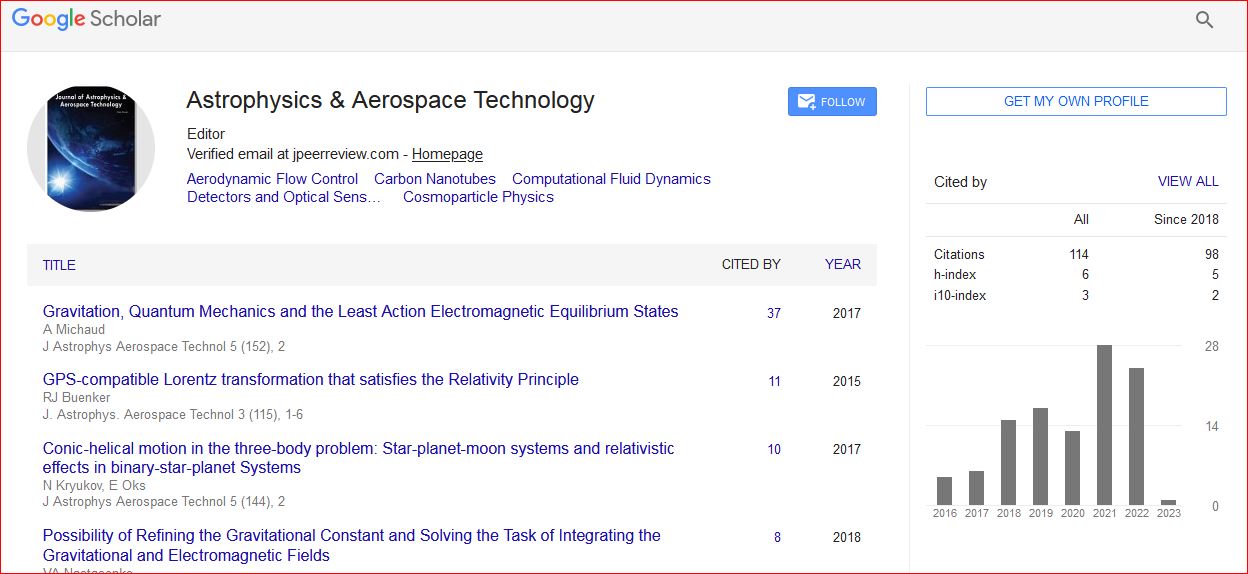
Astrophysics & Aerospace Technology received 114 citations as per Google Scholar report