Brief Report - (2025) Volume 19, Issue 4
Received: 01-Aug-2025, Manuscript No. jmgm-26-188364;
Editor assigned: 04-Aug-2025, Pre QC No. P-188364;
Reviewed: 18-Aug-2025, QC No. Q-188364;
Revised: 22-Aug-2025, Manuscript No. R-188364;
Published:
29-Aug-2025
, DOI: 10.37421/1747-0862.2025.19.734
Citation: Nowak, Karolina. ”Somatic Versus Germline Mutations: A Targeted Therapy Guide.” J Mol Genet Med 19 (2025):734.
Copyright: © 2025 Nowak K. This is an open-access article distributed under the terms of the Creative Commons Attribution License, which permits unrestricted use, distribution and reproduction in any medium, provided the original author and source are credited.
The distinction between somatic and germline mutations is fundamental to understanding the genetic underpinnings of various diseases, particularly cancer. Somatic mutations arise during an organism's lifetime and affect individual cells, driving cancer development by accumulating genetic alterations within the tumor [1].
In contrast, germline mutations are inherited from parents and are present in every cell of an individual's body, predisposing them to hereditary diseases [1].
This fundamental difference has profound implications for molecular diagnosis and therapeutic strategies, as somatic mutations can be targeted specifically within tumors, while germline mutations necessitate broader diagnostic approaches and family counseling [1].
The genomic landscape of cancer is increasingly well-defined, with somatic mutations offering actionable targets for precision medicine through advancements in next-generation sequencing technologies [2].
These technologies have revolutionized our ability to identify specific mutations, leading to the development of targeted drugs that inhibit mutated proteins or pathways, thereby significantly improving patient outcomes for certain cancers [2].
Conversely, germline predispositions to cancer, such as those associated with BRCA1/2 mutations, highlight the critical importance of genetic screening and early detection strategies [3].
Understanding inherited mutation patterns allows for accurate risk stratification and the implementation of prophylactic measures or tailored surveillance programs, offering a proactive approach to disease management for individuals and families at higher risk [3].
The interplay between somatic and germline mutations can significantly influence disease aggressiveness and the response to therapeutic interventions [4].
For instance, a germline predisposition might interact synergistically with somatic mutations to accelerate tumor evolution, making a comprehensive genomic profiling that considers both types of mutations essential for a complete picture in personalized treatment planning [4].
Somatic mosaicism, where mutations arise post-zygotically, presents a complex diagnostic challenge due to its varied distribution and potential to lead to a spectrum of phenotypes [5].
This phenomenon can profoundly affect treatment decisions, especially in developmental disorders or when tumors exhibit intratumoral heterogeneity arising from mosaic mutations [5].
The therapeutic targeting of mutations within the germline is an emerging frontier, particularly relevant in the context of inherited cancer predispositions [6].
Advanced gene editing technologies hold considerable promise for correcting such germline mutations, although significant ethical considerations and delivery challenges must still be addressed [6].
The development of liquid biopsies has greatly enhanced our ability to detect circulating tumor DNA, which primarily harbors somatic mutations [7].
This non-invasive approach enables the monitoring of treatment response, the detection of resistance mechanisms, and the identification of minimal residual disease, providing a dynamic view of tumor evolution [7].
Beyond cancer, understanding the germline genetic architecture of complex diseases, including neurodevelopmental disorders and cardiovascular conditions, is crucial for accurate diagnosis and effective genetic counseling [8].
Identifying pathogenic germline variants facilitates personalized risk assessment and the development of tailored management strategies for a wide range of heritable conditions [8].
The concept of tumor mutational burden (TMB), which primarily reflects the accumulation of somatic mutations, is gaining prominence as a predictive biomarker for immunotherapy response [9].
A high TMB suggests a greater neoantigen load, potentially leading to a more robust immune response against cancer cells and improved outcomes with immunotherapies [9].
Furthermore, somatic mutations occurring in non-coding regions of the genome are increasingly recognized for their critical roles in disease pathogenesis, especially in cancer [10].
These mutations can significantly affect gene regulation and splicing mechanisms, underscoring the necessity for comprehensive genomic analysis that extends beyond protein-coding exons to fully elucidate disease mechanisms [10].
The critical distinction between somatic mutations, acquired during an individual's lifespan, and germline mutations, inherited from parents, underpins much of our understanding in genetics and medicine [1].
Somatic mutations are instrumental in driving the development and progression of cancer by altering the genetic makeup of individual cells within a tissue, leading to uncontrolled growth and proliferation [1].
Conversely, germline mutations are present in the reproductive cells and are therefore transmitted to offspring, increasing the risk of hereditary diseases across generations [1].
Recognizing this fundamental difference is paramount for the development of precise diagnostic tools and effective therapeutic interventions [1].
For instance, therapies can be designed to specifically target somatic mutations within a tumor, while the identification of germline mutations often requires comprehensive genetic screening and counseling for affected families [1].
The comprehensive characterization of the somatic mutation landscape across various cancers has revealed a wealth of actionable targets for the advancement of precision medicine [2].
The advent of next-generation sequencing technologies has fundamentally transformed our capability to identify these mutations with unprecedented accuracy and speed, paving the way for novel drugs that precisely inhibit mutated proteins or disrupt aberrant signaling pathways [2].
This targeted approach has demonstrably improved patient outcomes in specific cancer types [2].
In parallel, understanding germline predispositions to cancer, exemplified by mutations in genes like BRCA1 and BRCA2, emphasizes the vital role of genetic screening and early detection in proactive healthcare [3].
By identifying inherited mutation patterns, clinicians can effectively stratify individuals based on their risk, enabling the implementation of preventive strategies or personalized surveillance programs designed to detect disease at its earliest, most treatable stages [3].
The intricate interplay between somatic and germline mutations can profoundly influence the clinical trajectory of a disease, including its aggressiveness and the patient's response to various therapies [4].
For example, a germline susceptibility may interact with somatic mutations to accelerate the evolutionary process of tumor development [4].
Consequently, comprehensive genomic profiling that considers both somatic and germline alterations provides a more holistic understanding of the disease, crucial for devising personalized treatment plans [4].
Somatic mosaicism, characterized by mutations that arise after the formation of the zygote, presents a significant diagnostic hurdle due to its heterogeneous distribution and the varied phenotypes it can manifest [5].
Such mosaic mutations can complicate treatment decisions, particularly in the context of developmental disorders or in cases where tumors exhibit intratumoral heterogeneity driven by these post-zygotic alterations [5].
The therapeutic manipulation of germline mutations is an emerging and rapidly evolving field, particularly pertinent for addressing inherited predispositions to diseases like cancer [6].
Cutting-edge gene editing technologies, such as CRISPR-Cas9, offer a potential pathway for correcting disease-causing germline mutations; however, significant ethical considerations and technical challenges related to their safe and effective delivery remain substantial barriers [6].
The proliferation of liquid biopsy technologies has dramatically improved our capacity to detect circulating tumor DNA, which predominantly harbors somatic mutations shed from tumors [7].
This non-invasive diagnostic modality is invaluable for monitoring therapeutic efficacy, identifying the emergence of resistance mechanisms, and detecting even minimal residual disease, thereby offering a dynamic perspective on tumor evolution throughout treatment [7].
Beyond oncological applications, elucidating the germline genetic architecture of complex diseases such as neurodevelopmental disorders and various cardiovascular conditions is indispensable for accurate diagnosis and informed genetic counseling [8].
The identification of pathogenic germline variants is a cornerstone of personalized risk assessment, enabling the development of customized management and prevention strategies for individuals and families affected by these conditions [8].
The metric of tumor mutational burden (TMB), which primarily quantifies the extent of somatic mutations within a tumor, is increasingly recognized as a predictive biomarker for response to immunotherapy [9].
A high TMB suggests a greater repertoire of tumor-specific antigens (neoantigens), which can elicit a stronger immune response against cancer cells, thereby enhancing the efficacy of immunotherapies [9].
Furthermore, the importance of somatic mutations occurring in the non-coding regions of the genome is gaining significant recognition for their contributions to disease pathogenesis, especially in cancer [10].
These mutations can exert profound effects on gene regulation, alternative splicing, and other critical cellular processes, highlighting the need for comprehensive genomic analyses that extend beyond the protein-coding exons to fully unravel disease mechanisms [10].
Somatic mutations, acquired during life, drive cancer by affecting individual cells, while germline mutations are inherited and increase hereditary disease risk. Understanding this difference is crucial for targeted therapies. Somatic mutations offer actionable targets for precision medicine, identified through advanced sequencing technologies. Germline predispositions necessitate genetic screening and early detection. The interplay between both mutation types impacts disease progression and treatment response. Somatic mosaicism poses diagnostic challenges, and gene editing for germline mutations is an emerging area with ethical considerations. Liquid biopsies enable non-invasive monitoring of somatic mutations. Germline genetics is essential for diagnosing complex non-cancerous diseases. Tumor mutational burden reflects somatic mutations and predicts immunotherapy response. Non-coding somatic mutations also play a significant role in disease.
None
None
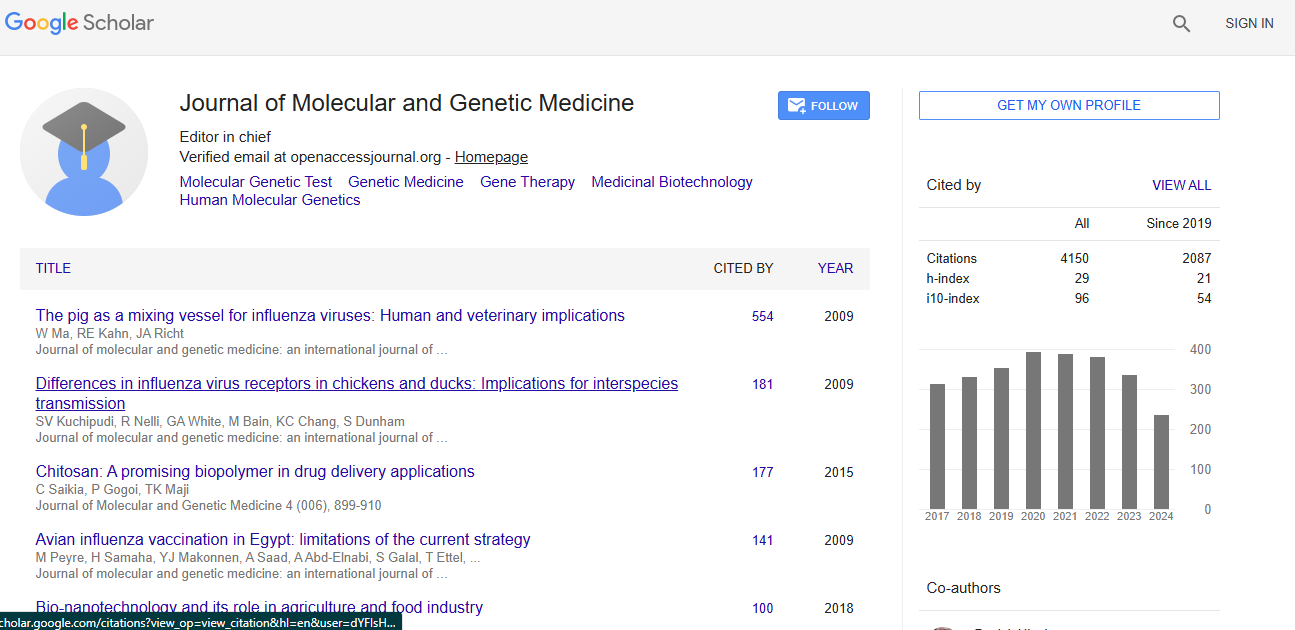
Molecular and Genetic Medicine received 3919 citations as per Google Scholar report