Opinion - (2025) Volume 15, Issue 3
Received: 30-May-2025, Manuscript No. jmcj-25-176496;
Editor assigned: 02-Jun-2025, Pre QC No. P-176496;
Reviewed: 13-Jun-2025, QC No. Q-176496;
Revised: 20-Jun-2025, Manuscript No. R-176496;
Published:
27-Jun-2025
, DOI: 10.37421/2165-7912.2025.15.624
Citation: Leila Haddad. ”Social Media’s Pervasive Impact on Modern Life.” J Mass Communicat Journalism 15(2025):624.
Copyright: © 2025 H. Leila This is an open-access article distributed under the terms of the Creative Commons Attribution License, which permits unrestricted use, distribution and reproduction in any medium, provided the original author and source are credited.
This systematic review delves into how social media affects mental health, highlighting both the negative impacts like increased anxiety, depression, and body image issues, and potential positive aspects such as fostering social connection and support. It emphasizes the complex, multifaceted nature of social media's influence on psychological well-being[1].
This study examines how social media influencers drive consumer purchase decisions, identifying perceived value as a key mediator. It suggests that when consumers perceive high value from influencer-promoted products, their intent to purchase significantly increases, underscoring the strategic role of influencer marketing[2].
This cross-country study investigates the relationship between social media use, the formation of echo chambers, and the escalation of political polarization. It highlights how algorithmic curation and selective exposure on social platforms can reinforce existing beliefs, potentially exacerbating societal divisions and hindering constructive political discourse[3].
This systematic review and meta-analysis examines the intricate relationship between social media use and student academic performance. It uncovers mixed findings, suggesting that while excessive or distracted use can negatively impact grades, strategic integration of social media for collaborative learning or access to educational resources can yield positive outcomes[4].
This systematic review explores the diverse applications of social media in public health, encompassing surveillance, health promotion, and communication strategies. It highlights social media's potential to disseminate vital health information rapidly, monitor disease outbreaks, and foster community engagement for public health initiatives, while also noting challenges related to misinformation[5].
This systematic review explores the dynamics of misinformation dissemination and its impact across various social media platforms. It reveals how factors like algorithmic amplification, user engagement patterns, and cognitive biases contribute to the rapid spread of false information, posing significant challenges to public understanding and decision-making[6].
This systematic review investigates how social media tools are leveraged for internal communication and employee engagement within organizations. It highlights social media's capacity to foster transparency, facilitate knowledge sharing, and build a sense of community among employees, ultimately contributing to improved morale and productivity[7].
This systematic review and meta-analysis examines the strong link between social media engagement and body image concerns. It highlights how exposure to idealized images and appearance-focused content on platforms can contribute to body dissatisfaction, self-objectification, and negative self-perception, particularly among young adults[8].
This study examines how social media's rise has reshaped news consumption patterns and impacted public trust in traditional journalism. It reveals that as individuals increasingly rely on social platforms for news, there's a corresponding decline in confidence in established news outlets, suggesting a profound shift in the media landscape[9].
This systematic review analyzes the complex relationship between social media engagement and political participation. It suggests that while social platforms can lower barriers to political engagement and mobilize collective action, their impact on sustained, meaningful participation remains nuanced and contingent on various individual and contextual factors[10].
This systematic review delves into how social media affects mental health, highlighting both the negative impacts like increased anxiety, depression, and body image issues, and potential positive aspects such as fostering social connection and support. It emphasizes the complex, multifaceted nature of social media's influence on psychological well-being[1]. Complementing this, research directly links social media engagement to significant body image concerns, especially among young adults. Exposure to idealized images and appearance-focused content on these platforms is shown to contribute to body dissatisfaction, self-objectification, and a general negative self-perception[8].
This study examines how social media influencers drive consumer purchase decisions, identifying perceived value as a key mediator. It suggests that when consumers perceive high value from influencer-promoted products, their intent to purchase significantly increases, underscoring the strategic role of influencer marketing[2]. This dynamic highlights the significant impact of social media influencers, where perceived value mediates consumer intent to purchase, underscoring the undeniable strategic importance of influencer marketing in today's digital economy.
This cross-country study investigates the relationship between social media use, the formation of echo chambers, and the escalation of political polarization. It highlights how algorithmic curation and selective exposure on social platforms can reinforce existing beliefs, potentially exacerbating societal divisions and hindering constructive political discourse[3]. Beyond polarization, social media also plays a complex role in political participation. While platforms can lower barriers to engagement and mobilize collective action, their impact on sustained, meaningful participation remains nuanced and contingent on various individual and contextual factors[10]. Furthermore, the pervasive issue of misinformation on social media platforms is highlighted, where factors like algorithmic amplification, user engagement patterns, and cognitive biases contribute to the rapid spread of false information, posing significant challenges to public understanding and decision-making[6].
This systematic review and meta-analysis examines the intricate relationship between social media use and student academic performance. It uncovers mixed findings, suggesting that while excessive or distracted use can negatively impact grades, strategic integration of social media for collaborative learning or access to educational resources can yield positive outcomes[4]. Looking at professional environments, social media tools are increasingly leveraged for internal communication and employee engagement within organizations. Such use highlights the platforms' capacity to foster transparency, facilitate knowledge sharing, and build a stronger sense of community among employees, ultimately contributing to improved morale and productivity[7].
This systematic review explores the diverse applications of social media in public health, encompassing surveillance, health promotion, and communication strategies. It highlights social media's potential to disseminate vital health information rapidly, monitor disease outbreaks, and foster community engagement for public health initiatives, while also noting challenges related to misinformation[5]. However, the media landscape itself has shifted dramatically, with social media reshaping news consumption patterns and impacting public trust in traditional journalism. As individuals increasingly rely on social platforms for news, there is a corresponding decline in confidence in established news outlets, indicating a profound transformation in how information is accessed and perceived[9].
<p>Social media's pervasive influence shapes various aspects of modern life. It significantly impacts mental health, fostering both negative outcomes like anxiety and body image issues, and positive ones through social connection. Influencers on these platforms play a strategic role in driving consumer purchase decisions, with perceived value being a key mediator. The digital landscape also affects political discourse, contributing to echo chambers and political polarization through algorithmic curation and selective exposure. Moreover, social media has mixed effects on academic performance, with excessive use potentially harming grades while strategic integration can support learning. In public health, these platforms offer tools for surveillance, health promotion, and communication, yet they face challenges related to misinformation. The spread of false information is amplified by algorithms and user biases, impacting public understanding. Internally, organizations leverage social media to enhance communication and employee engagement, fostering transparency and community. However, a strong link exists between social media engagement and body image concerns, particularly for young adults exposed to idealized content. The rise of social media has also profoundly reshaped news consumption, leading to a decline in trust in traditional journalism. Finally, social media influences political participation by lowering engagement barriers, though its effect on sustained involvement is complex.</p>
None
None
Indexed at, Google Scholar, Crossref
Indexed at, Google Scholar, Crossref
Indexed at, Google Scholar, Crossref
Indexed at, Google Scholar, Crossref
Indexed at, Google Scholar, Crossref
Indexed at, Google Scholar, Crossref
Indexed at, Google Scholar, Crossref
Indexed at, Google Scholar, Crossref
Indexed at, Google Scholar, Crossref
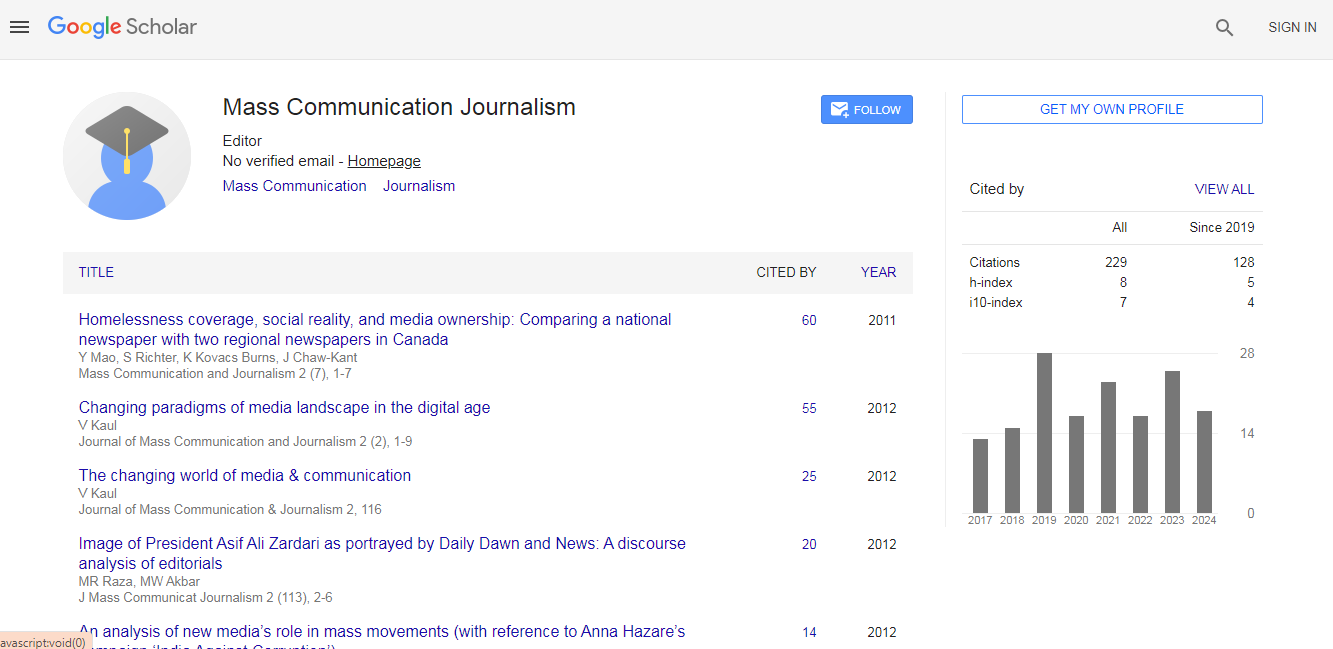
Journal of Mass Communication & Journalism received 205 citations as per Google Scholar report