Brief Report - (2025) Volume 9, Issue 3
Received: 02-Jun-2025, Manuscript No. ahbs-26-182423;
Editor assigned: 04-Jun-2025, Pre QC No. P-182423;
Reviewed: 18-Jun-2025, QC No. Q-182423;
Revised: 23-Jun-2025, Manuscript No. R-182423;
Published:
30-Jun-2025
, DOI: 10.37421/2952-8097.2025.9.315
Citation: Nakamura, Yumi. ”Social Behavior’s Role in Animal
Disease Transmission.” J Anim Health Behav Sci 09 (2025):315.
Copyright: © 2025 Nakamura Y. This is an open-access article distributed under the terms of the Creative Commons Attribution License, which permits unrestricted use,
distribution and reproduction in any medium, provided the original author and source are credited.
Social behavior plays a profoundly influential role in shaping the dynamics of disease transmission within animal populations, impacting everything from pathogen prevalence to outbreak intensity. The intricate web of social interactions, encompassing group living, mating systems, and established social hierarchies, can act as either a catalyst or a barrier to the spread of infectious agents. A comprehensive understanding of these complex interactions is therefore paramount for accurately predicting the trajectory of disease outbreaks, designing effective intervention strategies, and ultimately ensuring the health and conservation of wildlife populations across diverse ecosystems [1].
Conspecific density and the patterns of aggregation exhibited by animals, which are intrinsically linked to their social behaviors, emerge as critical determinants in the spatial dissemination of diseases. Environments characterized by high levels of social interaction and frequent physical contact among individuals are inherently more susceptible to experiencing outbreaks that are both rapid in their onset and severe in their impact. This highlights the spatial dimension of disease spread as being heavily influenced by social structures [2].
Mating behavior, a fundamental aspect of social interaction, can inadvertently serve as a potent vector for the transmission of sexually transmitted diseases. The intensity and frequency of mating activities are directly correlated with the rates at which such pathogens can spread through a population. Consequently, detailed investigation into the reproductive strategies employed by different species offers valuable insights into the persistence and dissemination patterns of associated diseases [3].
Social hierarchy and the dominance interactions that occur within these structures can significantly modulate an individual's susceptibility to and exposure to various pathogens. Individuals occupying lower ranks within a social hierarchy may experience elevated levels of chronic stress, a physiological state that can compromise their immune systems. This compromised immunity renders them more vulnerable to infections, thereby creating distinct risk gradients within the population based on social standing [4].
Philopatry, the tendency of an animal to return to or remain in a specific location, and dispersal patterns, the movement of individuals away from their natal areas, are behaviors often dictated by complex social bonds and the establishment of territorial boundaries. These patterns play a significant role in determining the geographic scale and speed at which diseases can spread across different animal populations, influencing the connectivity of disease transmission networks [5].
Kin recognition and the manifestation of kin-biased behaviors can profoundly affect disease transmission dynamics. While such behaviors may serve to limit the spread of pathogens within established family groups, they can simultaneously facilitate transmission between related individuals who reside in separate groups, creating complex transmission pathways that are influenced by genetic relatedness [6].
Grooming, particularly allogrooming (grooming of others), is a ubiquitous social behavior observed in a wide array of species. This behavior, while often serving social bonding functions, can also represent a significant route for pathogen transmission, especially for ectoparasites and various skin pathogens that can be readily transferred through close physical contact during grooming bouts [7].
Territoriality and the maintenance of social spacing among individuals and groups exert a direct influence on the frequency and nature of contact rates. By dictating the proximity and interaction patterns, these behaviors fundamentally affect both the spatial scale at which diseases can spread and the overall speed of epidemic progression through a population [8].
Social learning, particularly in relation to foraging behaviors, can have indirect but significant implications for disease transmission. If social learning leads to increased congregation at shared food resources or greater exposure to contaminated food sources, it can create novel pathways for pathogen spread, linking behavioral ecology with disease ecology [9].
The size and internal composition of social groups can act as either a buffer or an amplifier for disease outbreaks, a phenomenon contingent upon the specific transmission mode of the pathogen and the inherent social structure of the species. Larger, more cohesive groups may potentiate rapid disease spread, whereas fragmented or smaller groups might serve to slow down or contain an epidemic [10].
Social behavior is a fundamental ecological factor that significantly influences the transmission dynamics of infectious diseases within animal populations. The ways in which animals interact, form groups, establish mating systems, and organize themselves into social hierarchies directly impact the facilitation or inhibition of pathogen spread. Understanding these intricate social-pathogen interactions is therefore indispensable for developing accurate predictive models of disease outbreaks, designing robust and effective control strategies, and ultimately safeguarding the health and well-being of wildlife populations worldwide [1].
The spatial distribution and aggregation patterns of animal populations, which are deeply rooted in their social behavior, are key drivers in the geographical spread of diseases. Areas characterized by dense populations with frequent and intense social interactions are naturally predisposed to experiencing more rapid and widespread disease outbreaks. This underscores the critical link between social structure and the spatial epidemiology of infectious diseases [2].
Mating behaviors, a vital component of social life for many species, can serve as a direct conduit for the transmission of sexually transmitted diseases. The intensity and frequency of mating activity are directly proportional to the rate at which these specific pathogens can disseminate through a population. Therefore, a thorough understanding of the diverse reproductive strategies employed by different species provides crucial insights into the persistence and spread of such diseases [3].
Within social groups, the established hierarchy and the dynamics of dominance interactions play a significant role in determining individual susceptibility to pathogens and the extent of their exposure. Animals at lower ranks within a hierarchy often experience elevated physiological stress, which can impair immune function. This heightened vulnerability makes them more susceptible to various diseases, creating disease risk disparities based on social position within the group [4].
Philopatric tendencies and dispersal behaviors, which are often governed by the strength of social bonds and the establishment of territorial boundaries, are critical factors influencing the geographic spread of diseases across animal populations. These behaviors dictate the movement patterns of individuals, thereby affecting the connectivity of populations and the potential for long-distance pathogen transmission [5].
Kin recognition and the propensity for kin-biased behaviors can have complex effects on disease transmission. While these behaviors might limit the spread of diseases within close-knit family units, they can simultaneously promote transmission between related individuals residing in different social groups, creating intricate transmission networks shaped by kinship [6].
Grooming, particularly the mutual grooming known as allogrooming, is a common and important social behavior across many animal species. This activity can serve as a primary route for the transmission of various pathogens, especially ectoparasites and skin-dwelling microorganisms, which can be easily transferred through close physical contact during these social interactions [7].
Territorial behavior and the maintenance of social spacing are critical in regulating contact rates between individuals and between different social groups. By influencing how often and how closely individuals interact, these behaviors have a direct impact on both the spatial scale and the temporal speed at which diseases can spread through a population [8].
Social learning, especially concerning foraging strategies, can indirectly influence disease transmission dynamics. If social learning leads to increased congregation at shared food sources or heightened exposure to contaminated food, it can create new opportunities for pathogens to spread, linking behavioral ecology with disease ecology in unexpected ways [9].
The size and composition of social groups can either mitigate or exacerbate disease outbreaks, depending on the pathogen's transmission mode and the species' typical social structure. Larger, more cohesive groups may facilitate rapid disease spread, while fragmented or smaller groups might act to slow down or contain an epidemic, highlighting the complex interplay between group dynamics and epidemic potential [10].
Social behavior is a critical factor influencing disease transmission in animal populations. Group living, mating systems, and social hierarchies can either promote or impede pathogen spread. Conspecific density and aggregation patterns, driven by social behavior, are key to the spatial dissemination of diseases, with high social interaction areas prone to rapid and intense outbreaks. Mating behavior can act as a vector for sexually transmitted diseases, with transmission rates linked to mating intensity. Social hierarchy can affect individual susceptibility, with lower-ranking individuals potentially being more vulnerable due to stress-induced immune compromise. Philopatry and dispersal patterns, influenced by social bonds and territoriality, play a significant role in the geographic spread of diseases. Kin recognition and kin-biased behavior can limit spread within family groups but facilitate it between related individuals in different groups. Grooming behaviors, particularly allogrooming, can be a significant route for pathogen transmission. Territoriality and social spacing influence contact rates, affecting the spatial scale and speed of disease spread. Social learning of foraging behaviors can indirectly influence disease transmission by increasing contact at shared resources. Group size and composition can buffer or amplify outbreaks depending on the pathogen's transmission mode and social structure.
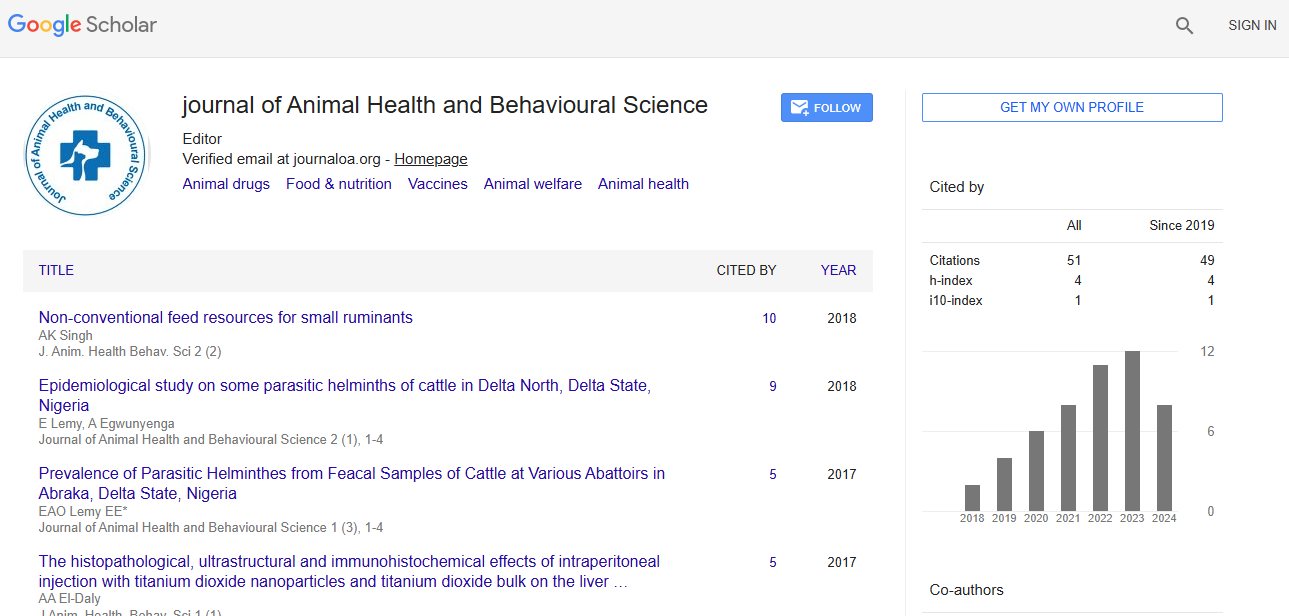
Journal of Animal Health and Behavioural Science received 38 citations as per Google Scholar report