Perspective - (2025) Volume 14, Issue 5
Received: 01-Oct-2025, Manuscript No. idse-26-183627;
Editor assigned: 03-Oct-2025, Pre QC No. P-183627;
Reviewed: 17-Oct-2025, QC No. Q-183627;
Revised: 22-Oct-2025, Manuscript No. R-183627;
Published:
29-Oct-2025
, DOI: 10.37421/2168-9768.2025.14.514
Citation: Vega, Lucia Martinez. "Smarter, Sustainable Irrigation
and Drainage Systems." Irrigat Drainage Sys Eng 14 (2025):514.
Copyright: © 2025 Vega M. Luca This is an open-access article distributed under the terms of the Creative Commons Attribution License, which permits unrestricted use,
distribution and reproduction in any medium, provided the original author and source are credited.
The optimization of agricultural productivity hinges significantly on the efficient management of water resources, a challenge amplified by evolving environmental conditions and increasing global demand. Advanced engineering designs for irrigation and drainage systems are paramount to achieving this balance, focusing on enhancing efficiency, promoting sustainability, and adapting to diverse agro-climatic settings. Research in this area has increasingly integrated smart technologies, leading to real-time monitoring and control mechanisms that refine water application and system management. The development of precision irrigation techniques is a key outcome, aiming to drastically reduce water waste and improve crop health. Furthermore, the design of improved drainage networks plays a critical role in preventing waterlogging and mitigating the pervasive issue of soil salinization, thereby safeguarding arable land for long-term agricultural use [1].
The scheduling of irrigation strategies significantly influences crop yields and the overall water footprint of agricultural operations. Understanding and accounting for soil moisture dynamics, evapotranspiration rates, and regional rainfall patterns are fundamental to optimizing water application. In water-scarce environments, specific strategies like deficit irrigation and supplementary irrigation have demonstrated substantial benefits, enabling the maintenance of acceptable crop yields while concurrently conserving precious water resources. This approach acknowledges the nuanced relationship between water availability and crop productivity, advocating for adaptive management practices tailored to local conditions [2].
A crucial aspect of agricultural water management involves the design and performance of drainage systems. Comparative analyses of various designs, including subsurface tile drainage and surface drainage, have been conducted to assess their effectiveness in improving soil aeration, reducing salinity, and preventing crop damage associated with waterlogging. The effectiveness of these systems is intrinsically linked to their proper design and installation, with factors such as soil type, topography, and specific crop requirements being critical considerations for ensuring optimal performance and system longevity. This highlights the need for site-specific engineering solutions in drainage design [3].
The integration of modern technological advancements, such as sensor networks and remote sensing, into irrigation systems offers unprecedented opportunities for enhanced water management. Real-time data acquisition on soil moisture, weather conditions, and crop status allows for the automation of irrigation decisions, resulting in substantial water savings and improvements in crop health. The benefits of precision irrigation, facilitated by these technologies, are significant, although challenges related to data interpretation and system integration require careful consideration to maximize their potential [4].
Micro-irrigation systems, including drip and micro-sprinkler technologies, are increasingly vital for high-value crops, offering targeted water delivery. Evaluating their water application uniformity, energy efficiency, and suitability for fertigation reveals significant advantages. These systems contribute to water conservation, reduce weed proliferation by minimizing water spread, and enhance nutrient delivery, ultimately leading to improved crop quality and yield. The careful design and implementation of these systems are key to realizing their full potential in intensive agricultural settings [5].
Beyond water application, the environmental consequences of agricultural drainage systems warrant careful examination. The transport of nutrients and pesticides to downstream water bodies is a significant concern, necessitating the development of mitigation strategies. Design approaches and management practices, such as the implementation of constructed wetlands and controlled drainage techniques, are crucial for minimizing non-point source pollution. An integrated approach that concurrently addresses water management objectives and environmental protection is essential for sustainable agricultural practices [6].
Artificial intelligence (AI) and machine learning (ML) are emerging as powerful tools for optimizing irrigation scheduling and predicting water requirements. These advanced computational methods can analyze extensive datasets, including historical irrigation records, weather forecasts, and crop physiological responses, to generate highly accurate irrigation recommendations. The potential for AI and ML to revolutionize irrigation management by driving substantial water savings and enhancing crop performance is immense, paving the way for more intelligent and responsive agricultural systems [7].
The efficiency of energy consumption within agricultural irrigation pumping systems is a critical factor influencing both economic viability and environmental impact. Evaluating diverse pump types, motor technologies, and system configurations helps identify strategies to minimize energy usage while ensuring sufficient water delivery. Optimizing pumping systems yields significant economic and environmental benefits, particularly in regions where energy costs are substantial. This optimization contributes to the overall sustainability of irrigated agriculture [8].
The resilience of irrigation and drainage systems against extreme climatic events, such as prolonged droughts and intense floods, is a growing concern. Analyzing the performance of existing infrastructure and proposing design modifications and operational adjustments are vital for enhancing their adaptive capacity. Incorporating climate change projections into the planning and design phases of agricultural water management systems is paramount for ensuring their long-term functionality and effectiveness in a changing climate [9].
The use of treated wastewater for agricultural irrigation presents a potential solution for water scarcity in arid and semi-arid regions. Evaluating the quality of treated water, its effects on soil properties and crop development, and associated health and environmental risks is essential. When coupled with appropriate treatment and management practices, treated wastewater can serve as a viable irrigation water source, contributing to water resource sustainability in water-stressed agricultural landscapes [10].
The optimization of agricultural productivity is intrinsically linked to the efficient management of water resources, a challenge that is becoming increasingly complex due to shifting environmental conditions and escalating global demand for food. Consequently, the development of advanced engineering designs for both irrigation and drainage systems is considered fundamental to achieving a sustainable balance between agricultural output and water conservation. Current research trends highlight the increasing integration of smart technologies within these systems, enabling real-time monitoring and sophisticated control mechanisms that refine the precision of water application and the overall management of water resources. A significant outcome of this technological advancement is the evolution of precision irrigation techniques, which are specifically designed to minimize water wastage and enhance crop health. Simultaneously, the design of improved drainage networks plays an indispensable role in preventing the detrimental effects of waterlogging and mitigating the widespread problem of soil salinization, thereby ensuring the long-term viability of arable land for agricultural purposes [1].
In the realm of agricultural water management, the strategic scheduling of irrigation practices has been identified as a key determinant of both crop yields and the overall water footprint associated with agricultural operations. A thorough understanding and careful consideration of soil moisture dynamics, evapotranspiration rates, and prevailing local rainfall patterns are prerequisites for effectively optimizing water application. In regions characterized by water scarcity, specific irrigation strategies, such as deficit irrigation and supplementary irrigation, have demonstrated considerable advantages. These approaches enable the sustenance of acceptable crop yields while concurrently promoting the conservation of limited water resources. This nuanced perspective underscores the critical interdependency between water availability and agricultural productivity, advocating for the adoption of adaptive management practices that are specifically tailored to the unique conditions of each region [2].
A vital component of sustainable agricultural water management involves the meticulous design and performance evaluation of drainage systems. Comprehensive comparative analyses have been undertaken to assess the efficacy of various drainage designs, including subsurface tile drainage and surface drainage systems. These evaluations focus on their capacity to improve soil aeration, reduce salinity levels, and prevent crop damage resulting from waterlogging. The success of these drainage systems is directly proportional to their appropriate design and installation. Factors such as soil characteristics, topographical features, and the specific requirements of the crops being cultivated are critical elements that must be considered to ensure optimal performance and extended system longevity. This underscores the imperative for engineering solutions in drainage design that are bespoke to each agricultural site [3].
The incorporation of cutting-edge technological advancements, notably sensor networks and remote sensing capabilities, into irrigation systems represents a significant leap forward in achieving enhanced water management. The ability to gather real-time data concerning soil moisture levels, prevailing weather conditions, and the physiological status of crops facilitates the automation of irrigation decisions. This automation, in turn, leads to substantial water savings and notable improvements in overall crop health. While the benefits of precision irrigation, driven by these advanced technologies, are considerable, potential challenges associated with data interpretation and the integration of complex systems necessitate careful attention to fully harness their transformative potential [4].
Micro-irrigation systems, encompassing technologies such as drip and micro-sprinkler irrigation, are gaining increasing prominence, particularly for the cultivation of high-value crops, due to their capacity for precise water delivery. Assessments of their water application uniformity, energy efficiency, and suitability for integrated nutrient and water application (fertigation) consistently reveal substantial advantages. These systems are instrumental in water conservation efforts, contribute to the reduction of weed growth by limiting water spread to areas adjacent to the crop, and enhance the efficient delivery of essential nutrients. Collectively, these benefits contribute to improved crop quality and increased yields. The careful and meticulous design and subsequent implementation of these advanced irrigation systems are paramount to realizing their full potential within intensive agricultural contexts [5].
Beyond the immediate concerns of water application, the broader environmental implications stemming from agricultural drainage systems demand thorough scrutiny. The transport of essential nutrients and potentially harmful pesticides from agricultural lands to downstream water bodies poses a significant ecological threat. Consequently, the development and implementation of effective mitigation strategies are imperative. These strategies encompass both innovative design approaches and robust management practices, including the beneficial use of constructed wetlands and the application of controlled drainage techniques, all aimed at minimizing non-point source pollution. A holistic and integrated approach that simultaneously addresses water management objectives and environmental protection is fundamental to achieving truly sustainable agricultural practices [6].
The application of artificial intelligence (AI) and machine learning (ML) methodologies is rapidly emerging as a transformative force in the optimization of irrigation scheduling and the accurate prediction of crop water requirements. These sophisticated computational tools possess the capability to analyze vast and complex datasets, which include historical irrigation data, meteorological forecasts, and detailed information on crop physiological responses. This comprehensive analysis enables the generation of highly precise and reliable irrigation recommendations. The potential for AI and ML to fundamentally revolutionize the field of irrigation management, leading to significant water conservation and substantial improvements in crop performance, is immense, heralding a new era of intelligent and responsive agricultural systems [7].
The critical factor of energy consumption within agricultural irrigation pumping systems has a direct bearing on both the economic feasibility and the overall environmental impact of irrigated agriculture. Through the systematic evaluation of various pump types, advanced motor technologies, and optimized system configurations, effective strategies can be devised to minimize energy usage while concurrently ensuring the consistent delivery of adequate water volumes. The optimization of these pumping systems yields substantial economic benefits and contributes positively to environmental sustainability, particularly in regions where energy costs are a significant operational expense. This focus on efficiency further supports the broader sustainability goals of irrigated agriculture [8].
The capacity of irrigation and drainage systems to withstand and adapt to extreme climatic phenomena, such as extended periods of drought and intense flood events, represents a growing area of concern. This necessitates a thorough analysis of the performance characteristics of existing infrastructure, coupled with the proposal of strategic design modifications and adaptive operational adjustments. These measures are essential for enhancing the overall resilience and adaptive capacity of these vital agricultural systems. Furthermore, it is imperative that projections related to climate change are systematically incorporated into the planning and design phases of all agricultural water management systems to ensure their long-term efficacy and functionality in an increasingly unpredictable climate [9].
The utilization of treated wastewater for agricultural irrigation purposes presents a promising and viable solution for addressing water scarcity issues, particularly in arid and semi-arid geographical regions. A comprehensive evaluation of the quality of the treated water, its potential impacts on soil properties and crop development, and the associated health and environmental risks is an indispensable step. The findings from such assessments consistently indicate that, when subjected to appropriate treatment processes and managed with robust practices, treated wastewater can serve as a dependable source of irrigation water, thereby contributing significantly to the sustainable management of water resources in areas experiencing water stress [10].
This collection of research highlights advancements in agricultural irrigation and drainage systems, emphasizing efficiency, sustainability, and adaptability. Key themes include the integration of smart technologies for real-time monitoring and control, precision irrigation techniques to minimize water waste, and the design of improved drainage to prevent waterlogging and salinization. Studies explore the impact of irrigation scheduling on water productivity and crop yield, the performance evaluation of different drainage system designs, and the role of micro-irrigation for high-value crops. The use of AI and machine learning for optimizing irrigation, energy efficiency in pumping systems, and enhancing resilience to climate change are also discussed. Furthermore, the suitability of treated wastewater for irrigation is assessed, along with strategies to mitigate pollution from drainage systems. Overall, the research points towards a future of smarter, more sustainable water management in agriculture.
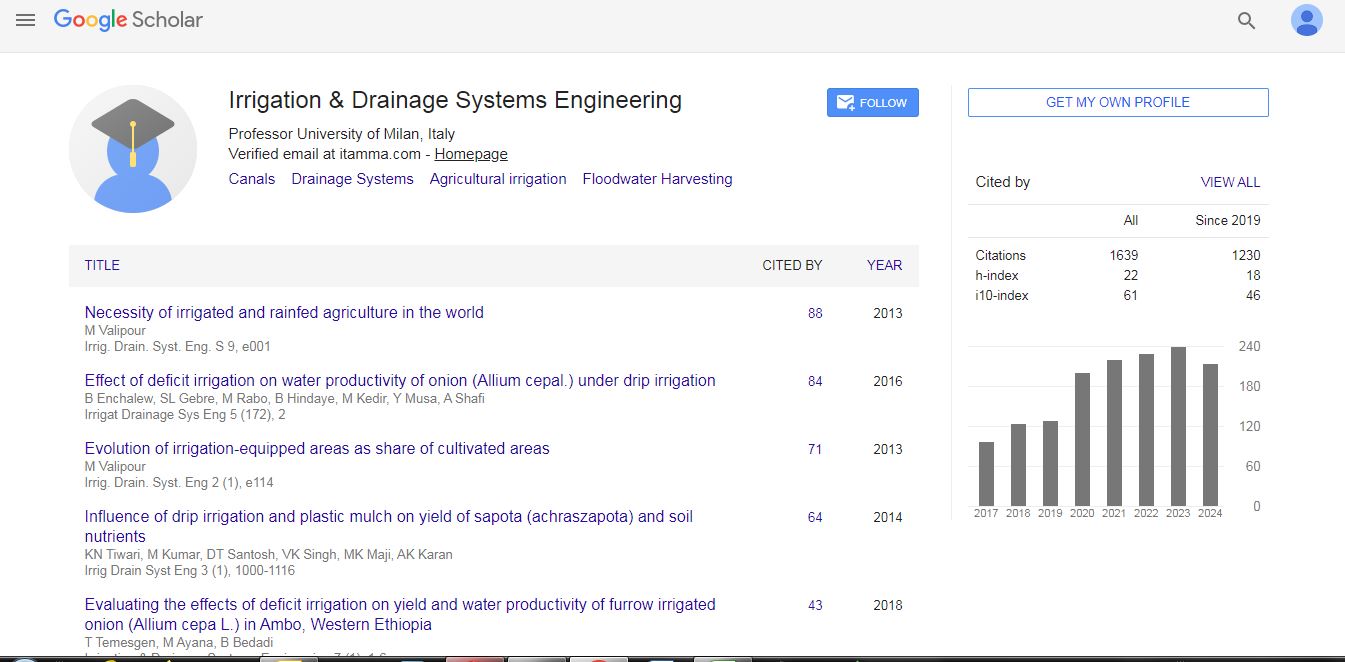
Irrigation & Drainage Systems Engineering received 835 citations as per Google Scholar report