Brief Report - (2025) Volume 14, Issue 3
Received: 01-Jun-2025, Manuscript No. idse-26-182801;
Editor assigned: 03-Jun-2025, Pre QC No. P-182801;
Reviewed: 17-Jun-2025, QC No. Q-182801;
Revised: 23-Jun-2025, Manuscript No. R-182801;
Published:
30-Jun-2025
, DOI: 10.37421/2168-9768.2025.14.487
Citation: Rahimi, Fatemeh. ”Smart Irrigation: Integrated Approaches
for Sustainable Agriculture.” Irrigat Drainage Sys Eng 14 (2025):487.
Copyright: © 2025 Rahimi F. This is an open-access article distributed under the terms of the Creative Commons Attribution License, which permits unrestricted use,
distribution and reproduction in any medium, provided the original author and source are credited.
Effective irrigation system planning, design, operation, and maintenance are undeniably critical for achieving agricultural sustainability and ensuring long-term food security. This multifaceted approach necessitates a deep understanding of available water resources, precise crop water requirements, nuanced soil properties, and the potential environmental impacts associated with water management practices [1].
Modern agricultural practices are increasingly integrating advanced technologies, such as sophisticated sensor networks and robust data analytics platforms, to facilitate precision irrigation. These innovations are paramount for optimizing water use efficiency, thereby minimizing the depletion of precious water reserves and concurrently reducing energy consumption associated with irrigation operations [1].
Furthermore, the implementation of regular and thorough maintenance protocols is essential for guaranteeing the longevity and consistent performance of irrigation systems. Proactive upkeep prevents costly breakdowns, reduces unforeseen water loss, and ensures that systems operate at their intended efficiency throughout their operational lifespan [1].
The seamless integration of all these crucial phases, from the initial conceptual planning and meticulous design to the ongoing operational oversight and diligent maintenance, forms the fundamental backbone of resilient and highly productive agricultural water management systems [1].
This comprehensive strategy is vital for adapting to changing climatic conditions and growing global demands for food production. Without this integrated approach, the sustainability of agricultural water use remains precarious, threatening both environmental health and economic viability. The continuous evaluation and refinement of these integrated strategies are therefore imperative for advancing the field of agricultural water management and meeting future challenges.
The strategic alignment of planning, design, operation, and maintenance fosters a synergistic effect, where each component reinforces the others for optimal outcomes. This holistic perspective is a cornerstone of sustainable agriculture in the 21st century. The success of any irrigation initiative hinges on the diligent execution and interconnectedness of these core elements, ensuring that water is used judiciously and effectively to support crop growth and agricultural productivity. The commitment to these principles underpins the resilience of agricultural systems against environmental and economic pressures.The evolution of irrigation technology and practices is driven by the need for greater efficiency and sustainability, making the integration of these components a continuous process of improvement and innovation. The strategic management of water in agriculture is not merely about delivering water to crops; it is about optimizing a complex system that impacts resource availability, energy use, and environmental sustainability. By embracing a holistic approach that encompasses all stages of the irrigation lifecycle, stakeholders can build more robust and productive agricultural landscapes.
The foundation of productive and sustainable agriculture lies in the intelligent and integrated management of water resources, from the source to the field and beyond. The ongoing advancements in technology and understanding further underscore the importance of a cohesive strategy that addresses all facets of irrigation. This integrated framework is essential for navigating the complexities of modern agriculture and ensuring its long-term viability. It is through the diligent application of these principles that agricultural systems can achieve their full potential while minimizing their environmental footprint. The proactive engagement with all stages of irrigation management is key to fostering resilience and productivity in the face of evolving challenges.The impact of various irrigation scheduling methods on water productivity, particularly within maize cultivation, has been a significant area of investigation. Research highlights that precise timing and judicious water application, critically informed by continuous soil moisture monitoring, can lead to substantial reductions in water usage while simultaneously maintaining or even enhancing crop yields. This emphasizes the vital role of operational adjustments, which should be based on real-time data to ensure optimal system performance and effective resource conservation [2].
The maintenance of drip irrigation systems stands out as a pivotal factor in ensuring their long-term efficiency and overall sustainability. Detailed documentation exists on common issues encountered, such as emitter clogging, pipe leaks, and pump failures. Practical guidelines are readily available for implementing both proactive and reactive maintenance strategies. Proper upkeep directly influences the uniformity of water distribution and the energy efficiency of the system, thereby guaranteeing that the intended benefits of the irrigation design are fully realized throughout the system's operational lifespan [3].
The design principles governing efficient sprinkler irrigation systems have also been explored extensively, with a primary focus on achieving uniform water application and minimizing energy consumption. Analyses have been conducted on different sprinkler types and their performance under a variety of climatic conditions, underscoring the necessity for careful selection and strategic layout based on specific field characteristics. This research emphasizes how fundamental design choices directly influence operational costs and the overall environmental footprint of sprinkler systems [4].
The application of remote sensing and Geographic Information Systems (GIS) for irrigation system planning and management presents a powerful, integrated approach. This methodology enables detailed land use analysis, comprehensive soil mapping, and the precise estimation of crop water requirements at a highly granular scale. Findings from such studies consistently suggest that these spatial technologies significantly enhance the accuracy and operational efficiency of planning and decision-making processes, particularly for large-scale irrigation projects [5].
Subsurface drip irrigation (SDI) systems present unique operational considerations, with research focusing on energy efficiency and water delivery uniformity. Challenges related to maintaining adequate pressure and effectively managing clogging within buried systems are often highlighted. Consequently, operational strategies are proposed to mitigate these specific issues. This research often emphasizes the critical need for a holistic approach to operation that concurrently considers both system design and ongoing maintenance requirements [6].
The influence of maintenance practices on the performance of traditional canal irrigation systems has been thoroughly evaluated. This body of work discusses the paramount importance of regular activities such as desilting, lining repairs, and structural upkeep to effectively reduce water losses and improve the overall efficiency of water delivery. Insights are provided into the development of cost-effective maintenance schedules designed to maximize the operational life and economic benefits derived from these established irrigation systems [7].
The development of smart irrigation systems represents a significant advancement, with research presenting novel design frameworks that effectively incorporate real-time weather data and detailed crop physiological responses. The primary objective of these proposed designs is to automate irrigation decisions, thereby significantly enhancing water use efficiency and reducing associated labor costs. The integration of sensor networks, robust communication protocols, and sophisticated control algorithms is central to achieving intelligent water management through these smart systems [8].
The operational performance and energy consumption of pumping stations, which are integral to large-scale irrigation projects, are subjected to rigorous analysis. This research typically identifies key factors that exert a significant influence on efficiency, including the appropriate selection of pumps, the optimization of system hydraulics, and the strategic scheduling of operations. Recommendations are consistently provided for optimizing pump station operations to achieve substantial reductions in energy costs and to improve the overall reliability of the entire irrigation system [9].
Finally, the effectiveness of various maintenance strategies for ensuring the sustainability of micro-irrigation systems is a subject of ongoing evaluation. Comparative analyses are conducted to assess scheduled maintenance, condition-based maintenance, and reactive maintenance approaches. These comparisons are typically made in terms of cost-effectiveness, system downtime, and overall system performance. The findings consistently highlight the substantial benefits of adopting a proactive and data-driven approach to maintenance for maximizing both water use efficiency and the operational lifespan of micro-irrigation systems [10].
This collection of research underscores the critical importance of integrated approaches to agricultural irrigation systems, covering planning, design, operation, and maintenance for enhanced sustainability and efficiency. Modern methods leverage advanced technologies like sensor networks, data analytics, remote sensing, and GIS to optimize water use, reduce energy consumption, and improve crop yields. Specific studies delve into the optimization of irrigation scheduling, particularly for crops like maize, and highlight the impact of soil moisture monitoring. Maintenance is consistently identified as a crucial factor for the long-term performance and water use efficiency of various irrigation types, including drip and subsurface drip systems, as well as traditional canal systems. Research also focuses on the design and operational efficiency of sprinkler systems and pumping stations, emphasizing uniform water distribution and energy conservation. The development of smart irrigation systems that integrate real-time weather and crop data is paving the way for automated, efficient water management. Overall, the findings advocate for proactive, data-driven strategies across all phases of irrigation to ensure agricultural resilience and resource conservation.
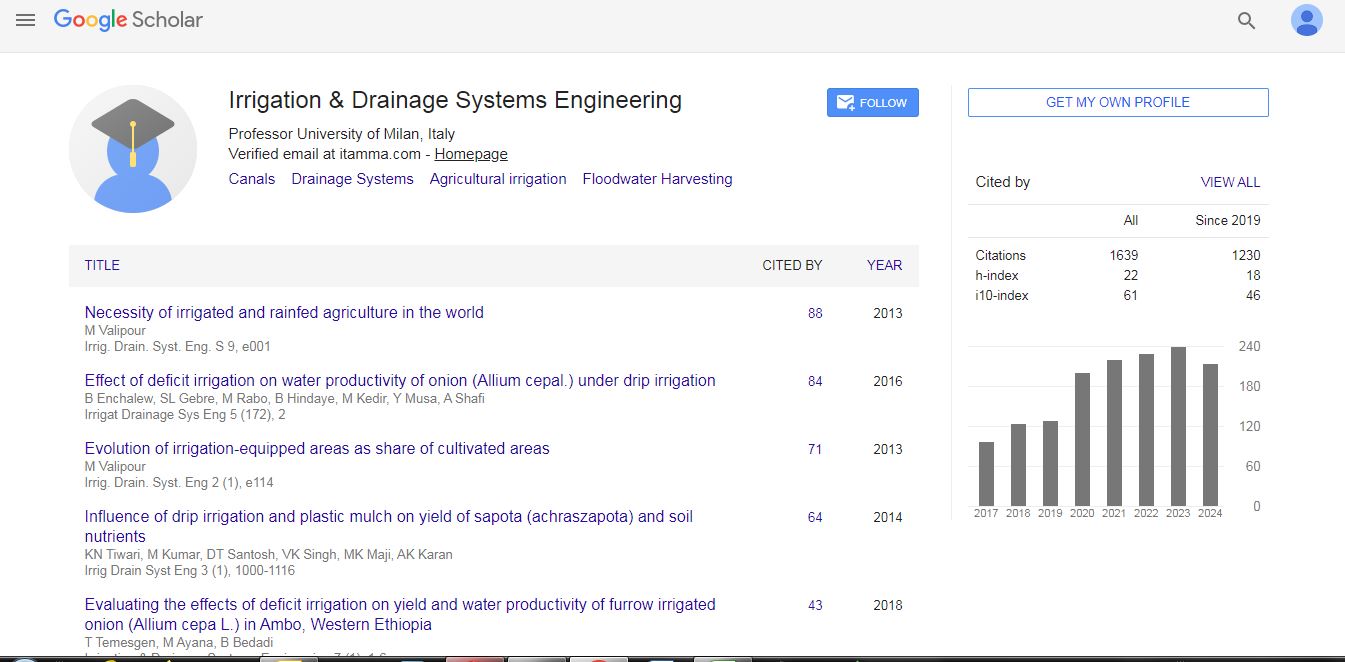
Irrigation & Drainage Systems Engineering received 835 citations as per Google Scholar report