Perspective - (2025) Volume 14, Issue 2
Received: 01-Apr-2025, Manuscript No. idse-26-182782;
Editor assigned: 03-Apr-2025, Pre QC No. P-182782;
Reviewed: 17-Apr-2025, QC No. Q-182782;
Revised: 22-Apr-2025, Manuscript No. R-182782;
Published:
29-Apr-2025
, DOI: 10.37421/2168-9768.2025.14.484
Citation: Mwangi, Peter. ”Smart Irrigation and Drainage for Agricultural
Sustainability.” Irrigat Drainage Sys Eng 14 (2025):484.
Copyright: © 2025 Mwangi P. This is an open-access article distributed under the terms of the Creative Commons Attribution License, which permits unrestricted use,
distribution and reproduction in any medium, provided the original author and source are credited.
Efficient irrigation and drainage systems are fundamental for ensuring sustainable agricultural production, especially in the face of climate change and increasing water scarcity. These systems optimize water use, prevent waterlogging and salinization, and ultimately enhance crop yields and quality. Technologies like micro-irrigation, sensor-based irrigation scheduling, and improved subsurface drainage designs play a crucial role in this sustainability by minimizing water losses and reducing energy consumption. Integrating these systems with sound agronomic practices further amplifies their benefits, promoting environmental stewardship and economic viability for farmers. [1]
The effectiveness of drainage systems is directly linked to their design and maintenance. Poorly designed or clogged drainage can lead to waterlogged soils, hindering root respiration and nutrient uptake, thereby reducing crop productivity. Conversely, well-functioning systems ensure adequate aeration and prevent the accumulation of harmful salts, creating a more favorable environment for plant growth. Modern approaches often incorporate advanced modeling and monitoring to optimize subsurface drainage layout and performance. [2] Precision irrigation technologies, such as drip and micro-sprinkler systems, are essential for water conservation in agriculture. These methods deliver water directly to the plant root zone, significantly reducing evaporation and runoff losses compared to traditional flood or furrow irrigation. Coupled with soil moisture sensors and weather data, these systems allow for site-specific water application, ensuring crops receive the precise amount of water they need, when they need it, which is key to sustainable intensification. [3] The integration of renewable energy sources with irrigation systems offers a sustainable pathway to reduce operational costs and carbon footprints. Solar-powered pumps, for example, can provide reliable water supply in off-grid areas, complementing the efficiency of modern irrigation methods. This synergy not only enhances agricultural productivity but also contributes to rural development and climate change mitigation. [4] Water management in agriculture faces significant challenges due to climate variability. Implementing adaptive irrigation and drainage strategies is crucial for maintaining crop production and resilience. This involves not only adopting efficient technologies but also incorporating climate forecasting and risk assessment into water management plans to respond effectively to drought or flood events. [5] The economic feasibility and social acceptance of new irrigation and drainage technologies are paramount for their widespread adoption. Studies often evaluate the return on investment for farmers considering upgrades to their systems, alongside the impact on labor requirements and overall farm profitability. Community involvement and stakeholder engagement are vital to ensure that implemented solutions meet local needs and contribute to sustainable livelihoods. [6] Effective drainage is not only about removing excess water but also about managing soil salinity, a major threat to agricultural productivity in arid and semi-arid regions. Subsurface drainage systems, when properly designed and maintained, can help leach accumulated salts from the root zone, improving soil health and crop performance. Monitoring the quality of drained water is also important to prevent environmental pollution. [7] Water-saving irrigation techniques are central to sustainable agriculture, particularly in regions facing increasing water stress. Research highlights that optimizing irrigation scheduling using real-time data from soil moisture sensors and evapotranspiration models can lead to substantial water savings while maintaining or even enhancing crop yields. This intelligent application of water minimizes waste and ensures resource availability for future use. [8] The management of agricultural drainage water, including its quality and reuse, is a critical aspect of sustainable water resource management. Runoff and drainage water can contain nutrients and pesticides, posing environmental risks if not managed properly. Practices like constructed wetlands or nutrient removal systems can help treat this water, making it suitable for reuse in irrigation and thus closing the water loop. [9] The modernization of irrigation systems, moving from traditional to water-efficient technologies, has a profound impact on water productivity and the overall sustainability of agriculture. This transition often involves significant investment but yields benefits through reduced water consumption, energy savings, and improved crop yields. Policy support and farmer education are crucial for successful adoption and long-term benefits. [10]Sustainable agricultural production is increasingly dependent on the efficient management of water resources, with advanced irrigation and drainage systems playing a pivotal role. These technologies are instrumental in optimizing water utilization, mitigating the adverse effects of waterlogging and soil salinization, and ultimately leading to enhanced crop yields and superior quality. The implementation of innovative approaches such as micro-irrigation, sensor-driven irrigation scheduling, and sophisticated subsurface drainage designs contributes significantly to water conservation and reduced energy consumption, thereby supporting environmental sustainability and economic viability for farming communities. [1]
The efficacy of agricultural drainage systems is intrinsically tied to their design integrity and consistent maintenance. Inadequate or obstructed drainage infrastructure can precipitate soil waterlogging, which impairs root function and nutrient absorption, consequently diminishing crop productivity. Conversely, optimally functioning drainage systems facilitate proper soil aeration and preclude the buildup of detrimental salts, thereby cultivating a more conducive environment for plant development. Contemporary strategies frequently integrate advanced computational modeling and real-time monitoring to refine subsurface drainage configurations and performance. [2] Precision irrigation technologies, including drip and micro-sprinkler systems, are indispensable for achieving water conservation in agricultural practices. These methods direct water precisely to the plant root zones, thereby substantially decreasing losses due to evaporation and surface runoff compared to conventional flood or furrow irrigation techniques. When complemented by soil moisture sensors and meteorological data, these systems enable tailored water application, ensuring that crops receive the exact quantity of water required at the opportune moments, which is a cornerstone of sustainable agricultural intensification. [3] The incorporation of renewable energy sources into irrigation systems presents a sustainable avenue for reducing both operational expenses and the environmental carbon footprint. Solar-powered irrigation pumps, for instance, can ensure a consistent water supply in remote locations, augmenting the efficiency of modern irrigation methodologies. This synergistic integration not only boosts agricultural output but also fosters rural development and contributes to climate change mitigation efforts. [4] Agricultural water management is confronted with substantial challenges stemming from climate variability. The adoption of adaptive irrigation and drainage strategies is therefore essential for sustaining crop production and enhancing agricultural resilience. This necessitates not only the embrace of efficient technologies but also the integration of climate forecasting and risk assessment protocols into water management frameworks to effectively address emergent drought or flood conditions. [5] The economic viability and societal acceptance of novel irrigation and drainage technologies are critical determinants of their widespread adoption. Comprehensive evaluations often focus on the return on investment for farmers contemplating system upgrades, as well as the implications for labor demands and overall farm profitability. Engaging communities and stakeholders is paramount to ensuring that implemented solutions align with local requirements and foster sustainable livelihoods. [6] Effective agricultural drainage transcends the mere removal of surplus water; it is also critical for managing soil salinity, a significant impediment to agricultural productivity, particularly in arid and semi-arid zones. Properly designed and maintained subsurface drainage systems can facilitate the flushing of accumulated salts from the root zone, thereby improving soil health and enhancing crop performance. The monitoring of drained water quality is equally important to prevent potential environmental contamination. [7] Water-saving irrigation techniques are fundamental to the pursuit of sustainable agriculture, especially in regions experiencing escalating water scarcity. Research consistently demonstrates that optimizing irrigation schedules by leveraging real-time data from soil moisture sensors and evapotranspiration models can result in significant water savings without compromising crop yields, and often with yield enhancements. This judicious application of water minimizes wastage and safeguards water resources for future agricultural needs. [8] The management of agricultural drainage water, encompassing its quality assessment and potential for reuse, constitutes a vital component of sustainable water resource management. Agricultural runoff and drainage water may contain nutrients and pesticides, which can pose environmental risks if not adequately managed. Employing practices such as constructed wetlands or specialized nutrient removal systems can effectively treat this water, rendering it suitable for subsequent irrigation use and thereby promoting a closed-loop water system. [9] The transition from conventional to water-efficient irrigation technologies represents a significant modernization effort with profound implications for water productivity and the overall sustainability of the agricultural sector. While this modernization typically requires substantial initial investment, it yields considerable benefits through reduced water consumption, energy savings, and improved crop yields. Supportive policies and comprehensive farmer education programs are indispensable for ensuring successful adoption and realizing long-term advantages. [10]Sustainable agriculture heavily relies on efficient irrigation and drainage systems to optimize water use, prevent soil degradation, and boost crop yields, especially under climate change pressures. Technologies like micro-irrigation, sensor-based scheduling, and precision techniques are crucial for water conservation. Effective drainage design and maintenance are vital for soil health, preventing waterlogging and salinity. The integration of renewable energy, such as solar-powered pumps, enhances sustainability and reduces costs. Adaptive strategies, informed by climate forecasting, are necessary for resilience. Economic feasibility and social acceptance are key to technology adoption, and proper management of drainage water quality is essential for reuse and environmental protection. Modernizing irrigation systems leads to significant improvements in water productivity and agricultural sustainability, supported by policy and education.
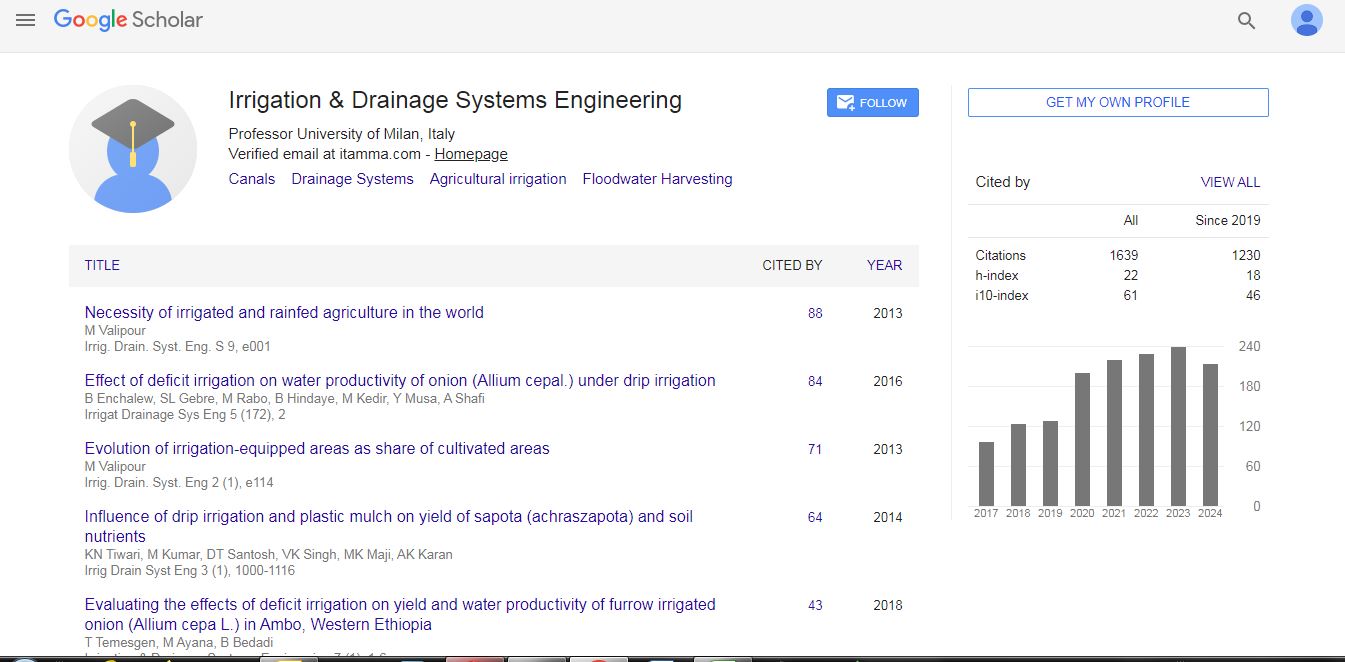
Irrigation & Drainage Systems Engineering received 835 citations as per Google Scholar report