Perspective - (2025) Volume 14, Issue 3
Received: 02-Jun-2025, Manuscript No. jnc-25-171661;
Editor assigned: 04-Jun-2025, Pre QC No. P-171661;
Reviewed: 16-Jun-2025, QC No. Q-171661;
Revised: 23-Jun-2025, Manuscript No. R-171661;
Published:
30-Jun-2025
, DOI: 10.37421/2167-1168.2025.14.711
Citation: Arturo, Jeanette. “Smart Care: The Role of AI in Enhancing Patient Monitoring and Outcomes.” *J Nurs Care* 14 (2025): 711.
Copyright: © 2025 Arturo J. This is an open-access article distributed under the terms of the Creative Commons Attribution License, which permits unrestricted use, distribution and reproduction in any medium, provided the original author and source are credited.
AI in healthcare encompasses machine learning, natural language processing, predictive algorithms and robotics each contributing uniquely to clinical decision-making and patient management. With the growing availability of health data through Electronic Health Records (EHRs), biosensors and smart devices, AI systems are capable of identifying subtle physiological changes that might precede clinical deterioration. AI-powered wearable devices track vital signs such as heart rate, oxygen saturation, temperature and glucose levels in real time. These tools alert nurses and clinicians to deviations from baseline before critical thresholds are reached. For example, AI algorithms can predict sepsis in hospitalized patients several hours before traditional clinical signs appear, allowing for early intervention and reduced mortality. Predictive models help nurses anticipate patient deterioration, pressure ulcer formation, or falls by analyzing trends in mobility, vitals and behavioral data. In Intensive Care Units (ICUs), AI systems assist in managing alarm fatigue by filtering false alerts and highlighting meaningful deviations. This allows nurses to prioritize care efficiently and focus on high-risk patients [2].
AI-driven virtual assistants provide 24/7 support for patients and nursing staff. These tools can answer routine queries, schedule medication reminders and offer patient education. In home care, AI chatbots support chronic disease management, ensuring continuity of care and reducing unnecessary hospital readmissions. For nurses, such systems offload administrative burden and allow more time for direct patient care. AI systems integrate with EHRs to provide evidence-based recommendations, detect medication errors and ensure adherence to clinical guidelines. This real-time decision support enhances nursing accuracy and patient safety. Moreover, AI supports personalized care plans by identifying patient-specific risks and outcomes, enabling nurses to tailor interventions. While the benefits of AI in nursing are considerable, ethical concerns related to data privacy, algorithmic bias and the nurse-patient relationship must be addressed. Nurses must advocate for transparent AI systems that respect patient autonomy and confidentiality. Additionally, continuous training in AI literacy is essential for nurses to confidently utilize these tools in practice [3].
The future of nursing includes working alongside AI systems rather than replacing human judgment. Nurses must collaborate with IT professionals and clinical data scientists to design, evaluate and refine AI applications. In this evolving landscape, nursing input ensures that patient-centered values remain central to technologically enhanced care. Artificial Intelligence (AI) is rapidly reshaping healthcare by enabling smarter, more proactive patient monitoring and improving clinical outcomes. In patient care, AI-driven tools can continuously analyze vast amounts of data from electronic health records, wearable devices and remote monitoring systems to detect early signs of deterioration, predict complications and support timely interventions. This allows nurses and healthcare professionals to focus on critical decision-making, optimize resource allocation and deliver care that is both precise and timely. By integrating AI into routine monitoring, healthcare teams can reduce hospital readmissions, prevent adverse events and enhance overall patient safety. Beyond real-time monitoring, AI also contributes to improved patient outcomes through predictive analytics, workflow optimization and personalized care recommendations. AI-powered decision support systems can assist clinicians in medication management, chronic disease monitoring and early detection of conditions such as sepsis or heart failure. Additionally, virtual assistants and chatbots provide patients with timely guidance, reminders and education, fostering engagement and adherence to treatment plans. While the adoption of AI requires careful attention to ethical considerations, data privacy and the need for clinician oversight, its potential to enhance efficiency, accuracy and patient-centered care is substantial. By embracing AI responsibly, healthcare systems can achieve smarter, safer and more effective patient care [4-5].
Google Scholar Cross Ref Indexed at
Google Scholar Cross Ref Indexed at
Google Scholar Cross Ref Indexed at
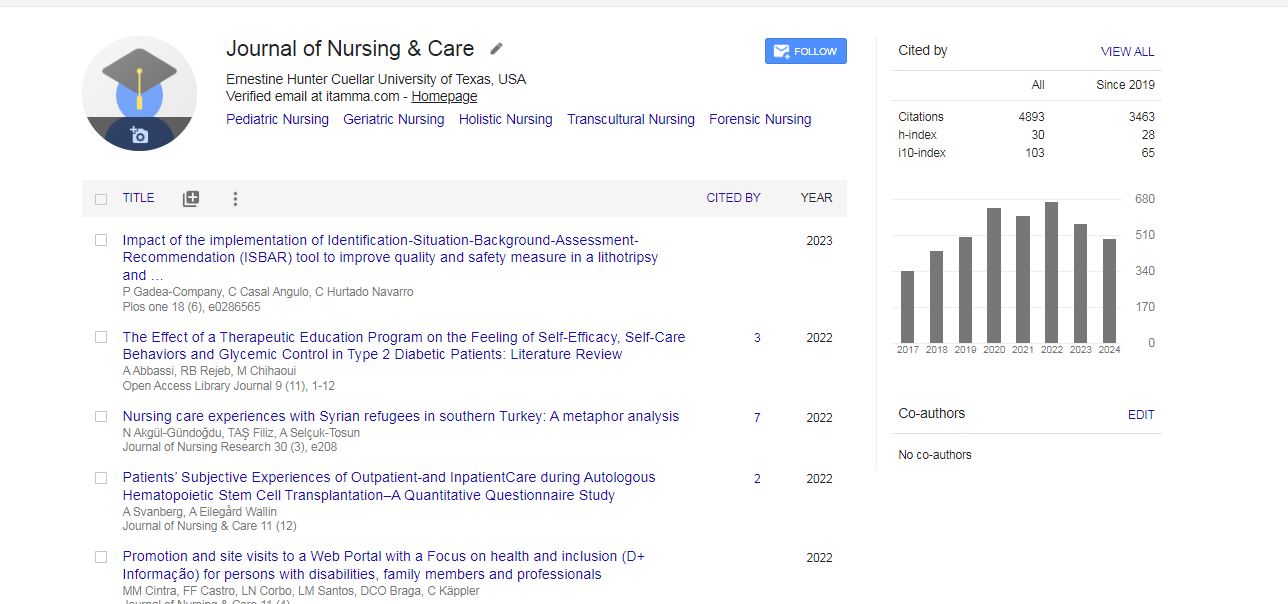
Journal of Nursing & Care received 4230 citations as per Google Scholar report