Short Communication - (2025) Volume 14, Issue 3
Received: 01-Jun-2025, Manuscript No. idse-26-182818;
Editor assigned: 03-Jun-2025, Pre QC No. P-182818;
Reviewed: 17-Jun-2025, QC No. Q-182818;
Revised: 23-Jun-2025, Manuscript No. R-182818;
Published:
30-Mar-2025
, DOI: 10.37421/2168-9768.2025.14.495
Citation: Becker, Thomas. ”Smart Agriculture: Water Management
Innovations for Sustainability.” Irrigat Drainage Sys Eng 14 (2025):495.
Copyright: © 2025 Becker T. This is an open-access article distributed under the terms of the Creative Commons Attribution License, which permits unrestricted use,
distribution and reproduction in any medium, provided the original author and source are credited.
Efficient irrigation water distribution and drainage system management are paramount for ensuring agricultural productivity and environmental sustainability. Recent advancements in sensor technologies, remote sensing, and data analytics are enabling real-time monitoring of crucial parameters like water levels, soil moisture, and water quality, paving the way for more effective management strategies [1].
The integration of machine learning and artificial intelligence is further enhancing these capabilities by optimizing water allocation, minimizing water losses, and proactively predicting potential system failures, thereby contributing to more resilient agricultural systems [1].
A newly developed smart irrigation system, incorporating IoT sensors and a cloud-based decision-support platform, has demonstrated its potential to dynamically adjust irrigation schedules based on real-time data, leading to substantial water savings and improved crop yields [2].
The research also highlights the importance of addressing data security and system reliability challenges inherent in agricultural IoT deployments [2].
Furthermore, the escalating impacts of climate change necessitate a thorough examination of agricultural drainage systems' design and operation. A framework for assessing the resilience of existing drainage networks to extreme rainfall events, along with proposed adaptation strategies, is essential for maintaining agricultural productivity in the face of evolving environmental conditions [3].
These adaptation strategies include enhancing storage capacity and improving outlet designs, emphasizing the need for integrated approaches that consider both water quantity and quality aspects [3].
Remote sensing techniques, including satellite imagery and drone-based data, are proving invaluable for monitoring the spatial and temporal dynamics of water availability and crop water stress in large-scale irrigation areas, providing high-resolution data for informed decision-making [4].
These technologies facilitate better water distribution and the implementation of deficit irrigation strategies, optimizing water use in water-scarce regions [4].
In arid and semi-arid regions, the effectiveness of various water harvesting techniques when integrated with existing irrigation systems is being evaluated. The findings underscore the significance of micro-catchment structures and small-scale storage for augmenting water supply for supplemental irrigation, thereby enhancing crop resilience to drought [5].
Such integrated approaches are crucial for adapting agricultural practices to water-limited environments [5].
The socio-economic factors influencing the adoption and success of participatory irrigation management (PIM) approaches are also under scrutiny. Community involvement in decision-making, equitable water distribution, and effective conflict resolution mechanisms are identified as key contributors to the long-term sustainability of irrigation systems [6].
Understanding these social dynamics is as critical as technological advancements for successful water management [6].
The impact of different drainage design criteria on the efficiency of tile drainage systems in controlling soil salinity and improving crop performance is a significant area of research. Optimizing drainage design requires careful consideration of soil properties, rainfall patterns, and crop water requirements [7].
Effective drainage design directly impacts soil health and crop productivity, making it a critical component of sustainable agriculture [7].
Advancements in sensor networks and real-time data acquisition are revolutionizing water quality monitoring in irrigation and drainage channels. These technologies play a vital role in detecting pollution sources, assessing water suitability for irrigation, and managing water quality to protect agricultural ecosystems [8].
The proactive management of water quality is essential for preventing long-term environmental degradation and ensuring the viability of agricultural production [8].
The application of artificial intelligence and machine learning algorithms is showing great promise in optimizing the operation of large-scale irrigation distribution networks. Predictive models can accurately forecast water demand, identify leaks, and enhance water delivery efficiency, leading to considerable water and energy savings [9].
These sophisticated analytical tools are transforming the efficiency and sustainability of water resource management in agriculture [9].
Finally, the role of subsurface drainage in mitigating waterlogging and enhancing soil health in rice-based cropping systems is being investigated. Optimal depth and spacing of drainage systems are crucial for improving aeration, reducing salinity, and promoting root development, ultimately leading to increased crop yields and reduced environmental impact [10].
Addressing waterlogging and salinity through effective subsurface drainage is fundamental to maintaining soil fertility and maximizing crop production in susceptible areas [10].
Efficient irrigation water distribution and drainage system management are critical pillars supporting agricultural productivity and environmental sustainability. Advances in sensor technologies, coupled with sophisticated remote sensing and data analytics, are now enabling real-time monitoring of essential parameters such as water levels, soil moisture content, and water quality. These technological strides are fundamental to developing more responsive and effective water management strategies in agriculture [1].
Furthermore, the incorporation of machine learning and artificial intelligence is significantly amplifying these capabilities. These advanced computational approaches are instrumental in optimizing water allocation decisions, minimizing water losses through improved system control, and proactively forecasting potential system failures, thereby contributing to the overall resilience and efficiency of agricultural water infrastructure [1].
A notable development in this field is a newly developed smart irrigation system that skillfully integrates the power of IoT sensors with a robust cloud-based decision-support platform. This integrated system demonstrates the ability to dynamically adjust irrigation schedules in response to a multitude of real-time data inputs, including soil moisture levels and weather forecasts, leading to quantifiable water savings and demonstrably improved crop yields [2].
However, the widespread implementation of such advanced systems necessitates a careful consideration and proactive addressing of the inherent challenges related to data security and overall system reliability within the context of agricultural IoT deployments [2].
In parallel, the escalating and undeniable impacts of climate change are compelling a critical re-evaluation of the design and operational paradigms of agricultural drainage systems. Researchers are developing frameworks specifically designed to assess the resilience of existing drainage networks when confronted with increasingly frequent and intense extreme rainfall events. Proposed adaptation strategies, which include enhancing water storage capacity and refining outlet designs, are vital for maintaining agricultural viability in the face of evolving environmental conditions [3].
These adaptation measures underscore a critical need for integrated approaches that holistically consider both the quantity and quality of water within the agricultural landscape [3].
Remote sensing techniques, encompassing sophisticated satellite imagery analysis and data acquisition from drones, are emerging as indispensable tools for monitoring the intricate spatial and temporal dynamics of water availability and crop water stress across extensive irrigation areas. The high-resolution data generated by these methods provides a crucial foundation for informed decision-making regarding water distribution strategies and the implementation of deficit irrigation approaches [4].
These advanced monitoring capabilities empower land managers to optimize water use, particularly in water-scarce regions, by providing precise information on crop water needs and soil moisture conditions [4].
For regions characterized by arid and semi-arid climates, the evaluation of various water harvesting techniques and their synergistic integration with established irrigation systems is of paramount importance. This research highlights the crucial role of micro-catchment structures and the strategic deployment of small-scale storage facilities in augmenting water supply for supplemental irrigation purposes. Such practices are vital for enhancing crop resilience, particularly during periods of drought stress [5].
The successful implementation of these integrated water management strategies is key to ensuring agricultural stability in environments prone to water scarcity [5].
The socio-economic factors that profoundly influence the adoption and ultimate success of participatory irrigation management (PIM) approaches are also a significant area of investigation. The research indicates that active community involvement in decision-making processes, coupled with the establishment of equitable water distribution mechanisms and effective conflict resolution frameworks, are fundamental contributors to the long-term sustainability and operational effectiveness of irrigation systems [6].
A deeper understanding of these social and economic dimensions is essential for the successful and equitable management of shared water resources [6].
The impact of different drainage design criteria on the overall efficiency of tile drainage systems, particularly in their role of reducing soil salinity and enhancing crop performance, is another critical research focus. The study emphasizes the necessity of meticulously considering specific soil properties, prevailing rainfall patterns, and the precise water requirements of the crops being cultivated when optimizing drainage system design [7].
Effective drainage design directly influences soil health, nutrient availability, and ultimately, crop yield potential, making it a cornerstone of productive and sustainable agricultural practices [7].
The rapid advancement of sensor networks and real-time data acquisition technologies is revolutionizing the monitoring of water quality parameters within irrigation canals and drainage channels. These innovative technologies are indispensable for accurately detecting pollution sources, rigorously assessing the suitability of water for irrigation purposes, and effectively managing water quality to safeguard valuable agricultural ecosystems [8].
Proactive and informed water quality management is essential to prevent the long-term degradation of water resources and to ensure the continued viability of agricultural production systems [8].
The application of artificial intelligence and machine learning algorithms is demonstrating significant potential for optimizing the operational efficiency of large-scale irrigation distribution networks. Predictive modeling capabilities allow for accurate forecasting of water demand, early detection of leaks within the system, and substantial improvements in the overall efficiency of water delivery, resulting in considerable water and energy savings [9].
These sophisticated analytical tools represent a paradigm shift in how water resources can be managed more effectively and sustainably in agricultural settings [9].
Finally, the critical role of subsurface drainage in mitigating the detrimental effects of waterlogging and concurrently improving soil health within specific cropping systems, such as rice-based systems, is a key area of ongoing investigation. The research findings focus on identifying the optimal depth and spacing of drainage systems, which are crucial for enhancing soil aeration, effectively reducing salinity levels, and promoting robust root development, ultimately leading to increased crop yields and a reduced overall environmental footprint [10].
Addressing challenges like waterlogging and soil salinity through well-designed subsurface drainage systems is fundamental to maintaining long-term soil fertility and maximizing crop production potential in affected agricultural regions [10].
This collection of research highlights advancements in agricultural water management and drainage systems, driven by technological innovation and a focus on sustainability. Key areas of development include real-time monitoring using sensor technologies, remote sensing, and data analytics, enhanced by machine learning and artificial intelligence for optimized water allocation and system efficiency. Smart irrigation systems are improving water savings and crop yields by dynamically adjusting schedules based on environmental data. The impact of climate change on drainage systems is being addressed through resilience assessments and adaptation strategies. Water harvesting techniques are being integrated for supplemental irrigation, particularly in arid regions. The social and economic aspects of participatory irrigation management are recognized as crucial for system sustainability. Research also focuses on optimizing drainage design for soil salinity control and waterlogging mitigation, and the use of advanced sensor networks for real-time water quality monitoring. Artificial intelligence is being applied to optimize large-scale irrigation distribution networks, leading to significant water and energy savings. Subsurface drainage plays a vital role in managing waterlogging and improving soil health in specific cropping systems.
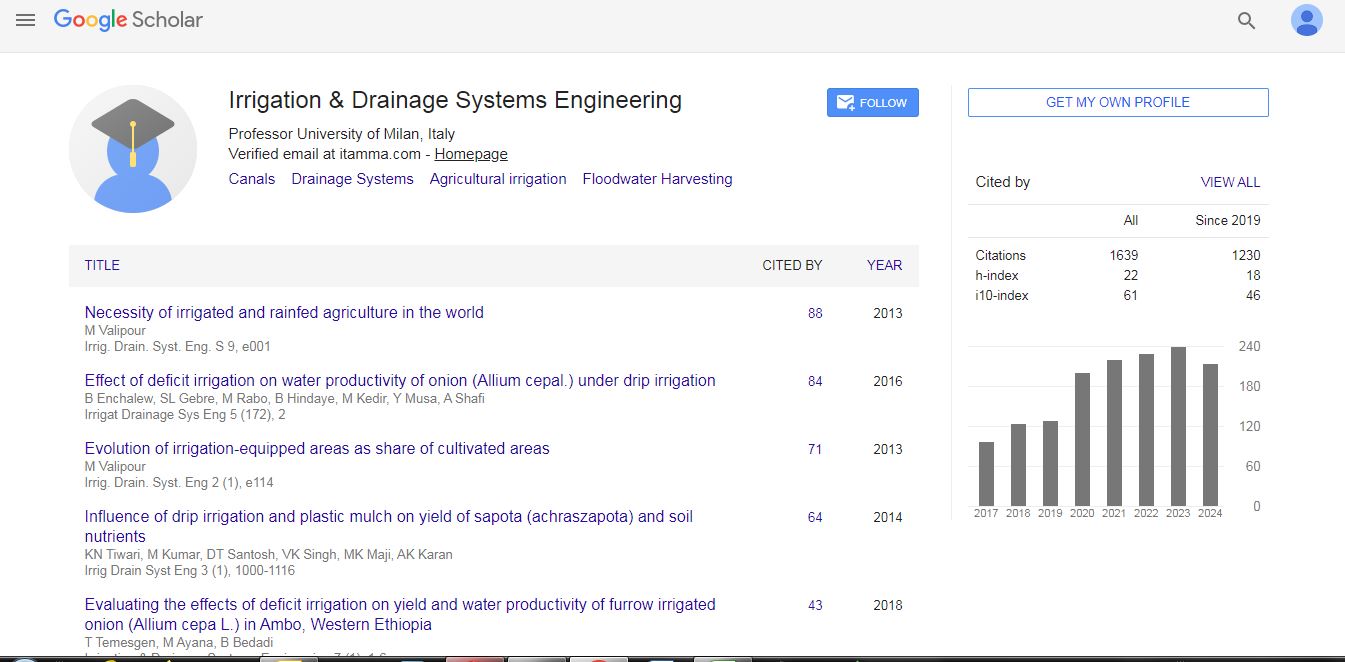
Irrigation & Drainage Systems Engineering received 835 citations as per Google Scholar report