Short Communication - (2025) Volume 16, Issue 3
Received: 02-Jun-2025, Manuscript No. csj-26-183445;
Editor assigned: 04-Jun-2025, Pre QC No. P-183445;
Reviewed: 18-Jun-2025, QC No. Q-183445;
Revised: 23-Jun-2025, Manuscript No. R-183445;
Published:
30-Jun-2025
, DOI: 10.37421/2160-3494.2025.16.462
Citation: Molina, Andrés. ”Small Molecules: Diverse Roles in Biology and Therapeutics.” Chem Sci J 16 (2025):462.
Copyright: © 2025 Molina A. This is an open-access article distributed under the terms of the Creative Commons Attribution License, which permits unrestricted use, distribution and reproduction in any medium, provided the original author and source are credited.
Small molecules are indispensable components within biological systems, performing critical roles as signaling mediators, enzyme inhibitors, and substrates. Their precise design allows for the perturbation and elucidation of intricate biological pathways, making them invaluable tools in drug discovery and chemical biology research. The inherent specificity and potency of synthetic small molecules provide researchers with precise instruments for biological interrogation, enabling a deeper understanding of cellular processes and disease mechanisms. These molecules act as versatile probes, facilitating the dissection of complex molecular interactions and cellular functions, thereby advancing our knowledge of life at the molecular level [1].
The mechanism of action for novel small molecule inhibitors targeting key protein kinases in cancer cell proliferation is a significant area of investigation. Understanding the structural basis for such inhibition, coupled with robust in vitro and in vivo data, is crucial for developing effective therapeutic agents. The demonstration of significant anti-tumor activity highlights the potential of these small molecules to serve as promising candidates for cancer treatment, offering targeted approaches with potentially reduced side effects [2].
Small molecule probes have emerged as powerful tools for visualizing and quantifying protein-protein interactions within cellular signaling networks. By employing fluorescently labeled small molecules, researchers can achieve real-time observation of these dynamic interactions. This capability provides critical insights into cellular dynamics and the underlying mechanisms of various diseases, opening new avenues for diagnostic and therapeutic development [3].
The regulation of gene expression through epigenetic modifications by small molecule metabolites is another crucial aspect of cellular control. Identifying specific metabolites that can influence the activity of enzymes involved in DNA methylation and histone modification is key to understanding how these processes alter the transcriptional landscape and, consequently, cellular phenotype. This area holds significant promise for understanding and potentially modulating disease states [4].
The development of small molecule-based therapeutics for neurodegenerative diseases represents a critical frontier in medical research. The design of compounds that can effectively cross the blood-brain barrier and modulate protein aggregation, a hallmark of diseases such as Alzheimer's, is a challenging yet vital endeavor. Promising pre-clinical data in animal models offer a glimmer of hope for future treatments [5].
Modulating immune responses with small molecules is central to advancing treatments for autoimmune diseases and cancer immunotherapy. Specific small molecule agonists and antagonists can be strategically employed to fine-tune the activity of immune cells, offering novel therapeutic interventions. This precise control over immune cell function is essential for developing effective immunomodulatory therapies [6].
The integration of small molecule libraries with high-throughput screening methodologies is instrumental in identifying novel chemical probes for challenging biological targets. Addressing the challenges and implementing effective strategies in designing diverse and relevant compound collections, along with optimizing screening assays for biological relevance, is paramount for success in this field [7].
The design and synthesis of small molecules that mimic natural products represent a significant effort to harness their inherent biological activities for therapeutic purposes. The intricate chemical structures of natural products pose substantial synthetic challenges, yet their replication and functional characterization are essential for unlocking their full therapeutic potential [8].
Small molecules serve as critical chemical tools for dissecting signaling pathways in plants, offering insights into plant growth, development, and stress responses. The use of specific inhibitors and activators provides a means to understand these complex processes, with potential implications for enhancing agricultural productivity and sustainability [9].
Chemical genetics, significantly empowered by the capabilities of small molecules, offers a potent approach for perturbing gene function and studying complex biological processes. The synergy between chemical biology and genomics facilitates the uncovering of gene function and the identification of valuable therapeutic targets, paving the way for innovative research and clinical applications [10].
Small molecules are fundamental players in biological systems, acting as signaling mediators, enzyme inhibitors, and substrates. This research explores how carefully designed small molecules can be utilized to perturb and understand complex biological pathways, with a focus on applications in drug discovery and chemical biology research. The work highlights the specificity and potency achievable with synthetic small molecules, offering precise tools for biological interrogation. This approach allows for a detailed examination of molecular mechanisms and interactions, providing a foundation for developing targeted therapies and advancing fundamental biological knowledge [1].
This article delves into the mechanism of action of a novel small molecule inhibitor targeting a key protein kinase involved in cancer cell proliferation. It details the structural basis for inhibition and presents in vitro and in vivo data demonstrating significant anti-tumor activity. The findings suggest potential for this small molecule as a therapeutic agent, underscoring the importance of structure-activity relationships and rigorous preclinical evaluation in drug development for oncological indications [2].
The study investigates the use of small molecule probes to elucidate protein-protein interactions within cellular signaling networks. By synthesizing and employing fluorescently labeled small molecules, researchers can visualize and quantify these interactions in real-time, providing critical insights into cellular dynamics and disease mechanisms. This advanced imaging capability allows for the dynamic observation of molecular events, offering a deeper understanding of cellular communication and regulation [3].
This paper explores the role of small molecule metabolites in regulating gene expression through epigenetic modifications. It identifies specific metabolites that can influence the activity of enzymes involved in DNA methylation and histone modification, thereby altering the transcriptional landscape and cellular phenotype. This reveals a critical link between metabolic state and epigenetic control of gene expression, impacting cellular identity and function [4].
The research focuses on the development of small molecule-based therapeutics for neurodegenerative diseases. It presents a novel compound that can cross the blood-brain barrier and modulate protein aggregation, a hallmark of diseases like Alzheimer's. Pre-clinical data demonstrate promising results in animal models, suggesting a viable strategy for targeting the underlying pathology of these devastating conditions [5].
This study explores the application of small molecules in modulating immune responses, particularly in the context of autoimmune diseases and cancer immunotherapy. It details how specific small molecule agonists and antagonists can fine-tune the activity of immune cells, offering new avenues for therapeutic intervention. Precise control over immune cell function is crucial for restoring immune balance and enhancing anti-tumor immunity [6].
The article examines the integration of small molecule libraries with high-throughput screening to identify novel chemical probes for challenging biological targets. It discusses the challenges and strategies in designing diverse and relevant compound collections and optimizing screening assays for biological relevance. This approach accelerates the discovery of molecules that can interact with specific biological targets with high affinity and selectivity [7].
This paper discusses the design and synthesis of small molecules that mimic natural products, aiming to harness their biological activities for therapeutic purposes. It highlights the intricate chemical structures of natural products and the challenges in their synthetic replication and functional characterization. This endeavor seeks to leverage the evolutionary wisdom embedded in natural products for human health [8].
The research investigates the use of small molecules as chemical tools to dissect signaling pathways in plants. It describes how specific inhibitors and activators can be used to understand plant growth, development, and stress responses, with potential implications for agricultural applications. This work provides a molecular basis for understanding plant physiology and improving crop resilience [9].
This paper reviews the advancements in the field of chemical genetics, focusing on the power of small molecules to perturb gene function and study complex biological processes. It highlights the synergy between chemical biology and genomics in uncovering gene function and identifying therapeutic targets. This integrated approach enhances our ability to decipher the genetic architecture of life and its associated diseases [10].
This collection of research explores the multifaceted roles and applications of small molecules across various biological disciplines. Studies highlight their utility as precise tools for dissecting cellular pathways, acting as signaling mediators, enzyme inhibitors, and substrates. Novel small molecule inhibitors are being developed for targeted cancer therapy by inhibiting key protein kinases. Furthermore, small molecules serve as fluorescent probes for visualizing protein interactions, and as metabolites that regulate gene expression through epigenetic modifications. Significant efforts are directed towards developing small molecule therapeutics for neurodegenerative diseases, including compounds that can cross the blood-brain barrier. The modulation of immune responses using small molecules is also a key focus for treating autoimmune diseases and advancing cancer immunotherapy. Advancements in high-throughput screening and the design of small molecule libraries aid in identifying novel chemical probes for challenging biological targets. Research also involves mimicking natural products with synthetic small molecules to harness their therapeutic potential and using small molecules to probe plant signaling pathways for agricultural applications. The field of chemical genetics leverages small molecules to understand gene function and identify therapeutic targets, showcasing their broad impact from fundamental research to therapeutic development.
None
None
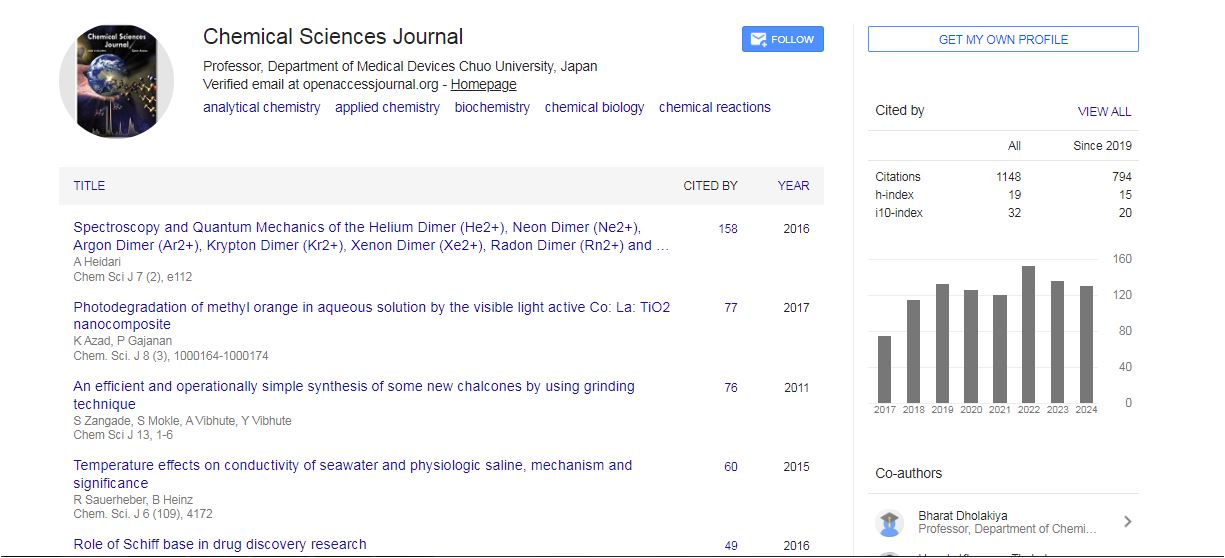
Chemical Sciences Journal received 912 citations as per Google Scholar report