Brief Report - (2025) Volume 14, Issue 4
Received: 01-Jul-2025, Manuscript No. iem-26-179796;
Editor assigned: 03-Jul-2025, Pre QC No. P-179796;
Reviewed: 14-Jul-2025, QC No. Q-179796;
Revised: 22-Jul-2025, Manuscript No. R-179796;
Published:
29-Jul-2025
, DOI: 10.37421/2169- 0316.2025.14.307
Citation: Pereira, Ana.Simulation: Optimize Industrial Systems For Efficiency. J Ind Eng Manag 14 (2025):307.
Copyright: © 2025 Pereira A. This is an open-access article distributed under the terms of the Creative Commons Attribution License, which permits unrestricted use,
distribution and reproduction in any medium, provided the original author and source are credited.
Simulation and modeling are fundamental tools for enhancing industrial systems, offering a virtual environment for testing, analyzing, and optimizing processes prior to their physical implementation. This approach is instrumental in identifying operational bottlenecks and evaluating various strategies to predict system performance under diverse conditions, ultimately leading to cost reduction and efficiency improvements in industrial operations [1].
The application of discrete-event simulation to supply chain optimization provides critical insights into inventory management, logistics, and network design. By modeling complex interactions and uncertainties, businesses can gain a better understanding of lead times, service levels, and total costs, fostering more resilient and efficient supply chains [2].
Agent-based modeling presents a powerful methodology for simulating intricate industrial systems where individual entities interact and adapt dynamically. This approach is particularly valuable for investigating emergent behaviors in areas such as factory floor scheduling, human-robot collaboration, and market dynamics within industrial ecosystems [3].
Digital twins, which leverage real-time data and sophisticated simulation models, are revolutionizing industrial maintenance and operations. They facilitate predictive maintenance, remote monitoring, and performance optimization by creating a virtual replica of a physical asset or system, thereby enabling proactive problem-solving and extending operational longevity [4].
The integration of machine learning with simulation models offers a significant enhancement in the accuracy and adaptability of industrial system predictions. Machine learning algorithms can learn from both simulation outputs and real-world data to refine models, leading to more precise forecasting of demand, resource utilization, and potential equipment failures [5].
Simulation-based optimization techniques are indispensable for determining optimal operating parameters within complex industrial processes. These methods combine simulation with advanced optimization algorithms to systematically explore the solution space, identifying configurations that maximize key performance metrics such as throughput or energy efficiency [6].
The utilization of stochastic simulation models is vital for accurately capturing the inherent randomness and variability present in industrial systems, including factors like equipment failures, fluctuating demand, and unpredictable processing times. These models offer a more realistic representation of system behavior, supporting robust decision-making in uncertain environments [7].
Modeling and simulation play a crucial role in the design and validation of flexible manufacturing systems. They empower engineers to evaluate diverse layouts, automation levels, and production schedules, ensuring the system's ability to adapt efficiently to changing product demands and manufacturing requirements [8].
High-performance computing and cloud-based simulation platforms are now making it possible to undertake more complex and large-scale modeling of industrial systems. This advancement facilitates the simulation of intricate supply networks, extensive factory floors, and complex multi-agent systems that were previously considered computationally intractable [9].
The rigorous verification and validation of simulation models are paramount to ensuring their reliability and trustworthiness for industrial decision-making. Comprehensive V&V processes, encompassing data validation, expert review, and comparison with real-world performance, are essential for building confidence in simulation-derived recommendations [10].
Simulation and modeling provide a virtual environment essential for the testing, analysis, and optimization of industrial processes before their physical implementation. This methodology is critical for identifying bottlenecks, assessing different operational strategies, and forecasting system performance under various scenarios, ultimately leading to reduced costs and enhanced efficiency in industrial operations [1].
Discrete-event simulation is increasingly applied to optimize supply chains, offering profound insights into inventory management, logistics, and network design. By meticulously modeling complex interactions and inherent uncertainties, businesses can achieve a superior understanding of lead times, service levels, and overall costs, contributing to the development of more robust and efficient supply chains [2].
Agent-based modeling emerges as a powerful technique for simulating industrial systems characterized by the dynamic interactions and adaptive behaviors of individual entities. Its utility is particularly pronounced in studying emergent phenomena within contexts such as factory floor scheduling, human-robot collaboration, and the intricate market dynamics of industrial ecosystems [3].
Digital twins, underpinned by real-time data streams and sophisticated simulation models, are fundamentally transforming industrial maintenance and operational management. They enable advanced capabilities such as predictive maintenance, remote monitoring, and performance optimization through the creation of virtual replicas of physical assets, thereby facilitating proactive issue resolution and extending system longevity [4].
The synergy between machine learning and simulation models significantly boosts the accuracy and adaptability of predictions for industrial systems. Machine learning algorithms can effectively learn from simulation outputs and actual operational data to refine models, resulting in more precise forecasts for demand, resource allocation, and potential failure events [5].
Simulation-based optimization methodologies are indispensable for identifying optimal operating parameters in complex industrial processes. These approaches integrate simulation with advanced optimization algorithms to systematically explore the entire solution space, pinpointing configurations that maximize critical performance indicators like throughput and energy efficiency [6].
Stochastic simulation models are crucial for accurately reflecting the inherent randomness and variability found in industrial systems, encompassing factors such as equipment downtime, fluctuating customer demand, and unpredictable processing durations. Such models offer a more realistic depiction of system dynamics, enabling more resilient decision-making in the face of uncertainty [7].
The design and validation of flexible manufacturing systems heavily rely on modeling and simulation techniques. These tools allow engineers to thoroughly evaluate various potential layouts, levels of automation, and production sequences, ensuring the system possesses the requisite agility to adapt efficiently to evolving product demands and manufacturing requirements [8].
The advent of high-performance computing and cloud-based simulation platforms is expanding the scope for complex, large-scale modeling of industrial systems. This technological advancement permits the simulation of highly intricate supply networks, expansive factory operations, and complex multi-agent systems that were previously beyond computational reach [9].
Ensuring the reliability and trustworthiness of simulation models for industrial decision-making hinges on rigorous verification and validation processes. Comprehensive V&V, including meticulous data checks, expert assessments, and comparisons against real-world performance data, is essential for establishing confidence in the outcomes derived from simulation studies [10].
Simulation and modeling are critical for enhancing industrial systems by providing virtual environments for testing, analysis, and optimization. This approach identifies bottlenecks, evaluates strategies, and predicts performance, leading to reduced costs and improved efficiency. Discrete-event simulation aids supply chain optimization, while agent-based modeling handles complex interactions. Digital twins enable predictive maintenance and remote monitoring. Machine learning integration enhances model accuracy, and simulation-based optimization finds optimal parameters. Stochastic models capture system variability for robust decision-making. Flexible manufacturing systems benefit from simulation-driven design. High-performance computing and cloud platforms enable larger-scale simulations. Rigorous verification and validation are essential for model trustworthiness.
None
None
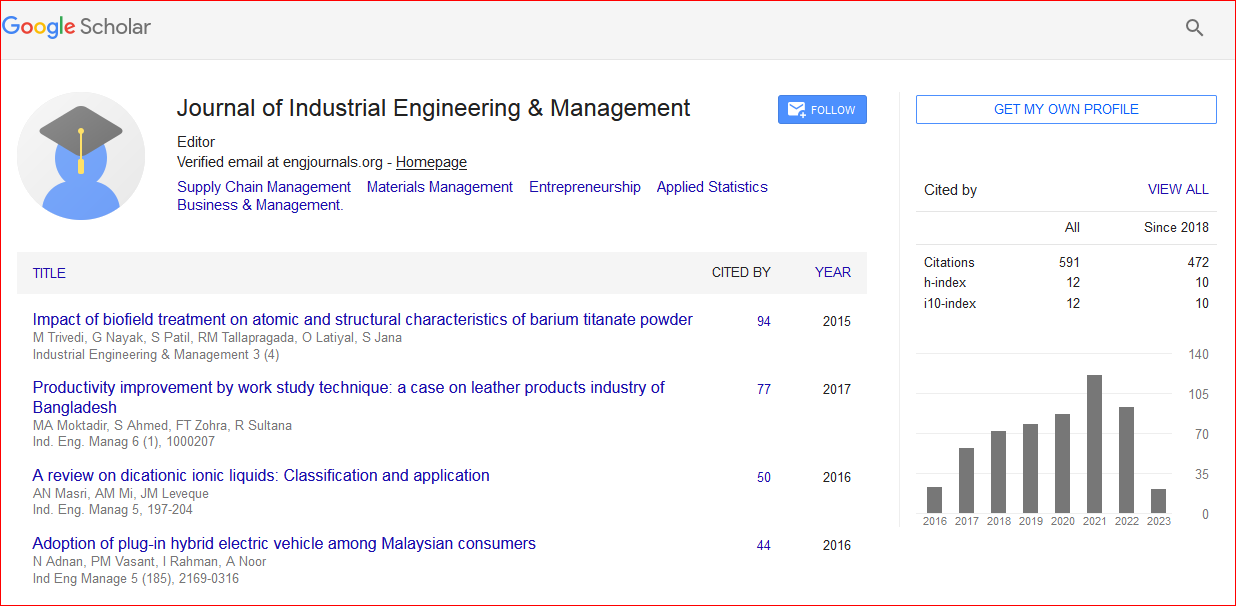
Industrial Engineering & Management received 739 citations as per Google Scholar report