Research Article - (2025) Volume 14, Issue 2
Received: 16-Jun-2024, Manuscript No. JME-24-139129 ;
Editor assigned: 18-Jun-2024, Pre QC No. JME-24-139129 (PQ);
Reviewed: 02-Jul-2024, QC No. JME-24-139129 ;
Revised: 06-May-2025, Manuscript No. JME-24-139129 (R);
Published:
13-May-2025
, DOI: 10.37421/2169-0022.2025.14.697
Citation: S. Omprakasam, R. Raghu, V. Srinivasan and T. Velmurugan. "Simulation Behaviour of Aluminium Alloy AA5052 Alloys During Tungsten Inert Gas Welding." J Material Sci Eng 14 (2025): 697.
Copyright: © 2025 Omprakasam S, et al. This is an open-access article distributed under the terms of the creative commons attribution license which permits unrestricted use, distribution and reproduction in any medium, provided the original author and source are credited.
Aluminium alloys (5xxx series) are utilised in the aerospace, marine, and automotive industries as an alternative to steel owed to its light weight, good formability, high strength, and great corrosion resistance. The current work is an experimental investigation into the heat transmission behaviour of AA5052 plates during TIG welding. ANSYS finite element analysis software is used to create a three-dimensional transient study. The numerically simulated findings are compared to the experimental data. The numerical simulation results are more consistent with the experimental data.
TIG • Aluminium alloy • Heat transfer • Simulation
Aluminium alloys were thought to be resistant to hydrogen embrittlement. However, it has been discovered that many highstrength aluminium alloys are susceptible to environment-assisted cracking, with hydrogen embrittlement being one possible mechanism. Aluminium alloys, in their various tempers, are now used in a wide range of welding procedures. It is critical to understand the differences between the various alloys available, as well as their different performances and weldability characteristics. When developing arc weld procedures for these weldability alloys, the specific alloy being welded must be taken into account. It is frequently stated that arc welding with aluminium is not difficult; it is simply different. It is thought that becoming acquainted with the various alloys is an important part of understanding differences [1-3]. Vishnu, et al. created a 3D thermo-mechanical simulation model to determine the distribution of temperature and residual stresses during the symmetrical and asymmetrical TIG welding process parameters (welding current and welding speed) on a low carbon steel plate. Kolhe and Wavale made a study on two pass AA7020 aluminium alloys in accordance with British welding standards. Mechanical performance of multiphase welded joint has been tested and reported, including tensile strength, hardness, and impact strength [4,5]. The analysis was performed using the FEM solver ABACUS to determine the temperature distribution, stress and strain of welding. According to the results, residual stresses result from tensile stress acting at the weld and compressive strength acting at the heat affected zone. In this study, examining the relationship between welding current, arc voltage, and welding speed on the mechanical and microstructural properties of joints of 7xxx aluminium alloy in industrial applications is done. Investigated the modelling by finite elements of heat transfer and Von Mises stress field and simulation of the tensile test when applying Friction Stir Welding (FSW) and classical Tungsten Inert Gas (TIG) welding at aluminium alloy AA 6082-T6 butt joints performing. The results shows that tensile strength of TIG welded joints represents 66% from that of the parent metal, in the case of FSW butt joints the tensile strength is reaching about 75% compared to tensile strength of base metal [6,7]. Discovered that high stress and the establishment of an equiaxed zone both contribute to the formation of shear fractures in T-joints in response to microstructure, defects, and stress distribution.
Using a Gaussian heat source, Ismail and Afieq simulated the MIG welding process by using the nonlinear finite element method [8]. Temperature distribution and weld geometry were compared to experimental data, revealing that voltage and welding speed had a substantial impact on the temperature distribution and the size and shape of the fillet bead. Rong discussed strain gauges as measuring transient strain [9]. In welding processes, longitudinal strain starts as fluctuating compression and develops to residual tension at the beginning and end of each process. Experimental and simulation residual strains were found to be 842.0 and 826.8, respectively, with a relative error of 1.805 percent at the starting position and 17.986 percent at the finishing position. A three-dimensional simulation of the welding process of aluminum thin plates using ANASYS software was performed. Vishwanath, et al. investigated the heat transfer behavior during friction stir welding of AA5052-AA6061 plates by comparing experimental temperatures with ANSYS finite element analysis [10]. According to the temperature contours, both aluminum alloys have similar heat distribution due to their similar thermal properties.
Using a 3D Finite Element (FE) numerical model of 304 stainless steel [11]. Investigated the effect of welding heat input on temperature and residual stresses. Based on the simulated temperature result, the magnitude of peak temperature at a distance of 10 mm from the weld line is influenced by heat input. Peak temperatures increase as heat input increases, and Simulation results indicate that longitudinal residual stresses decrease as heat input increases. As the heat input increases, residual tensile and compressive stresses decrease. Transverse residual stresses also decrease with heat input. This study proposes a computational method to predict welding deformation. The numerical finite element model developed [12]. Was used to determine heat distribution and thermal fields during hybrid laser welding of AA5456 and AA6061 alloys. In both simulations and experiments, it is found that when the laser and arc are separated by a critical distance (8–14.5 mm), the plasma arc and laser act at different locations, causing the concentration of the arc to increase, increasing penetration depth, heat input, and weld pool volume. In an experimental study, Chao and Qi developed a moving heat source model by using FEA to validate temperature curves with the experimental and evaluate residual stresses and distortions in FSW [13]. During this study, both the tool and the work piece were taken into account when calculating the heat transfer [14]. Examined various parameters related to TIG welding such as welding current, gas flow rate, and filler rod ER4043. The researchers concluded that the selection of a suitable filler material and optimizing the current with proper shielding are important aspects to consider during TIG welding [15]. Were carried out the effects of Heat-Affected Zone (HAZ) welding parameters on aluminium structures. The response model was employed to find the soldering parameters to minimize HAZ. Higher temperatures and lower cooling levels have been demonstrated to increase HAZ. Joseph and Muthukumaran discussed the results of optimizing GTAW pulsing current welding parameters using a simulated annealing and genetic algorithm, showing that base current, peak current, gas flow rate and welding speed have affected tensile strength and elongation [16]. The metallographic inspection showed polished grain arranged at the welding interface and a high bond resistance [17]. Addressed Aluminium Al 5052 as base material and Taguchi L9 orthogonal array for optimization process, critical process parameters were studied, namely probe shape, rotational speed and transverse speed, to optimize tensile strength [18].
In the current study, numerical investigations of heat generation on TIG welding of aluminium alloy AA 5052 were performed. In order to simulate the thermal history during FSP of copper, ANSYS 11.0 software was used to develop a 3D, transient, non-linear thermal model with moving heat source. Results obtained from numerical simulation data to confirm the simulation's accuracy.
Experimental investigations
Base material used in this research was AA5052 aluminium alloy plate 200 × 100 × 3.5 mm welded with a filler material 4043. The research studies are conducted on the experimental setup shown in Figure 1. A 350-W power AC welding machine (Kemppi) was used to carried out the bead on plate welding experiments. The experimental welding parametric condition for attaining best response is found as current of 150 A, voltage of 14 V and speed of 45 mm/sec [19].
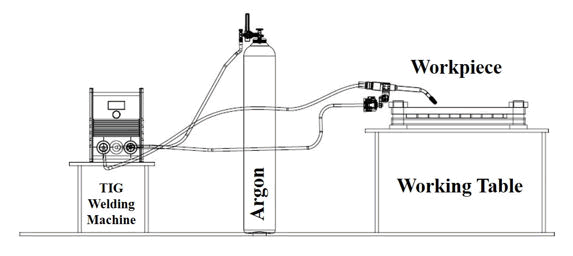
Figure 1. Experimental setup.
Workflow and consideration
The simulation in finite element to get the residual stress and distribution of temperature during the welding process. A 3D thermomechanical FEM was produced in ANSYS software. FEA approach is depicted in Figure 2. as a step-by-step process. In the welding simulation model, temperature fields and temperature history were evaluated using a transient thermal analysis. Mechanical analysis uses these thermal histories as pre-processing inputs as thermal loads to estimate residual stress distributions in weldments.
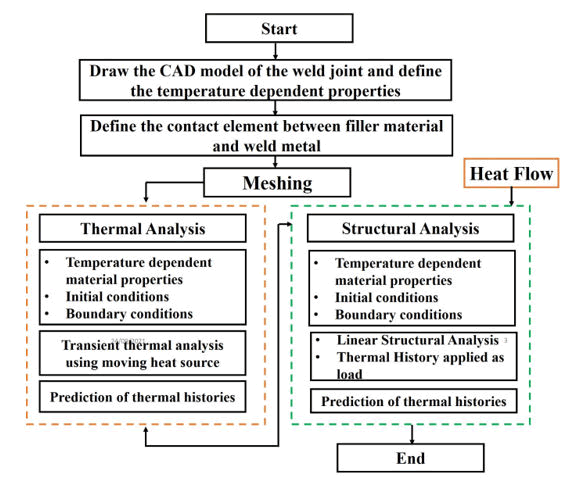
Figure 2. Schematic illustration of TIG welding numerical simulation.
Numerical modelling and FEA simulation using ANSYS
A 3D numerical model has been established and measurements have been taken, however to simulate process, bead on plate weldment should consider for the ANSYS FEA software. Temperature distribution of different AA5052 plates during TIG welding is investigated. To confirm the simulation procedure, the temperature distribution curves derived from numerical simulation are related to temperature data exiting methods inquiry.
Temperature dependent material properties
The transient temperature distribution in the weld plates is a time function and coordinate system. Temperature-dependent thermal thermal parameters such as specific heat, density and thermal conductivity are included in the heat balance equation. These material qualities are generally temperature dependant and are crucial for heat transfer studies in welding. To carry out the simulation procedure, researchers can use the ANSYS software package to specify temperature dependant properties for the materials being modelled. Table 1 lists the thermal characteristics of materials AA5052 aluminium alloys employed in this numerical simulation.
| Temp. (°C) | Density (Kg/m3) | Specific heat (KJ/kg°C) | Thermal conductivity (W/m°C) | Coefficient of thermal expansion (µ/°C) | Young’s modulus (Gpa) |
| 22 | 2700 | 0.9 | 168 | 23 | 71 |
| 280 | 2650 | 1.1 | 206.25 | 26 | 56 |
| 480 | 2605 | 1.2 | 237.5 | 28 | 22 |
| 660 | 2500 | 1.3 | 270 | 32 | 10 |
Table 1. Thermo-mechanical properties of AA5052 aluminium alloys.
Geometrical modelling and meshing
Figure 3 illustrates the 3D modeling and meshing required to simulate the welding process with a moving heat source in 3D. The work piece and the tool are both 3D modeled with the tool touching the disc face of the work piece and positioned so the tool can move during the simulation as it would do during experimentation. With 212859 nodes and 129051 elements available in ANSYS workbench, the mesh helps locate the thermocouple at the node and study the temperature distribution at the node. The dimensions are maintained for the tool and work piece used experimentally.
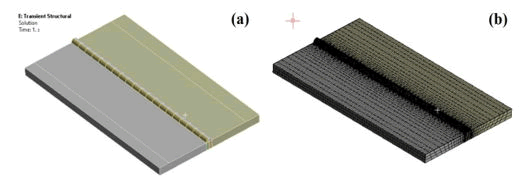
Figure 3. (a) 3D Model of the weldment, (b) Total of elements and nodes.
Temperature distribution
It is observed that during welding when electrode gets melted and its first drop of melted electrode is bead on plate weld of the base metal, it produced approximately 680°C at fusion zone. However, the temperature of base metal recorded for this section noted at room temperature was 22°C. The total length is divided into Nineteen parts. The temperature of 4 mm once should vary throughout the welding process. The weld's three-dimensional portion is depicted in Figure 4 (a) Three dimensional weldmen (b) Each 4 mm divided sections. (c) Full welding time. The peak temperature achieved while process is the beginning 10 seconds and maximum temperature and end of the welding temperature. The similar results were recorded at weld vertical axis from weld centre. The temperature of this section gets from weld vertical axis towards the base metal from left or right hand side of the vertical weld axis.
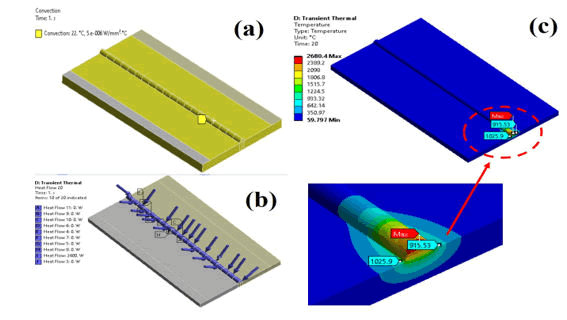
Figure 4. (a) Three dimensional weldmen, (b) Each 4 mm divided sections, (c) Full welding time.
Numerical simulation of temperature contours in aluminum alloy AA5052 plate at different time steps is shown in Figure 5 (a) 4s (b) 20s (c) 30s (d) 40s during TIG welding time around 620°C melting point of the material should maintain through out of the weldment. The above temperature difference denotes that the metal has plasticized before reaching the melting point required for TIG welding. Until the welding process is completed, a lowest temperature of 22°C to 29°C is present.
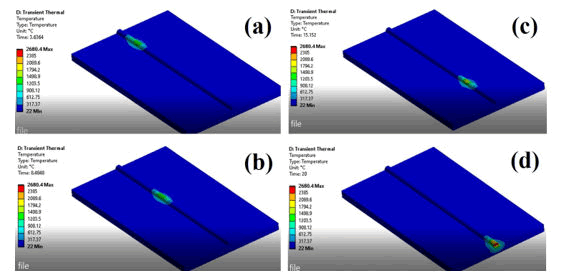
Figure 5. Bead on plate welding time steps (a) 4s (b) 20s (c) 30s (d) 40s.
Von Mises stress distribution
Applying the same analysis method, the heat transfer and Von Mises stress have been numerically investigated in order to simulate the AA5052 behaviour during welding by TIG classical procedure. Figure 6 presents a typical symmetrical temperature field achieved at TIG welding of bead on plate. Since of the large heat generated during fusion welding process, the maximum temperature is higher with approximately 200°C than in the first case. This time, the peak process temperature is about 610°C, higher compared to melting temperature of aluminium alloy, and this aspect will have an important influence on the thermomechanical behaviour of the base material, including on the stress level from the welded joint. All images Figure 7 which illustrate the temperature field contour, respectively temperature profile in the cross section of the joint and Von Mises stress field are captured at 40s. Both the temperature and Von Mises stress fields are symmetrical in comparison to those achieved in the joints obtained by TIG Welding process where the existence of proceeding and receding sides of weld leads to slight differences of the thermomechanical behaviour in these regions.
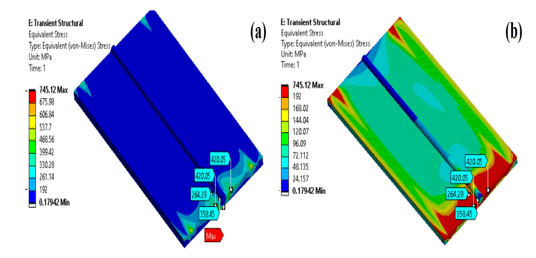
Figure 6. Von-mises residual stress distribution of the AA5052 weldment.
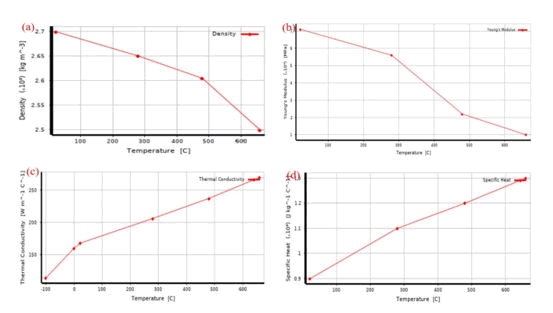
Figure 7. Comparison of the numerical simulated curves for AA5052 plate.
Microstructural analysis
The specimen welded at the optimized parametric condition has been taken for the microstructural analysis and it is displayed in Figure 8. There are no defects such as voids, cracks, or unbounded regions around the weld region. In comparison with the base material, grain growth is visualised in TIG welds on the weld region (fusion zone). Grain growth is caused by increased fusion soldering temperatures. Grain coarsening decreases fusion zone strength. The structure of the dendrite developed in fusion zone because weld metal is quickest to heat and to cool. In Figure 8 Dendritic spacing is clearly visible at the weld site. In Heat Hazard Zones (HAZ), the dendritic structure decreases. At HAZ, dendrite structure is relatively fine.
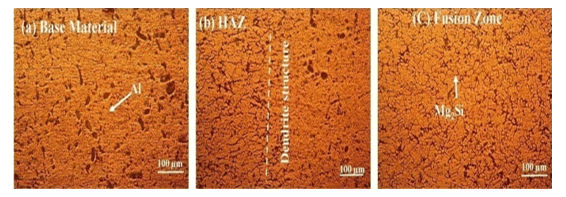
Figure 8. Microstructural analysis.
[Google Scholar] [PubMed]
Journal of Material Sciences & Engineering received 3677 citations as per Google Scholar report