Brief Report - (2025) Volume 16, Issue 6
Received: 01-Nov-2025, Manuscript No. hycr-25-175043;
Editor assigned: 03-Nov-2025, Pre QC No. P-175043;
Reviewed: 17-Nov-2025, QC No. Q-175043;
Revised: 24-Nov-2025, Manuscript No. R-175043;
Published:
01-Dec-2025
, DOI: 10.37421/2157-7587.2025.16.625
Citation: Petrova, Elena. "Sediments: Climate, Pollutants, History, and Ecology." Hydrol Current Res 16 (2025):625
Copyright: © 2025 Petrova E. This is an open-access article distributed under the terms of the Creative Commons Attribution License, which permits unrestricted use,
distribution and reproduction in any medium, provided the original author and source are credited.
Sediments represent a fundamental component of aquatic and terrestrial ecosystems, serving as critical interfaces for physical, chemical, and biological processes that profoundly influence global environmental systems. Their significance spans from deep geological time to contemporary environmental challenges. Understanding the diverse roles of sediments is therefore paramount for addressing issues ranging from climate change to pollution and resource management. One primary role of sediments is in regulating global climate. Marine sediments, for example, are recognized as significant long-term carbon sinks. Research delves into the intricate relationship between the marine sediment carbon cycle and global climate change, detailing processes of carbon burial and release. These processes are highly susceptible to anthropogenic disturbances and climate-induced alterations, which in turn feed back into the broader climate system. [1]
Complementing this, deep-sea sediments are critical sites for global biogeochemical cycling. They host diverse microbial communities responsible for transformations of carbon, nitrogen, and sulfur. Current understanding synthesizes these intricate processes, highlighting their substantial impact on ocean chemistry and global element cycles under extreme conditions. [7]
Beyond their role in active biogeochemical processes, sediments also serve as invaluable historical archives. Lake sediments, in particular, function as rich repositories for reconstructing past climate and environmental changes spanning millennia. Reviews in this area synthesize methods and recent advances in using lacustrine sediment proxies to unravel paleoclimate patterns. This work offers crucial insights into natural climate variability and its implications for future climate projections. [4]
Similarly, sediment cores provide invaluable historical records of human impact on aquatic environments. They reflect changes in land use, pollution loads, and climatic shifts over time. This research synthesizes how sedimentological and geochemical proxies are employed to reconstruct anthropogenic activities and their long-term effects on both freshwater and marine ecosystems. [10]
Sediments are also unfortunately prominent reservoirs for a wide array of contaminants. A major concern is the widespread microplastic contamination found across various marine sediment environments, from coastal zones to deep-sea trenches. Studies provide comprehensive overviews of the sources, distribution patterns, and ecological implications of these microplastics in sediments, underscoring the urgent need for mitigation strategies. [2]
In urban contexts, sediments from rivers are often laden with pollutants. Investigations into the distribution and ecological risk of heavy metal contamination in sediments from urban rivers frequently reveal high concentrations of specific metals. These concentrations are often directly linked to industrial and urban discharge, pointing to significant environmental concerns and the necessity for effective pollution control measures to protect aquatic ecosystems. [3] Adding to the contaminant burden, sediments function as reservoirs and hotspots for the dissemination of antibiotic resistance genes (ARGs) within aquatic environments. Research in this area explores the mechanisms of ARG transfer and persistence in both river and marine sediments, emphasizing the profound ecological risks and public health concerns associated with this pervasive environmental issue. [5]
The interaction between groundwater and sediment plays a crucial role in the transport and ultimate fate of contaminants in aquatic systems. This work reviews current understanding of contaminant exchange mechanisms at this critical interface, highlighting their implications for groundwater quality, overall ecological health, and the development of effective remediation strategies. [9]
Furthermore, sediment dynamics are central to understanding physical geomorphic processes. Coastal erosion processes, for example, are heavily influenced by the dynamics of sediment transport, deposition, and resuspension. This research examines the complex interplay between hydrodynamic forces, intrinsic sediment characteristics, and human interventions that collectively drive coastal change. Such insights are essential for informing robust coastal management and protection strategies. [6]
Finally, monitoring these complex sediment systems is increasingly facilitated by advanced technologies. Remote sensing techniques offer powerful tools for observing riverine suspended sediment dynamics across vast spatial and temporal scales. Reviews evaluate advancements in satellite-based observations and their application in estimating sediment concentrations, mapping distribution, and understanding fluvial processes, thereby providing a robust foundation for water resource management. [8]
Collectively, these diverse areas of research underscore the pivotal and often complex roles that sediments play in planetary health, demanding integrated approaches for their study and management.
Sediments are more than just passive layers at the bottom of water bodies; they are active environmental compartments essential for numerous global processes. Their capacity to sequester carbon makes them indispensable in understanding and mitigating climate change. Marine sediments act as a significant long-term carbon sink, playing a crucial role in the global carbon cycle. The delicate balance of carbon burial and release within these sediments is highly sensitive to human activities and climate-driven alterations, creating feedback loops influencing the broader climate system [1]. In a related vein, deep-sea sediments are bustling hubs of microbial activity, driving global biogeochemical cycles of carbon, nitrogen, and sulfur. The unique conditions of the deep sea foster diverse microbial communities whose metabolic processes significantly affect ocean chemistry and the cycling of elements on a global scale [7].
The archival quality of sediments offers an unparalleled window into Earth's past, providing critical data for paleoclimate and environmental reconstructions. Lake sediments, for example, are meticulously studied to reconstruct past climate and environmental changes spanning thousands of years. Scientists employ various proxies within these sediments, such as pollen, diatoms, and geochemical markers, to unravel paleoclimate patterns. This work is vital for understanding natural climate variability and can inform predictions about future climate scenarios, offering insights into long-term trends not visible in shorter observational records [4]. Similarly, sediment cores from both freshwater and marine environments hold invaluable historical records of human impact. These records allow researchers to reconstruct past land-use changes, track pollution trajectories, and observe the long-term environmental consequences of human activities, providing a baseline for assessing current ecological health and the effectiveness of conservation efforts [10].
Unfortunately, sediments are also potent reservoirs for a range of environmental contaminants, posing significant ecological and public health threats. Microplastic contamination is now a pervasive issue across all marine sediment environments. From nearshore coastal areas to the remotest deep-sea trenches, microplastics are accumulating. Research highlights the diverse sources, complex distribution patterns, and severe ecological implications of these plastics, emphasizing the urgent need for global mitigation strategies to prevent further accumulation and impact on marine life [2]. Urban environments face particular challenges, with river sediments often acting as sinks for heavy metals. Studies consistently reveal high concentrations of metals like lead, cadmium, and mercury in sediments from urban rivers. These contaminants typically originate from industrial discharge, stormwater runoff, and urban activities, leading to significant environmental concerns and necessitating stringent pollution control measures to safeguard aquatic ecosystems and human health [3].
The hidden threats within sediments extend to microbial contaminants. Sediments are increasingly recognized as reservoirs and hotspots for antibiotic resistance genes (ARGs) in aquatic systems. This research investigates the mechanisms by which ARGs transfer and persist in both river and marine sediments. The presence and dissemination of ARGs represent a grave public health concern, as they can contribute to the rise of antibiotic-resistant infections, underscoring the interconnectedness of environmental and human health [5]. Furthermore, the intricate interactions between groundwater and sediment are crucial for understanding how contaminants move through aquatic environments. The exchange mechanisms at the groundwater-sediment interface dictate the transport and ultimate fate of pollutants. This understanding is critical for assessing groundwater quality, maintaining ecological health, and developing effective strategies for environmental remediation, particularly in areas with permeable streambeds or coastal aquifers [9].
Beyond chemical and biological roles, sediments are integral to physical landscape dynamics, particularly in coastal zones. Coastal erosion processes are profoundly shaped by sediment dynamics, including transport, deposition, and resuspension. This complex interplay involves hydrodynamic forces like waves and currents, the inherent characteristics of the sediments themselves, and human interventions. Understanding these factors is essential for developing robust coastal management and protection strategies to combat erosion and maintain vital coastal habitats and infrastructure [6]. To manage these complex systems effectively, advanced monitoring techniques are becoming indispensable. Remote sensing offers powerful capabilities for observing riverine suspended sediment dynamics over extensive spatial and temporal scales. Satellite-based observations provide crucial data for estimating sediment concentrations, mapping their distribution, and gaining deeper insights into fluvial processes, thereby forming a vital foundation for comprehensive water resource management and flood control efforts [8].
Sediments play a multifaceted role in global environmental processes, acting as critical carbon sinks that influence climate change and also providing invaluable historical records for reconstructing past climates and human impacts. For instance, marine sediments are pivotal in the global carbon cycle, with their burial and release processes directly affecting the climate system, yet they remain vulnerable to human disturbances [1]. Similarly, lake sediments offer detailed archives for understanding paleoclimate patterns and natural climate variability over millennia [4]. Beyond their role in climate regulation and historical reconstruction, sediments are significant reservoirs for various pollutants. Widespread microplastic contamination affects marine environments from coasts to deep-sea trenches, necessitating urgent mitigation [2]. Urban river sediments frequently show high concentrations of heavy metals, often linked to industrial and urban discharges, which raises significant environmental concerns [3]. Furthermore, sediments are recognized as hotspots for antibiotic resistance genes (ARGs), facilitating their transfer and persistence in aquatic systems, with clear ecological and public health implications [5]. Groundwater-sediment interactions are key in controlling contaminant transport, impacting groundwater quality and requiring specific remediation strategies [9]. Deep-sea sediments host diverse microbial communities that drive global biogeochemical cycling of carbon, nitrogen, and sulfur, significantly influencing ocean chemistry [7]. Monitoring these dynamic systems is crucial. Remote sensing provides powerful tools for tracking riverine suspended sediment dynamics over large scales, aiding water resource management [8]. Coastal erosion, driven by complex sediment dynamics and hydrodynamic forces, also demands careful attention for effective management and protection strategies [6]. This integrated understanding of sediment functions is fundamental for addressing environmental challenges.
None
None
Indexed at, Google Scholar, Crossref
Indexed at, Google Scholar, Crossref
Indexed at, Google Scholar, Crossref
Indexed at, Google Scholar, Crossref
Indexed at, Google Scholar, Crossref
Indexed at, Google Scholar, Crossref
Indexed at, Google Scholar, Crossref
Indexed at, Google Scholar, Crossref
Indexed at, Google Scholar, Crossref
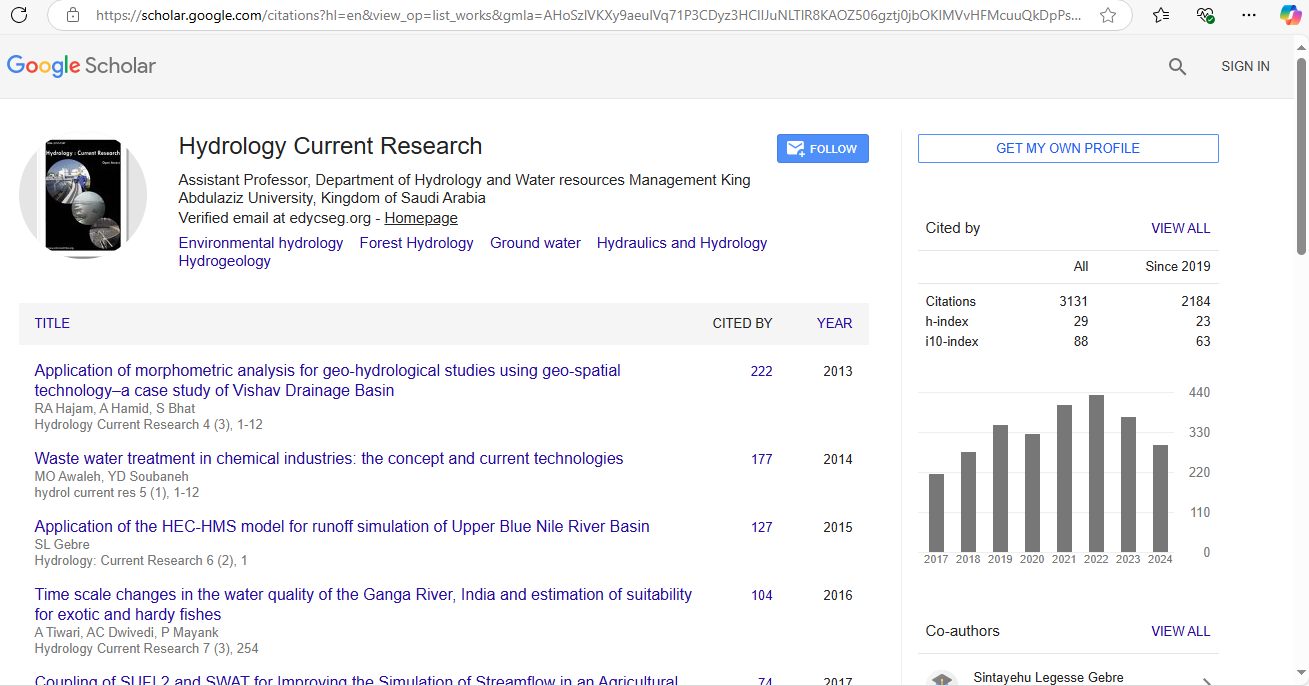
Hydrology: Current Research received 2843 citations as per Google Scholar report