Perspective - (2025) Volume 13, Issue 2
Received: 01-Apr-2025, Manuscript No. jaat-26-183150;
Editor assigned: 03-Apr-2025, Pre QC No. P-183150;
Reviewed: 17-Apr-2025, QC No. Q-183150;
Revised: 22-Apr-2025, Manuscript No. R-183150;
Published:
29-Apr-2025
, DOI: 10.37421/2329-6542.2025.13.349
Citation: El‑Hassan, Fatima B.. ”Searching for Life Beyond Earth: A Cosmic Quest.” J Astrophys Aerospace Technol 13 (2025):349.
Copyright: © 2025 El‑Hassan B. Fatima This is an open-access article distributed under the terms of the Creative Commons Attribution License, which permits unrestricted use, distribution and reproduction in any medium, provided the original author and source are credited.
Astrobiology stands as a burgeoning scientific discipline dedicated to the comprehensive exploration of life's origins, its evolutionary trajectories, and its prevalence throughout the cosmos. This multifaceted research area intrinsically converges with the domains of planetary science and astrophysics, with a significant emphasis on identifying exoplanets that may harbor conditions conducive to life's existence. A central tenet of astrobiological inquiry involves the in-depth study of extremophiles on Earth, which serve as invaluable terrestrial analogs for potential extraterrestrial life forms, alongside the development of sophisticated biosignature detection methodologies for remote sensing applications. The ongoing quest for habitable worlds is propelled by continuous advancements in telescope technology and an ever-deepening understanding of planetary formation processes and the complexities of atmospheric chemistry. A crucial aspect of assessing the potential habitability of exoplanets lies in the meticulous characterization of their atmospheres. Advanced techniques, such as transmission and emission spectroscopy, empower scientists to infer the chemical composition of these remote celestial bodies. The identification of specific molecular species, including water vapor, oxygen, or methane, can serve as potential indicators of biological processes, although it is imperative to thoroughly consider and rule out abiotic sources. The advent of next-generation observatories promises to significantly enhance our capacity to detect even the faintest biosignatures, opening new avenues in the search for life beyond Earth. The study of life's resilience on our own planet, particularly the remarkable capabilities of extremophiles, provides an indispensable framework for the broader search for extraterrestrial life. These organisms, which thrive in environments previously considered inhospitable to life, underscore the extraordinary adaptability and tenacity of living systems. By examining their unique biochemical and genetic mechanisms, researchers can refine and inform their search strategies for life in a diverse array of extraterrestrial settings, ranging from subsurface oceans to planets subjected to intense radiation. The habitability of terrestrial planets, encompassing both those within our solar system, such as Mars and Venus, and exoplanets, is a pivotal area of focus within astrobiology. Investigating the past and present conditions on these celestial bodies is instrumental in understanding the multifaceted factors that either enable or preclude the development and sustenance of life. This includes a thorough examination of the presence of liquid water, the availability of suitable energy sources, and the existence of organic molecules, alongside the profound impact of planetary evolution and atmospheric loss. The relentless progress in developing sophisticated telescope technologies is fundamentally underpinning the global endeavor to discover habitable exoplanets. State-of-the-art instruments, such as the James Webb Space Telescope, are revolutionizing the scientific community's ability to detect and characterize exoplanet atmospheres with unprecedented detail. Furthermore, future observational missions are being meticulously designed with the explicit goal of directly imaging Earth-like planets and performing sensitive searches for biosignatures. The intricate processes governing the formation and subsequent evolution of planetary systems are intrinsically linked to the determination of planetary habitability. A thorough understanding of the astrophysical and geological mechanisms that lead to the emergence of terrestrial planets within the habitable zones of their host stars is paramount. This understanding encompasses critical factors such as the level of stellar activity, the gravitational influence of giant planets within a system, and the crucial delivery of water and essential organic molecules. The paramount objective in the exploration of exoplanet atmospheres is the definitive search for biosignatures. This endeavor necessitates the identification of specific molecules or unique combinations of molecules that are highly unlikely to arise from purely abiotic geological or chemical processes. Current research efforts are intensely focused on developing robust and reliable methodologies for both detecting and accurately interpreting these potential indicators of life, while simultaneously addressing the critical challenge of mitigating false positives. Subsurface oceans concealed within icy moons, such as Jupiter's moon Europa and Saturn's moon Enceladus, represent some of the most compelling targets in the ongoing search for extraterrestrial life within our own solar system. These environments are theorized to possess the potential to harbor life, shielded from the harsh effects of surface radiation and offering the fundamental requisites of liquid water and available energy sources. Consequently, numerous missions are currently being conceptualized and planned to conduct detailed explorations of these intriguing ocean worlds. The conceptual framework of the habitable zone surrounding stars has undergone significant refinement, evolving to encompass a broader spectrum of critical factors that extend beyond the mere presence of liquid water. These expanded considerations include the composition of a planet's atmosphere, the level of stellar activity, and the intricacies of planetary geology. Astrobiologists are actively engaged in refining sophisticated models to more accurately define the specific conditions that are most conducive to the emergence and sustenance of life on exoplanets, moving beyond earlier, more simplified definitions. The ambitious pursuit of life beyond Earth fundamentally necessitates a deeply interdisciplinary approach, requiring the synergistic collaboration of experts from a wide array of scientific fields, including astronomy, biology, chemistry, geology, and engineering. This intellectual cross-pollination is indispensable for formulating comprehensive search strategies, pioneering innovative technological solutions, and ensuring the robust interpretation of any potential discoveries. The Department of Physics at the American University of Beirut actively contributes to advancing our collective understanding of these profound and complex questions.
Astrobiology, a field experiencing rapid growth, is dedicated to unraveling the mysteries surrounding the origins, evolution, and distribution of life across the universe. A significant portion of this research intersects directly with planetary science and astrophysics, particularly in the critical task of identifying exoplanets that possess conditions potentially suitable for life. Key areas of investigation include a deep dive into extremophiles found on Earth, which serve as crucial analogs for understanding potential extraterrestrial life, and the continuous development of biosignature detection methods for remote sensing purposes. The relentless pursuit of habitable worlds is significantly fueled by ongoing advancements in telescope technology and our expanding comprehension of planetary formation dynamics and atmospheric chemistry. The accurate characterization of exoplanet atmospheres is an absolutely vital step in evaluating their potential habitability. Sophisticated techniques, such as transmission and emission spectroscopy, provide scientists with the means to infer the chemical composition of these distant worlds. The detection of specific molecules, such as water vapor, oxygen, or methane, can be strongly indicative of biological processes, although it is equally important to rigorously consider and exclude abiotic sources. Future generations of observatories are poised to dramatically improve our capabilities in detecting subtle biosignatures. Understanding the absolute limits of life as we know it on Earth provides an essential and foundational context for the broader search for extraterrestrial life. Extremophiles, organisms that thrive in environments once believed to be utterly inhospitable, vividly demonstrate the extraordinary resilience and remarkable adaptability inherent in life itself. The detailed study of their unique biochemical and genetic mechanisms offers valuable insights that can inform and refine our search strategies for life in a wide spectrum of diverse extraterrestrial settings, from deep subsurface oceans to planets enduring intense levels of radiation. The habitability of terrestrial planets, including those within our own solar system like Mars and Venus, as well as numerous exoplanets, remains a central and critical focus in the field of astrobiology. Intensive research into the past and present conditions on these celestial bodies is fundamental to a comprehensive understanding of the intricate factors that either facilitate or prevent the development and persistence of life. This encompasses the rigorous study of the presence of liquid water, the identification of suitable energy sources, and the existence of organic molecules, alongside a thorough assessment of the impacts of planetary evolution and atmospheric loss. The ongoing development and deployment of advanced telescope technologies are absolutely fundamental to the success of the global search for habitable exoplanets. Cutting-edge instruments, prominently including the James Webb Space Telescope, are actively revolutionizing our capacity to detect and meticulously characterize the atmospheres of exoplanets. Furthermore, the design and planning phases for future observational missions are specifically focused on enabling the direct imaging of Earth-like planets and conducting searches for biosignatures with unparalleled sensitivity. The formation and subsequent evolution of planetary systems play a profoundly critical role in determining the habitability of planets within those systems. A deep and comprehensive understanding of the complex processes that ultimately lead to the formation of terrestrial planets situated within the habitable zones of their parent stars is absolutely essential. This understanding necessarily includes critical factors such as the inherent activity of the host star, the gravitational influence of any giant planets in the system, and the mechanisms responsible for the delivery of water and vital organic molecules. The focused search for biosignatures within the atmospheres of exoplanets represents a primary and overarching goal of contemporary astrobiology. This critical undertaking involves the identification of specific molecules or unique combinations of molecules that are highly improbable to be produced through abiotic processes. Current research efforts are intensely concentrated on developing highly robust and reliable methods for both detecting and accurately interpreting these potential indicators of life, while also giving careful consideration to the possibility of false positives. Subsurface oceans, discovered within icy moons such as Europa and Enceladus, are widely regarded as prime candidates in the search for extraterrestrial life within the confines of our solar system. These subterranean environments possess the theoretical potential to harbor life, offering a protective refuge from harmful surface radiation and providing essential resources like liquid water and available energy sources. Consequently, a significant number of missions are being actively planned and developed to conduct detailed explorations of these fascinating ocean worlds. The established concept of the habitable zone surrounding stars has undergone significant conceptual evolution, now incorporating a diverse array of factors that extend far beyond the mere presence of liquid water. These expanded considerations include crucial elements such as atmospheric composition, the level of stellar activity, and the planet's geological characteristics. Researchers are actively engaged in refining sophisticated models to more precisely define the conditions that are most conducive to the emergence and sustenance of life on exoplanets, moving beyond previously simplified definitions. The overarching quest for evidence of life beyond Earth inherently demands extensive interdisciplinary collaboration, bringing together the specialized expertise of professionals from astronomy, biology, chemistry, geology, and engineering. This vital synergy is absolutely essential for the development of comprehensive search strategies, the innovation of novel technologies, and the assurance of rigorous interpretations of any potential discoveries. The Department of Physics at the American University of Beirut plays a significant role in advancing our collective understanding of these complex and fundamental questions.
Astrobiology is a rapidly expanding field investigating life's origins, evolution, and distribution in the universe, intersecting with planetary science and astrophysics. Key research areas include studying Earth's extremophiles as analogs for extraterrestrial life and developing biosignature detection methods. The search for habitable exoplanets is driven by advances in telescope technology and our understanding of planetary formation and atmospheric chemistry. Characterizing exoplanet atmospheres using spectroscopy is crucial for assessing habitability, with specific molecules potentially indicating biological activity, though abiotic sources must be considered. The resilience of life on Earth, exemplified by extremophiles, provides vital context for extraterrestrial life searches. Understanding the habitability of terrestrial planets, including Mars and Venus, involves studying conditions like liquid water, energy sources, and organic molecules. Advanced telescopes like the James Webb Space Telescope are revolutionizing exoplanet atmosphere detection and characterization. Planetary system formation and evolution are critical to habitability, with factors like stellar activity and giant planet influence playing key roles. Detecting biosignatures in exoplanet atmospheres aims to identify molecules unlikely to be produced abiotically, while addressing false positives. Subsurface oceans on icy moons like Europa and Enceladus are prime targets for life detection due to protected conditions and resources. The habitable zone concept is being refined to include atmospheric composition, stellar activity, and geology. The search for extraterrestrial life necessitates interdisciplinary collaboration across various scientific fields.
None
None
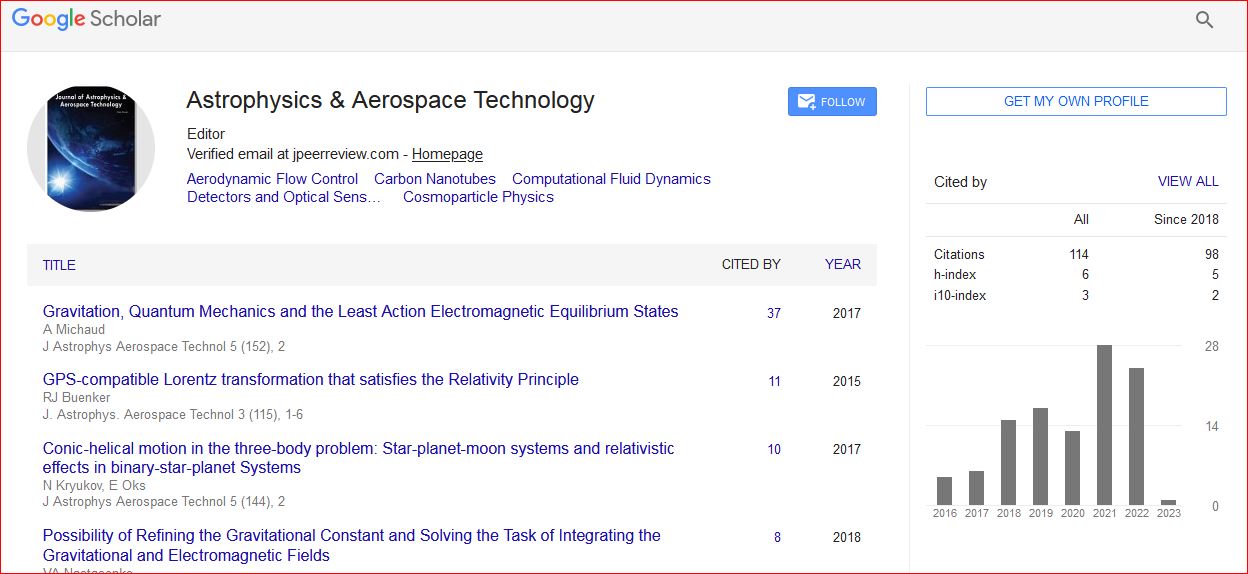
Astrophysics & Aerospace Technology received 114 citations as per Google Scholar report