Perspective - (2025) Volume 13, Issue 4
Received: 02-Aug-2025, Manuscript No. JGPR-26-190219;
Editor assigned: 04-Aug-2025, Pre QC No. P-190219;
Reviewed: 18-Aug-2025, QC No. Q-190219;
Revised: 25-Aug-2025, Manuscript No. R-190219;
Published:
29-Aug-2025
, DOI: 10.37421/2329-9126.2025.13.629
Citation: Benali, Youssef. ”Screening Stress and Burnout: A Primary Care Imperative.” J Gen Pract 13 (2025):629.
Copyright: © 2025 Benali Y. This is an open-access article distributed under the terms of the Creative Commons Attribution License, which permits unrestricted use, distribution and reproduction in any medium, provided the original author and source are credited.
The critical need for routine screening of stress and burnout in primary care settings is increasingly recognized, given the rising prevalence of these conditions among patients. Early identification and intervention by primary care physicians are crucial, supported by the development and validation of practical screening tools that can be easily integrated into clinical practice, ultimately improving patient outcomes and reducing the burden of chronic stress-related illnesses [1].
Focusing on the primary care physician's role, this paper discusses the challenges and opportunities in screening for stress and burnout. It outlines evidence-based strategies for integrating brief screening questionnaires into patient visits, along with approaches for effectively communicating findings and initiating management plans, underscoring the importance of a patient-centered approach and tailoring interventions to individual needs [2].
Research has investigated the psychometric properties of a novel screening tool designed to detect burnout in primary care patients. This study details the development process, validation against established measures, and its sensitivity and specificity, suggesting that the tool offers a reliable and efficient method for identifying individuals at risk of burnout, facilitating timely referral and support [3].
Examining the patient perspective, this qualitative study explores how individuals perceive and experience stress and burnout in the context of primary care. It highlights the importance of a compassionate and understanding approach from healthcare providers during screening, emphasizing the need for educational resources and support systems to empower patients in managing their stress [4].
A systematic review evaluates the effectiveness of different screening interventions for stress and burnout in primary care populations. By synthesizing evidence from randomized controlled trials and observational studies, it provides insights into which approaches yield the best outcomes and identifies gaps in the current literature, suggesting directions for future research [5].
This article addresses the implementation challenges of stress and burnout screening in busy primary care practices, offering practical solutions for workflow integration, provider training, and patient communication to facilitate the adoption of these screening practices. The authors emphasize the importance of team-based care and resource allocation [6].
The impact of chronic stress and burnout on physical health outcomes is explored, with a focus on their relevance to primary care. It highlights how these psychological states can exacerbate or contribute to various somatic conditions, making screening in primary care essential for comprehensive patient care and proposing a more integrated approach to mental and physical health management [7].
This article reviews the current landscape of digital tools and technologies available for screening stress and burnout in primary care. It discusses the potential benefits of using mobile applications, online questionnaires, and telehealth platforms to enhance screening accessibility and efficiency, while also addressing challenges related to data privacy and equitable access [8].
The ethical considerations surrounding the screening of stress and burnout in primary care are examined. The authors discuss issues of patient consent, confidentiality, and the potential for iatrogenic harm, advocating for ethical guidelines that prioritize patient well-being and autonomy throughout the screening and intervention process [9].
This perspective piece argues for the proactive integration of stress and burnout screening into routine primary care as a public health imperative. The authors highlight the societal costs of unaddressed stress and burnout and advocate for policy changes to support such initiatives, proposing a shift towards a more holistic and preventative model of primary healthcare [10].
The critical need for routine screening of stress and burnout in primary care settings is highlighted, emphasizing the increasing prevalence of these conditions among patients and the potential for early identification and intervention by primary care physicians. The development and validation of practical screening tools that can be easily integrated into routine clinical practice are crucial for improving patient outcomes and reducing the burden of chronic stress-related illnesses [1].
This paper discusses the challenges and opportunities for primary care physicians in screening for stress and burnout, outlining evidence-based strategies for integrating brief screening questionnaires into patient visits. It also covers approaches for effectively communicating findings and initiating management plans, underscoring the importance of a patient-centered approach and tailoring interventions to individual needs [2].
A study investigated the psychometric properties of a novel screening tool for detecting burnout in primary care patients, detailing its development, validation against established measures, and its sensitivity and specificity. The findings indicate that this tool provides a reliable and efficient method for identifying individuals at risk of burnout, facilitating timely referral and support [3].
From a patient perspective, a qualitative study explores perceptions and experiences of stress and burnout in primary care settings. It emphasizes the significance of a compassionate and understanding approach from healthcare providers during screening, highlighting the necessity of educational resources and support systems to empower patients in managing their stress [4].
A systematic review critically evaluates the effectiveness of various screening interventions for stress and burnout in primary care populations. By synthesizing evidence from diverse study designs, it offers insights into which approaches lead to the best outcomes and identifies areas for future research [5].
This article addresses the practical challenges associated with implementing stress and burnout screening in busy primary care settings. It proposes concrete solutions for workflow integration, provider training, and patient communication, aiming to streamline the adoption of these screening practices and stressing the value of team-based care and appropriate resource allocation [6].
The study examines the impact of chronic stress and burnout on physical health outcomes within the context of primary care. It underscores how these psychological states can exacerbate or contribute to various somatic conditions, thus making screening in primary care indispensable for holistic patient care and advocating for a more integrated approach to managing mental and physical health [7].
This review surveys the current array of digital tools and technologies available for screening stress and burnout in primary care. It delves into the potential advantages of employing mobile applications, online questionnaires, and telehealth platforms for enhanced screening accessibility and efficiency, while also acknowledging associated challenges concerning data privacy and equitable access [8].
The ethical dimensions pertinent to screening for stress and burnout in primary care are thoroughly examined. The authors address critical issues such as patient consent, confidentiality, and the potential for unintended harm, advocating for the establishment of ethical guidelines that firmly prioritize patient well-being and autonomy throughout the entire screening and intervention continuum [9].
This perspective piece strongly advocates for the proactive integration of stress and burnout screening into the routine fabric of primary care, framing it as a crucial public health imperative. It delineates the extensive societal costs associated with unaddressed stress and burnout and calls for policy reforms to bolster such initiatives, championing a paradigm shift towards a more comprehensive and preventative model of primary healthcare [10].
This collection of research highlights the essential role of routine stress and burnout screening in primary care. Studies emphasize the need for practical screening tools, effective physician strategies, and patient-centered approaches. The development and validation of new tools are discussed, alongside the importance of patient perspectives and ethical considerations. Challenges in implementation are addressed, with practical solutions offered. The impact of stress and burnout on physical health and the potential of digital tools are explored. Ultimately, the integration of screening is presented as a public health imperative for a more holistic and preventative healthcare model.
None
None
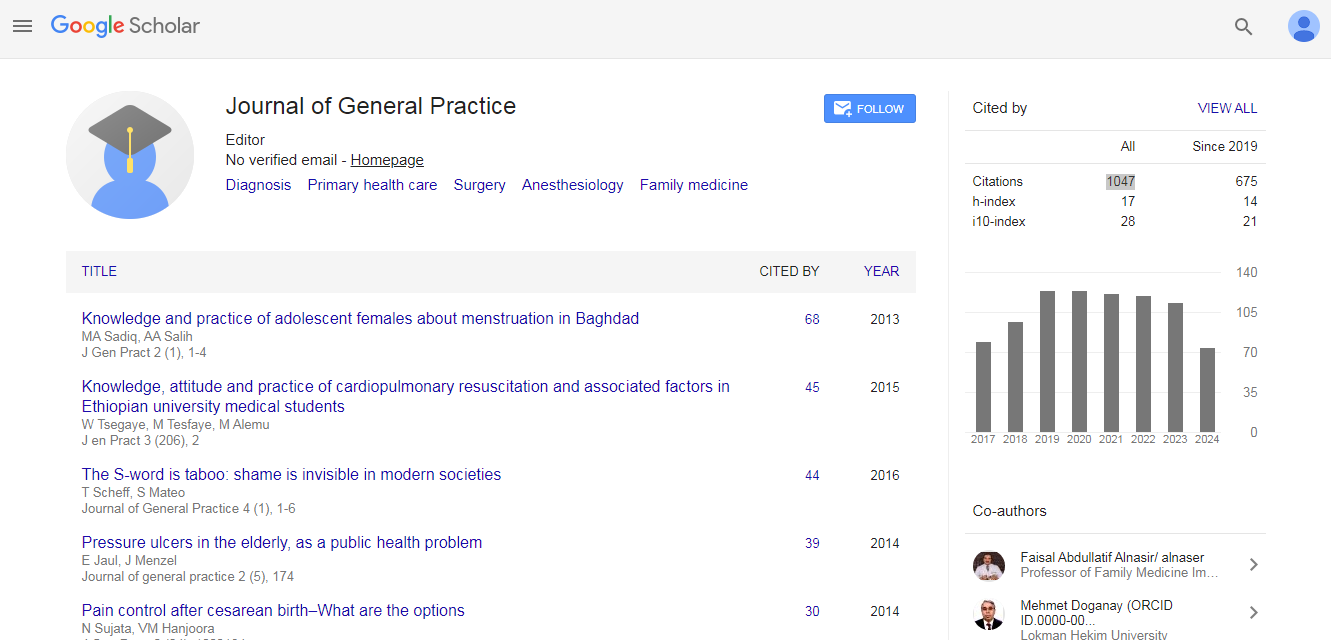
Journal of General Practice received 1047 citations as per Google Scholar report