Perspective - (2025) Volume 16, Issue 2
Received: 01-Apr-2025, Manuscript No. jar-25-176281;
Editor assigned: 03-Apr-2025, Pre QC No. P-176281;
Reviewed: 17-Apr-2025, QC No. Q-176281;
Revised: 22-Apr-2025, Manuscript No. R-176281;
Published:
29-Apr-2025
, DOI: 10.37421/2155-6113.2025.16.1057
Citation: Dubois, Helene. "Ryan White: Essential for HIV Care
Equity." J AIDS Clin Res 16 (2025):1057.
Copyright: © 2025 Dubois H. This is an open-access article distributed under the terms of the Creative Commons Attribution License, which permits unrestricted use,
distribution and reproduction in any medium, provided the original author and source are credited.
The Ryan White HIV/AIDS Program, which integrates components like the AIDS Drug Assistance Programs (ADAP), stands as a cornerstone in the ongoing fight against Human Immunodeficiency Virus. Its critical influence is seen in the sustained improvement of HIV care and treatment outcomes, particularly in achieving viral suppression among a wide array of populations [1].
What this really means is the program plays a vital role in upholding the entire continuum of care, an essential framework for managing HIV, while actively striving to reduce persistent health disparities across the nation. This commitment extends deeply into regions that historically grapple with significant health equity challenges. The program has a profound impact on mitigating HIV-related health disparities, particularly evident in the Southern United States [2].
Here's the thing: it successfully ensures equitable access to care and treatment for communities that have been historically underserved. This directly addresses critical gaps in health equity, making a tangible difference in people's lives. Exploring the foundational role of the Ryan White HIV/AIDS Program, which includes ADAP, reveals how public health initiatives, especially its robust funding structure, are key to sustaining the HIV care continuum [3].
Its central support for services keeps individuals living with HIV engaged in their care and on track to maintain viral suppression. This foundational backing is indispensable. Furthermore, over the past decade, the program has driven significant progress along the HIV care continuum [4].
It has underscored its adaptability and critical role in improving essential outcomes such as linkage to care, patient retention, and the crucial goal of viral suppression. This consistent progress speaks volumes about its design. The research also details how the Ryan White HIV/AIDS Program effectively addresses systemic barriers that often impede HIV care for some of the most vulnerable populations [5].
It emphasizes the comprehensive services, including ADAP, that guarantee access to life-saving treatment and unwavering support, particularly for those individuals navigating severe socioeconomic or structural challenges. This truly highlights its patient-centered approach. A systematic review delves into the economic impact of the program, implicitly including ADAP's cost-effectiveness in maintaining viral suppression and improving overall health outcomes [6].
What this shows is the program's remarkable efficiency in delivering comprehensive care, firmly establishing its value as a sound public health investment. Itâ??s not just about health; itâ??s about smart resource allocation. Beyond treatment and care, the program also plays an expanding role in prevention [7].
Specifically, it focuses on broadening access to HIV Pre-exposure Prophylaxis (PrEP) through initiatives like ADAP. These programs are undeniably crucial for facilitating wider prevention efforts and effectively reaching populations most in need of PrEP services, a proactive step in curbing the epidemic. Looking at its operationalization, this paper highlights the state-level execution of the Ryan White HIV/AIDS Program Part B, which fully encompasses ADAP [8].
It discusses how state-specific implementations are tailored to address local disparities and enhance access to HIV services. This flexibility in meeting diverse regional needs is a hallmark of its design. Moreover, invaluable qualitative studies offer patient perspectives on navigating the Ryan White HIV/AIDS Program, including ADAP, for treatment access and comprehensive support [9].
These insights into the lived experiences of individuals illuminate the program's effectiveness from the user's viewpoint and pinpoint areas for further patient-centered improvement, ensuring it remains relevant and responsive. Finally, recent assessments have focused on the COVID-19 pandemic on AIDS Drug Assistance Programs and overall HIV service delivery across the United States [10].
This critical review reveals the considerable challenges faced by ADAP in swiftly adapting to the crisis while simultaneously ensuring critical medication access and maintaining care continuity for people with HIV. Despite these hurdles, its resilience in a global health crisis is truly remarkable.
The Ryan White HIV/AIDS Program, along with its integral AIDS Drug Assistance Programs (ADAP), represents a comprehensive and adaptive public health initiative vital for managing the HIV epidemic in the United States. Its primary focus remains on improving the health and lives of people living with HIV by ensuring access to essential care and treatment. A key achievement has been its significant contribution to improved HIV care and treatment outcomes, most notably achieving viral suppression across diverse populations [1]. This program fundamentally supports the entire continuum of HIV care, from diagnosis to sustained treatment, while also making substantial strides in reducing persistent health disparities.
One of the program's most significant contributions lies in addressing health equity, particularly in regions where disparities are stark. For example, its profound impact on mitigating HIV-related health disparities in the Southern United States highlights its success in reaching underserved communities [2]. By ensuring equitable access to critical care and treatment, the program effectively closes vital gaps in health equity, thus uplifting communities that have historically faced systemic barriers. The structure of the program itself, including its funding mechanisms, is intricately designed to sustain the HIV care continuum [3]. This financial and logistical support is crucial for maintaining patient engagement in care and ensuring viral suppression, a critical public health goal that prevents disease progression and transmission.
Looking back at the past decade, the Ryan White HIV/AIDS Program has demonstrated remarkable progress across the HIV care continuum. Its adaptability has been a defining characteristic, enabling it to improve key outcomes such as initial linkage to care, long-term retention in treatment, and sustained viral suppression [4]. These improvements reflect the program's dynamic response to evolving healthcare landscapes and patient needs. Moreover, the program plays an indispensable role in directly addressing systemic barriers to HIV care that disproportionately affect vulnerable populations [5]. Through its comprehensive services, including ADAP, it guarantees access to life-saving treatments and robust support systems, particularly for individuals confronting complex socioeconomic or structural challenges that would otherwise prevent them from receiving care.
Beyond its direct care provision, the program also offers significant economic benefits. A systematic review has explored the economic impact of the Ryan White HIV/AIDS Program, implicitly including the cost-effectiveness of ADAP in maintaining viral suppression and enhancing overall health outcomes [6]. This research underscores the program's efficiency in delivering comprehensive care, solidifying its position as a valuable public health investment rather than merely an expenditure. Furthermore, the program's role continues to expand into crucial prevention efforts. It has given specific attention to broadening access to HIV Pre-exposure Prophylaxis (PrEP) through ADAP [7]. These initiatives are critical for facilitating preventative measures and ensuring PrEP services reach the populations most in need, thereby contributing to ending the HIV epidemic.
The decentralized yet coordinated approach of the Ryan White HIV/AIDS Program is also notable. Its state-level operationalization, particularly under Part B, showcases how state-specific implementations are tailored to address local disparities and enhance access to HIV services [8]. This flexible framework allows the program to adapt effectively to diverse regional needs, making its impact more relevant and profound at the community level. Crucially, the programâ??s effectiveness is also validated through the experiences of those it serves. Qualitative studies capturing patient perspectives on navigating the Ryan White HIV/AIDS Program, including ADAP, offer invaluable insights into how individuals access treatment and comprehensive support [9]. These lived experiences confirm the program's tangible benefits and help identify areas for continued patient-centered improvements. Even when faced with unprecedented global health crises, the program has demonstrated resilience. An assessment of the COVID-19 pandemic's impact on AIDS Drug Assistance Programs and broader HIV service delivery revealed the challenges ADAP faced in adapting to the crisis while still ensuring critical medication access and continuity of care for people with HIV [10]. This demonstrates the program's robust framework and its unwavering commitment to patient well-being, even under extreme pressure.
The Ryan White HIV/AIDS Program, including AIDS Drug Assistance Programs (ADAP), is fundamental to improving HIV care and treatment outcomes, notably viral suppression, across diverse populations. It is instrumental in supporting the continuum of care and actively works to reduce health disparities. This program significantly impacts HIV-related health disparities, particularly within the Southern United States, by ensuring equitable access to care for communities that have been underserved. Its robust funding structure is key to sustaining the HIV care continuum, helping individuals with HIV remain engaged in care and maintain viral suppression. Over the past decade, the Ryan White HIV/AIDS Program has demonstrated substantial progress across the entire HIV care continuum, markedly improving outcomes such as linkage to care, retention, and durable viral suppression, largely due to its inherent adaptability. The program effectively addresses systemic barriers that hinder HIV care for vulnerable populations, providing essential comprehensive services that guarantee access to vital treatment and support, especially for those encountering socioeconomic or structural challenges. Economically, the program shows efficiency in maintaining viral suppression and enhancing health outcomes, underscoring its significant value as a public health investment. Moreover, its evolving role, particularly through ADAP, is crucial for broadening access to HIV Pre-exposure Prophylaxis (PrEP), thereby boosting prevention efforts. The programâ??s state-level implementation, specifically Part B encompassing ADAP, allows for tailored approaches to address local disparities and improve access to services, reflecting its flexibility in meeting varied regional needs. Patient experiences consistently highlight the program's effectiveness in delivering comprehensive support and facilitating treatment access, even as it successfully navigated significant hurdles like the COVID-19 pandemicâ??s impact on service delivery.
Indexed at, Google Scholar, Crossref
Indexed at, Google Scholar, Crossref
Indexed at, Google Scholar, Crossref
Indexed at, Google Scholar, Crossref
Indexed at, Google Scholar, Crossref
Indexed at, Google Scholar, Crossref
Indexed at, Google Scholar, Crossref
Indexed at, Google Scholar, Crossref
Indexed at, Google Scholar, Crossref
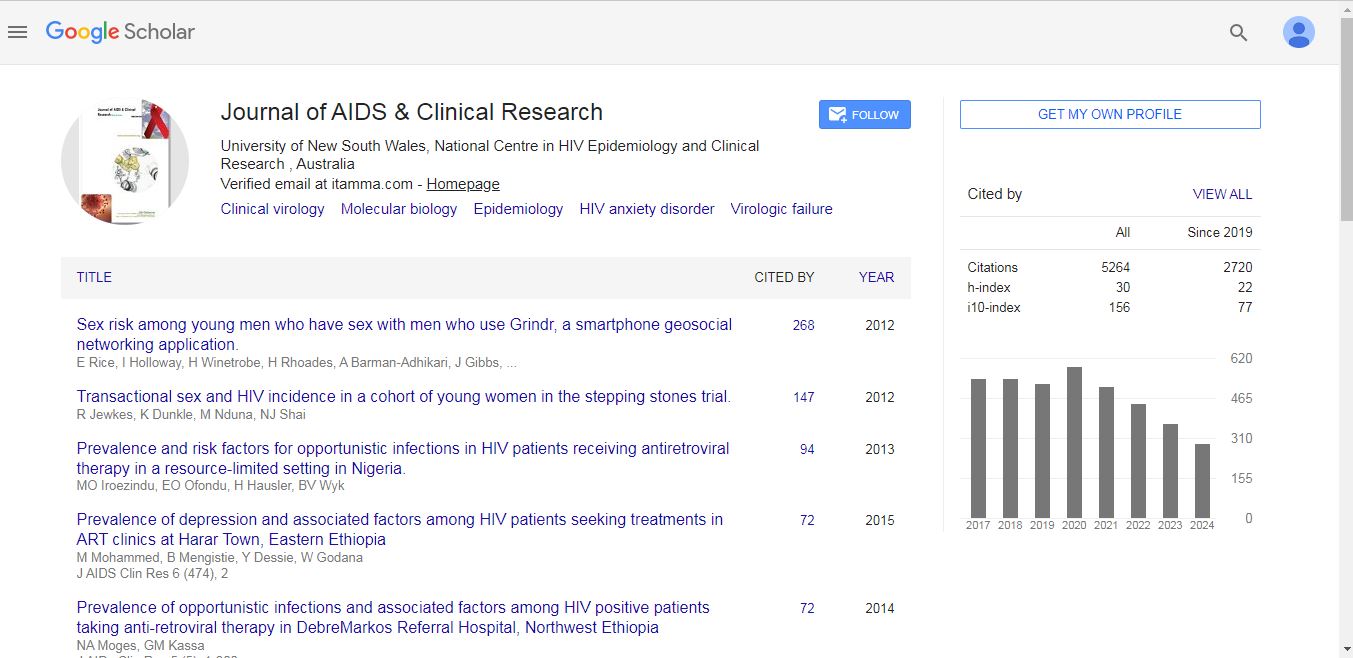
Journal of AIDS & Clinical Research received 5264 citations as per Google Scholar report