Review Article - (2026) Volume 17, Issue 1
Received: 14-Nov-2024, Manuscript No. BEJ-24-152448;
Editor assigned: 18-Nov-2024, Pre QC No. BEJ-24-152448 (PQ);
Reviewed: 03-Dec-2024, QC No. BEJ-24-152448;
Revised: 16-Feb-2026, Manuscript No. BEJ-24-152448 (R);
Published:
23-Feb-2026
Citation: Gajjar, Dipali Hasmukhbhai. "The Role of Microfinance in Social and Economic Development in India." Bus Econ J 17 (2026): 547.
Copyright: © 2026 Gajjar DH. This is an open-access article distributed under the terms of the creative commons attribution license which permits unrestricted use, distribution and reproduction in any medium, provided the original author and source are credited.
Microfinance has been recognized as an important tool for fostering social and economic development, particularly in emerging economies like India. This paper explores the role of microfinance in promoting financial inclusion, poverty alleviation, and overall socio-economic development. A conceptual model is presented, which demonstrates how microfinance can address barriers to development through credit access, empowerment, and sustainable livelihoods. The paper also reviews the current state of microfinance in India, its challenges, and the opportunities for growth.
Microfinance • Financial inclusion • Poverty alleviation • Socio-economic development • India
Microfinance refers to the provision of financial services, including small loans (microcredit), savings, insurance, and money transfer, to individuals who are typically excluded from traditional banking systems due to low income or lack of collateral. The core idea behind microfinance is to provide financial access to underserved populations, particularly in rural or marginalized communities, enabling them to improve their economic conditions through entrepreneurship and smallscale economic activities [1]. Microfinance has been hailed as an essential tool for poverty alleviation, financial inclusion, and social empowerment, especially in developing countries like India, where large sections of the population remain unbanked or underbanked.
The origins of modern microfinance are often traced to the work of Dr. Muhammad Yunus in Bangladesh, where he pioneered the Grameen Bank model in the 1970’s. His innovative approach of lending small amounts of money without requiring collateral, combined with a focus on lending to women, proved successful in transforming the lives of many low-income families. The success of the Grameen Bank inspired the global spread of microfinance as a development tool [2].
In India, microfinance has evolved into a significant sector, with millions of households benefiting from microcredit programs through Self-Help Groups (SHGs), Non-Banking Financial Companies (NBFCs), and Microfinance Institutions (MFIs). These institutions primarily target low-income households and provide them with access to financial services to meet their basic needs, initiate small businesses, and invest in income-generating activities such as agriculture, retail, or small-scale industries [3]. Microfinance is seen as a means of addressing the financial exclusion of the poor, thereby empowering them economically, socially, and politically.
The role of microfinance in development
The key role of microfinance is to break the cycle of poverty by providing low-income individuals access to capital, which can be used to invest in income-generating activities. By targeting those who are typically excluded from mainstream financial services, microfinance helps increase access to credit for vulnerable groups, particularly women, who often face barriers to traditional banking. Financial inclusion through microfinance not only facilitates entrepreneurship but also contributes to household income growth, improved living conditions, and overall socio-economic stability [4].
Microfinance’s impact is especially pronounced when it comes to women's empowerment. In many developing countries, including India, women are often the primary beneficiaries of microfinance programs. Access to microcredit enables women to start their own businesses, contribute to family income, and improve their bargaining power within households and communities. These financial services can lead to better education, health, and social welfare outcomes for families, thus driving broader societal change [5].
Despite its potential, microfinance is not without criticism. Issues such as over-indebtedness, high-interest rates, and lack of proper regulatory frameworks have raised concerns regarding its sustainability and effectiveness [6]. Moreover, the impact of microfinance on poverty reduction has been debated, with some arguing that the benefits are often overstated, and that other structural factors may be just as important for long-term [7].
Microfinance in India
India, with its large rural population and a substantial proportion of its people living in poverty, has become one of the largest markets for microfinance globally. As of 2015, over 200 million people in India were served by microfinance institutions [8]. The Indian government and various Non-Governmental Organizations (NGOs) have supported microfinance as a tool for reducing poverty and promoting rural development.
The Indian model of microfinance has primarily been shaped by the SHG-bank linkage program, initiated by the Reserve Bank of India (RBI) in the early 1990’s. Under this model, groups of individuals, particularly women, form self-help groups to pool their savings and access microloans from banks or other financial institutions. The SHG model has been successful in mobilizing savings, improving access to credit, and fostering social capital in rural communities [9]. Another key component of India's microfinance landscape is the proliferation of Non-Banking Financial Companies (NBFCs) and Microfinance Institutions (MFIs), which provide loans directly to individuals or groups, often focusing on specific sectors like agriculture, self-employment, and small business.
However, despite the success of microfinance in India, challenges remain. High interest rates charged by MFIs, concerns over overindebtedness, and the need for better regulation have been recurring issues. In response, the Indian government and the RBI have implemented various reforms to improve transparency, reduce interest rates, and ensure consumer protection.
Theoretical framework
Financial inclusion: The concept of financial inclusion refers to the accessibility and availability of affordable financial services to all individuals, particularly those from disadvantaged groups. In India, financial exclusion has historically been a significant barrier for marginalized communities, especially in rural areas. Microfinance aims to bridge this gap by offering services such as microloans, savings, and insurance to those who are excluded from conventional banking systems.
Social empowerment and gender equality: Microfinance programs have been especially effective in empowering women by giving them control over financial resources and enabling them to participate in economic activities. Empowering women through financial means can lead to broader social benefits, such as improved healthcare, education, and social status. The involvement of women in microfinance is not only a financial intervention but a step towards achieving gender equality and societal transformation.
Poverty alleviation: One of the main goals of microfinance is poverty alleviation. By providing small loans and financial services, Microfinance Institutions (MFIs) enable individuals in poverty to start or expand small businesses, leading to income generation, job creation, and economic sustainability. Studies have shown that access to microcredit can increase household income and improve the living conditions of low-income families.
Microfinance and socio-economic development in India
India has one of the largest microfinance sectors in the world, with over 200 million people currently benefiting from microfinance services. The microfinance ecosystem in India consists of Self-Help Groups (SHGs), Non-Banking Financial Companies (NBFCs), and Microfinance Institutions (MFIs).
Microfinance Institutions (MFIs): Microfinance Institutions (MFIs) are specialized organizations that provide small loans to the underserved population. In India, MFIs have been instrumental in promoting financial inclusion, with a significant number of women participating in these programs. These institutions provide loans for income-generating activities, such as agriculture, livestock rearing, handicrafts, and small-scale businesses.
Self-Help Groups (SHGs): Self-Help Groups (SHGs) are community-based organizations that provide mutual support to members in accessing microloans. The SHG model has been particularly successful in India, where millions of rural women have formed groups to access credit, savings, and insurance. The SHG model emphasizes collective action, peer support, and social mobilization, which has helped improve women’s economic and social status.
Impact on rural economy: The provision of microcredit in rural India has led to the creation of small-scale businesses and agricultural enterprises, thus contributing to local economic development. By providing access to credit, microfinance has enabled rural populations to invest in income-generating activities, thereby improving household income and reducing reliance on traditional agricultural practices.
Conceptual model: Role of microfinance in social and economic development
The conceptual model proposed here seeks to demonstrate the relationships between microfinance and the key dimensions of socioeconomic development in India. The model includes the following elements:
• Microfinance access: The availability of small loans, savings, and insurance products.
• Economic empowerment: Access to finance leads to entrepreneurship, improved livelihoods, and income generation.
• Social empowerment: Financial inclusion leads to increased decision-making power, gender equality, and social stability.
• Sustainability: Microfinance promotes financial independence, reduces dependency on informal sources of credit, and enhances community resilience.
The interactions among these factors form a cycle of development, wherein financial inclusion leads to empowerment, which in turn drives further economic and social growth. The model is visually represented as follows:
Conceptual model: Microfinance access (Loans, savings, insurance) → Economic empowerment (Entrepreneurship, income generation) → Social empowerment (Decision-making, gender equality) → Sustainability (Community resilience, financial independence).
Challenges in microfinance in India
Despite its successes, the microfinance sector in India faces several challenges:
• Over-indebtedness: One of the key risks associated with microfinance is the over-indebtedness of borrowers. The easy availability of credit can lead to multiple borrowings, resulting in repayment challenges and financial strain.
• High interest rates: Although microfinance aims to provide affordable financial services, some institutions charge high interest rates, which can be burdensome for borrowers.
• Regulatory issues: The microfinance sector in India is regulated by both the Reserve Bank of India (RBI) and the state governments, leading to inconsistencies in policy implementation and challenges in monitoring.
• Sustainability: Many microfinance institutions struggle to achieve long-term financial sustainability while maintaining a social mission. The challenge is to balance profitability with poverty alleviation.
Microfinance in India has played a crucial role in promoting financial inclusion, social empowerment, and economic development. Despite the challenges, such as over-indebtedness and high interest rates, the potential for microfinance to contribute to poverty alleviation and socio-economic progress remains significant. Through innovative models such as SHGs and MFIs, microfinance has provided millions of individuals with the means to improve their livelihoods, especially in rural and marginalized communities.
The proposed conceptual model highlights the interconnected nature of microfinance, social empowerment, economic growth, and sustainability. Moving forward, strengthening the regulatory framework, improving financial literacy, and ensuring the sustainability of microfinance institutions will be key to enhancing the impact of microfinance in India.
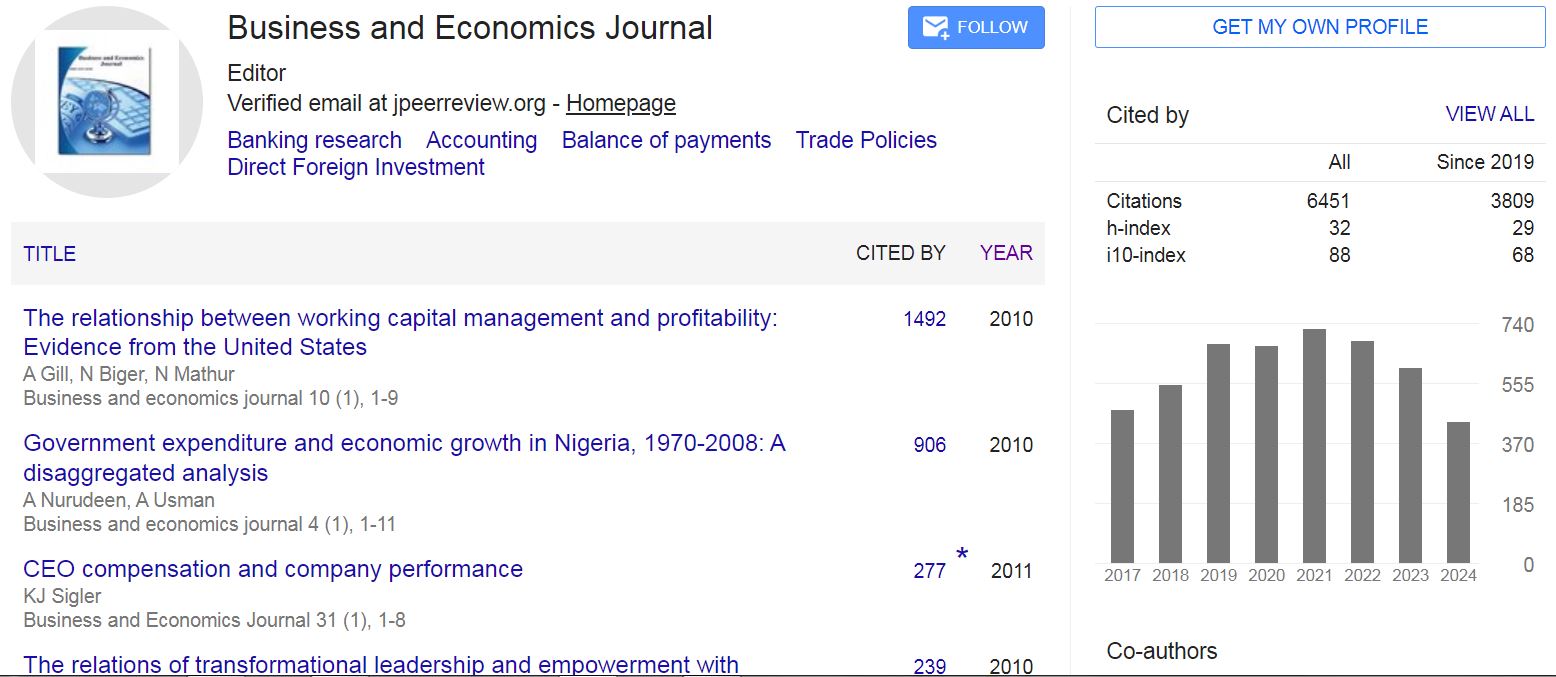
Business and Economics Journal received 6451 citations as per Google Scholar report