Perspective - (2025) Volume 14, Issue 4
Received: 01-Dec-2025, Manuscript No. ara-25-175633;
Editor assigned: 03-Dec-2025, Pre QC No. P-175633;
Reviewed: 17-Dec-2025, QC No. Q-175633;
Revised: 22-Dec-2025, Manuscript No. R-175633;
Published:
29-Dec-2025
, DOI: 10.37421/2168-9695.2025.14.349
Citation: Alvarado, Sara. ”Robotics & AI: Reshaping Modern Manufacturing.” Adv Robot Autom 14 (2025):349.
Copyright: © 2025 Alvarado S. This is an open-access article distributed under the terms of the Creative Commons Attribution License, which permits unrestricted use, distribution and reproduction in any medium, provided the original author and source are credited.
The evolving landscape of modern manufacturing is increasingly defined by the profound integration of advanced robotics and Artificial Intelligence (AI). This confluence of technologies is not only revolutionizing production methodologies but also addressing critical challenges and opportunities across diverse industrial sectors. The integration of robotics and Artificial Intelligence (AI) is fundamentally transforming manufacturing processes, offering comprehensive reviews of current applications and inherent challenges. This transformation impacts critical areas such as automated assembly, quality control, and predictive maintenance, while also addressing hurdles like data privacy, ethical considerations, and the need for skilled labor [1].
A key focus in this evolving landscape is human-robot collaboration within manufacturing environments, where safety and ergonomic aspects are paramount. Research delves into effective human-robot interaction, aiming to mitigate risks and ensure worker comfort, providing crucial insights for designing collaborative workspaces that enhance productivity without compromising well-being [2].
Artificial Intelligence and robotics are pivotal in driving smart manufacturing forward, covering applications from intelligent automation to advanced data analytics. These technologies reshape production processes and supply chains, offering transformative potential for increased efficiency and flexibility in modern factories [3].
The growing trend of reconfigurable robotic systems in manufacturing is also significant, as these adaptive systems allow manufacturers to quickly adjust to changing product demands and production volumes. This brings benefits of flexibility and cost-effectiveness to dynamic industrial environments [4].
Collaborative robots, or cobots, are finding specific implementation in Small and Medium-sized Enterprises (SMEs). While identifying challenges like investment costs and integration complexities, studies highlight the substantial opportunities cobots offer for increasing productivity, improving worker safety, and enabling more flexible production lines in smaller-scale operations [5].
Autonomous Mobile Robots (AMRs) play an expanding role in industrial applications, with recent advancements in navigation, manipulation, and decision-making capabilities. AMRs enhance logistics, material handling, and overall operational efficiency across various manufacturing settings [6].
The integration of robotics into Flexible Manufacturing Systems (FMS) is a critical area, addressing trends and persistent challenges in deploying robots to create highly adaptable production environments. Robotics contribute to FMS by enabling rapid product changes and varied production capabilities, meeting the demands of modern manufacturing [7].
Digital twin technology is also being applied in robotic manufacturing systems, providing virtual models that enhance real-time monitoring, predictive maintenance, and optimization of robotic processes. This integration aims to create more intelligent and autonomous manufacturing operations [8].
Robot vision systems are increasingly crucial in manufacturing, particularly for quality inspection applications. Advanced vision technologies enable robots to perform precise and consistent inspections, accurately identifying defects and ensuring product quality, despite challenges like lighting conditions and algorithm complexity [9].
Finally, the importance of robotics in achieving sustainable manufacturing goals is being recognized. Robots contribute to energy efficiency and resource optimization through precise movements, reduced waste, and optimized production processes, driving environmentally responsible and economically viable manufacturing practices [10].
The core of modern manufacturing transformation lies in the integration of Artificial Intelligence and robotics. These technologies are comprehensively reviewed for their applications and challenges, particularly in automated assembly, quality control, and predictive maintenance. While offering immense potential, issues like data privacy and the need for skilled labor remain [1]. The combined power of AI and robotics is critical for advancing smart manufacturing, encompassing intelligent automation and advanced data analytics that reshape production processes and supply chains for greater efficiency and flexibility [3]. Further enhancing this adaptability are reconfigurable robotic systems, which allow manufacturers to rapidly adjust to changing product demands and production volumes, providing significant flexibility and cost-effectiveness in dynamic industrial settings [4].
Human-robot collaboration (HRC) is a growing area, with significant attention paid to safety and ergonomic aspects. The goal is to design effective collaborative workspaces that enhance productivity while ensuring worker comfort and mitigating risks [2]. A specific application of this collaborative principle is seen with collaborative robots, or cobots, especially within Small and Medium-sized Enterprises (SMEs). SMEs face unique challenges such as investment costs and integration complexities, yet cobots offer substantial opportunities for boosting productivity, improving worker safety, and creating more flexible production lines in smaller-scale operations [5].
Autonomous Mobile Robots (AMRs) represent another vital component in enhancing industrial efficiency. Reviews highlight their expanding role in various applications, driven by advancements in navigation, manipulation, and decision-making capabilities. AMRs significantly improve logistics, material handling, and overall operational effectiveness across diverse manufacturing environments [6]. Concurrently, the integration of robotics into Flexible Manufacturing Systems (FMS) is essential for creating highly adaptable production environments. This integration enables rapid product changes and varied production capabilities, directly addressing the dynamic demands of modern manufacturing [7].
Advancements in supportive technologies further bolster robotic manufacturing systems. Digital twin technology, for instance, provides virtual models that revolutionize real-time monitoring, predictive maintenance, and optimization of robotic processes. This approach lays the groundwork for more intelligent and autonomous manufacturing operations in the future [8]. Crucially, robot vision systems play an indispensable role in ensuring product quality. These advanced vision technologies enable robots to perform precise and consistent inspections, accurately identifying defects. However, challenges like variable lighting conditions and the complexity of algorithms must be addressed for optimal implementation [9].
Looking towards a holistic view, robotics are increasingly important for achieving sustainable manufacturing goals. Robots contribute significantly to energy efficiency and resource optimization through precise movements, reduced waste, and streamlined production processes. The integration of robotics presents both challenges and opportunities for developing environmentally responsible and economically viable manufacturing practices [10].
The modern manufacturing landscape is being reshaped significantly by advancements in robotics and Artificial Intelligence (AI). These technologies are finding diverse applications, from enhancing production efficiency to ensuring worker safety and promoting sustainability. AI and robotics drive intelligent automation, advanced data analytics, and flexible production processes, transforming factory operations and supply chains. Human-robot collaboration is a key area, with a focus on designing safe and ergonomic workspaces to boost productivity. Reconfigurable robotic systems offer adaptability to changing demands, while collaborative robots, or cobots, provide smaller enterprises with opportunities to increase output and safety despite initial investment challenges. Autonomous Mobile Robots (AMRs) are also crucial for logistics and material handling, improving overall operational efficiency. Beyond physical deployment, digital twin technology is being integrated into robotic systems for real-time monitoring, predictive maintenance, and process optimization, moving towards more intelligent and autonomous operations. Robot vision systems are vital for precise quality inspection, identifying defects and maintaining high product standards. The integration of robotics also extends to flexible manufacturing systems, enabling rapid product changes. Furthermore, these technological advancements contribute to sustainable manufacturing goals by enhancing energy efficiency, optimizing resource use, and reducing waste.
None
None
Ali G, Seyed AA, Seyed MRH. "Robotics and artificial intelligence in manufacturing: A review of recent applications and challenges".Comput Ind 153 (2023):103986.
Indexed at, Google Scholar, Crossref
A. C, L. MV, G. DV. "Human-robot collaboration in manufacturing: A review of safety and ergonomic aspects".Rob Comput Integr Manuf 84 (2023):102263.
Indexed at, Google Scholar, Crossref
Rahul A, Rajesh KS, Pankaj KS. "Artificial intelligence and robotics in smart manufacturing: A comprehensive review".Int J Prod Res 62 (2024):4977-5007.
Indexed at, Google Scholar, Crossref
Ashish S, Mohammad SK, K.M. S. "Reconfigurable robotic systems in manufacturing: A systematic review".J Manuf Syst 65 (2022):300-322.
Indexed at, Google Scholar, Crossref
Joydeep M, S. KM, M. KG. "Implementation of collaborative robots in manufacturing SMEs: Challenges and opportunities".Int J Adv Manuf Technol 115 (2021):1619-1636.
Indexed at, Google Scholar, Crossref
Kalle K, Aki M, Jari V. "Autonomous mobile robots in industrial applications: A review of current developments and future trends".Rob Comput Integr Manuf 71 (2021):102047.
Indexed at, Google Scholar, Crossref
Gopal S, Manish KD, S. KS. "Robotics in flexible manufacturing systems: A systematic literature review on trends and challenges".J Manuf Syst 57 (2020):251-267.
Indexed at, Google Scholar, Crossref
Wenfu Z, Haoxuan L, Zhiqiang Y. "Digital twin for robotic manufacturing systems: A review of current state and future directions".Rob Comput Integr Manuf 84 (2023):102264.
Indexed at, Google Scholar, Crossref
Chunjin L, Zhiyong L, Xinlei L. "Robot vision systems in manufacturing: A review of applications and challenges for quality inspection".J Manuf Syst 65 (2022):13-26.
Indexed at, Google Scholar, Crossref
Paras G, Amrit PS, Sumit S. "Robotics for sustainable manufacturing: Challenges and opportunities for energy efficiency and resource optimization".J Clean Prod 419 (2023):136893.
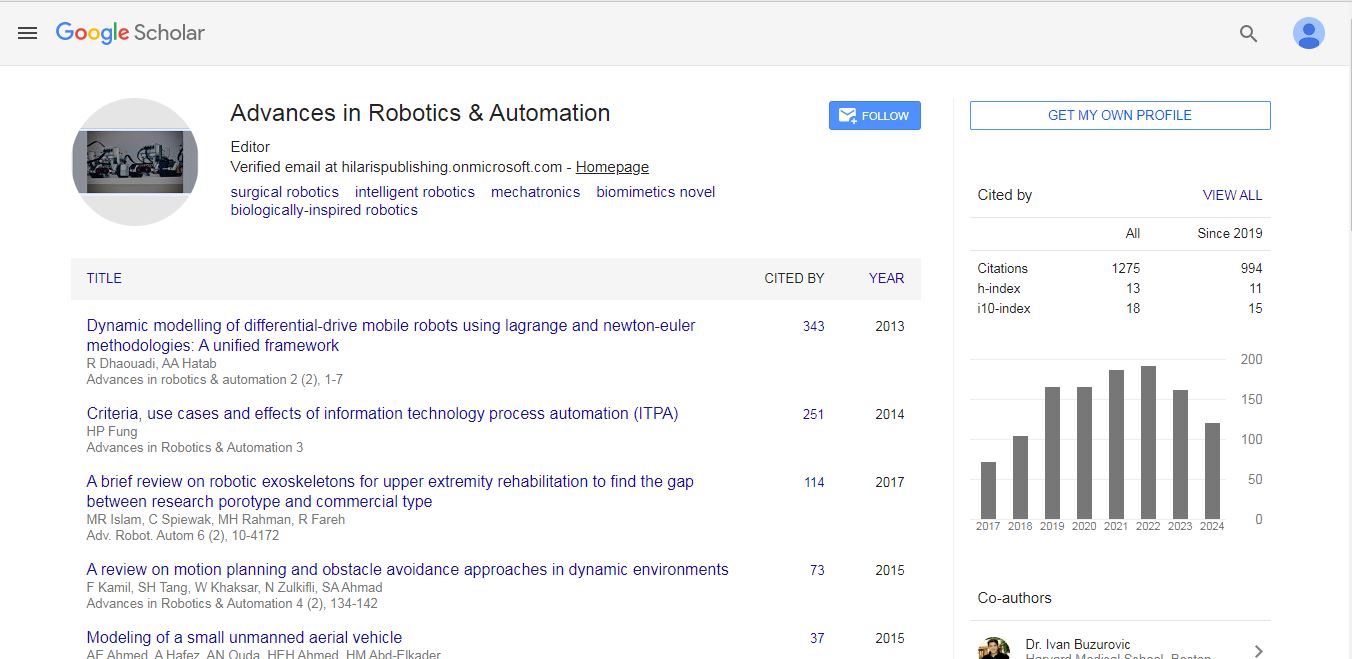
Advances in Robotics & Automation received 1275 citations as per Google Scholar report