Perspective - (2025) Volume 19, Issue 3
Received: 01-Jun-2025, Manuscript No. jmgm-26-185651;
Editor assigned: 03-Jun-2025, Pre QC No. P-185651;
Reviewed: 17-Jun-2025, QC No. Q-185651;
Revised: 23-Jun-2025, Manuscript No. R-185651;
Published:
30-Jun-2025
, DOI: 10.37421/1747-0862.2025.19.727
Citation: Rodriguez, Mateo. ”RNA Therapeutics: Revolutionizing Medicine With Gene Control.” J Mol Genet Med 19 (2025):727.
Copyright: © 2025 Rodriguez M. This is an open-access article distributed under the terms of the Creative Commons Attribution License, which permits unrestricted use, distribution and reproduction in any medium, provided the original author and source are credited.
RNA-based therapies have emerged as a transformative force in modern medicine, offering novel approaches to treating a wide spectrum of diseases. Among these, messenger RNA (mRNA) vaccines have revolutionized vaccinology by utilizing the body's own cellular machinery to generate antigens, thereby eliciting a potent immune response without the need for live pathogens. This innovative strategy has demonstrated remarkable efficacy against infectious diseases and holds considerable promise for the development of cancer vaccines. small interfering RNAs (siRNAs) represent another significant class of RNA therapeutics, employing the natural mechanism of RNA interference to silence specific genes. By targeting the root cause of protein dysfunction, siRNAs provide a powerful tool for managing genetic disorders and other diseases with a molecular basis. The success of mRNA therapeutics, particularly in the realm of vaccines, has been critically dependent on the development of sophisticated delivery systems. Lipid nanoparticles (LNPs) have played a pivotal role in enabling the in vivo delivery of mRNA, with their design principles dictating stability, cellular uptake, and endosomal escape. Further enhancing the efficacy and safety of mRNA therapeutics has been the incorporation of modified nucleosides. The strategic inclusion of modified nucleosides, such as pseudouridine, into synthetic mRNA sequences has been instrumental in reducing immunogenicity and improving protein translation, paving the way for more potent and safer RNA-based treatments. The broader landscape of RNA therapeutics also includes applications beyond mRNA and siRNA. CRISPR-Cas systems, guided by RNA, offer a revolutionary platform for precise genome editing, holding immense potential for correcting genetic defects that underlie numerous diseases. Their adaptability also extends to RNA targeting, further expanding the therapeutic toolkit. While siRNA therapeutics offer great promise, significant challenges remain in their effective delivery to target tissues and cells. Overcoming off-target effects and ensuring efficient accumulation at the desired sites are critical for realizing their full clinical potential. Various strategies, including chemical modifications and encapsulation in delivery vehicles, are being explored to address these hurdles. Beyond direct therapeutic intervention, mRNA technology is also being leveraged for protein replacement therapies. This approach involves delivering mRNA encoding a functional protein to cells, enabling the synthesis of therapeutic proteins for diseases characterized by protein deficiency or dysfunction. Antisense oligonucleotides (ASOs) represent another established class of RNA-based therapeutics. These molecules bind to specific mRNA sequences, modulating gene expression by inhibiting translation or altering splicing pathways, offering a versatile approach for treating various conditions. The application of RNA therapeutics in oncology is a rapidly expanding area of research. Both mRNA and siRNA are being explored for their ability to stimulate anti-tumor immunity or inhibit genes essential for cancer cell survival, though challenges related to tumor penetration and delivery persist. Lastly, the immunogenicity of mRNA-based therapies requires careful consideration. While a controlled immune response is desirable for vaccines, unintended immune reactions can compromise the safety and efficacy of other mRNA therapeutics. Strategies to modulate these responses are crucial for broad therapeutic application.
RNA-based therapeutics, encompassing mRNA vaccines and siRNA treatments, represent a significant leap forward in medical innovation, leveraging the body's endogenous mechanisms for therapeutic benefit. mRNA vaccines ingeniously employ the cellular machinery to produce antigens, thereby stimulating a robust immune response without introducing live pathogens. This approach has proven highly effective for infectious diseases and shows immense potential for cancer vaccines. small interfering RNAs (siRNAs) function by interfering with gene expression through the RNA interference pathway. They are processed by the Dicer enzyme and incorporated into the RNA-induced silencing complex (RISC), which then mediates the sequence-specific degradation of target messenger RNAs (mRNAs). This mechanism offers a powerful means to address diseases at their genetic origin. The successful translation of mRNA from a laboratory curiosity to a clinical tool has been largely facilitated by advancements in delivery systems, particularly lipid nanoparticles (LNPs). The intricate design of LNPs, encompassing ionizable lipids, cholesterol, helper lipids, and PEG-lipids, is critical for their stability, cellular uptake efficiency, and subsequent endosomal escape, all of which are vital for delivering mRNA payloads effectively. Enhancing the stability and reducing the immunogenicity of mRNA have been key objectives in the development of mRNA therapeutics. The incorporation of modified nucleosides, such as pseudouridine, into the mRNA sequence has been a pivotal strategy, helping to circumvent innate immune detection and improve protein translation rates, thereby contributing to safer and more effective RNA-based treatments. CRISPR-Cas systems, a revolutionary gene-editing technology, are increasingly being integrated into the development of RNA-based therapies. These systems, guided by RNA molecules, enable precise modifications to DNA, offering a pathway to correct genetic mutations underlying various diseases. Their potential for RNA targeting further broadens their therapeutic applicability. Despite the promise of siRNA therapeutics, a major challenge lies in their systemic delivery. Ensuring that siRNAs reach target tissues and cells effectively, while minimizing off-target effects, remains a critical area of research. Strategies such as chemical modification of siRNAs, conjugation with targeting ligands, and formulation within advanced delivery vehicles are being actively pursued. mRNA technology is also being utilized for protein replacement therapies, addressing diseases caused by the absence or deficiency of specific proteins. This involves delivering synthetic mRNA that encodes the missing protein, allowing the patient's cells to produce it, thereby correcting the underlying molecular deficit. Antisense oligonucleotides (ASOs) represent another established class of RNA-based therapeutics. These short, synthetic RNA molecules bind to complementary sequences on target mRNAs, leading to the inhibition of protein synthesis or modulation of gene splicing. ASOs have shown clinical success in treating a range of genetic disorders. In the field of oncology, RNA therapeutics, including mRNA and siRNA, are being explored for their potential to combat cancer. mRNA-based cancer vaccines aim to elicit an anti-tumor immune response, while siRNAs can be used to silence genes that promote cancer cell growth and survival. Overcoming challenges such as tumor penetration and immune evasion is crucial for their widespread application. Finally, the immunogenicity of mRNA-based therapies is a critical aspect that influences their therapeutic utility. While an immunogenic response is desired for vaccines, for other therapeutic applications, minimizing unintended immune reactions is paramount. Strategies involving modifications to mRNA sequences and delivery vehicle formulations are employed to modulate these immune responses, ensuring optimal safety and efficacy.
RNA-based therapies, including mRNA vaccines and siRNA treatments, are revolutionizing medicine by utilizing the body's cellular machinery. mRNA vaccines leverage this for robust immune responses against infectious diseases and cancer, while siRNAs silence specific genes to treat genetic disorders. Lipid nanoparticles are crucial for in vivo delivery of mRNA, and modified nucleosides enhance mRNA stability and reduce immunogenicity. CRISPR-Cas systems offer gene editing capabilities for genetic diseases. Challenges remain in siRNA delivery, but strategies like chemical modifications and nanoparticles are being developed. mRNA is also used for protein replacement therapies, and antisense oligonucleotides modulate gene expression. RNA therapeutics are being applied in oncology, with ongoing efforts to control immunogenicity for broader therapeutic use.
None
None
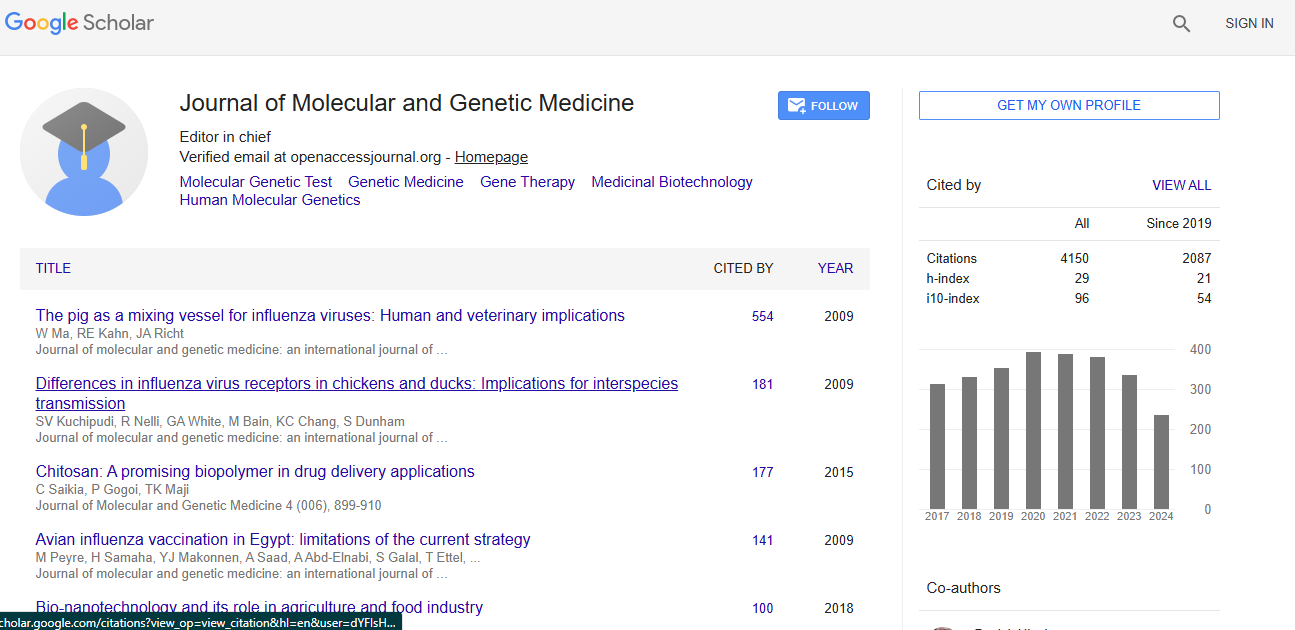
Molecular and Genetic Medicine received 3919 citations as per Google Scholar report