Opinion - (2025) Volume 16, Issue 4
Received: 01-Jul-2025, Manuscript No. hycr-25-174944;
Editor assigned: 03-Jul-2025, Pre QC No. P-174944;
Reviewed: 17-Jul-2025, QC No. Q-174944;
Revised: 22-Jul-2025, Manuscript No. R-174944;
Published:
29-Jul-2025
, DOI: 10.37421/2157-7587.2025.16.610
Citation: Kovacs, Raina. ”River Flow: Impacts, Futures, and Sustainable Management.” Hydrol Current Res 16 (2025):610.
Copyright: © 2025 Kovacs R. This is an open-access article distributed under the terms of the Creative Commons Attribution License, which permits unrestricted use,
distribution and reproduction in any medium, provided the original author and source are credited.
The complex dynamics of river flow are fundamental to understanding aquatic ecosystems and managing water resources globally. Research indicates that changes in forest cover significantly modulate how river flow alterations impact water quality and overall ecosystem health across various river basins. This highlights the critical importance of integrated land-water management strategies for maintaining healthy and resilient aquatic environments [1].
In specific regional contexts, such as Chinaâ??s Shiyang River Basin, detailed studies have quantified the separate and combined impacts of climate change and human activities on river flow. Using robust hydrological models and statistical methods, it's evident that both climate variability and extensive human interventions, particularly irrigation and dam construction, have substantially altered the natural flow regime. This understanding is crucial for localized water resource planning [2].
Projecting future river flow regimes and hydrological extremes under various climate change scenarios is a pressing concern. Comprehensive reviews synthesize current research, critically evaluating different modeling approaches and their inherent uncertainties. Such work emphasizes the vital need for robust methods to accurately predict changes in floods, droughts, and overall water availability, which is essential for informing effective adaptation strategies [3].
River flow also plays a fundamental and dynamic role in shaping estuarine environments. A global review systematically examines its significant influence on the formation and behavior of estuarine turbidity maxima (ETM). It elucidates how variations in river discharge directly impact sediment transport, flocculation, and the vertical circulation patterns critical for ETM development, which is vital for comprehending estuarine ecosystems and pollutant dispersion [4].
To enhance predictive capabilities in water resource management, novel methodologies are continually being developed. One such advancement is a hybrid deep learning model that incorporates an attention mechanism for significantly improved river flow forecasting. This innovative model effectively captures complex temporal dependencies and strategically leverages the importance of different input features, demonstrating superior accuracy compared to traditional methods and offering improved predictions for water resource management [5].
Within large and complex systems like the Yangtze River Basin, research identifies the spatiotemporal variations of runoff and river flow. Key influencing factors, including both climate change and diverse human activities, are thoroughly investigated. The analysis reveals distinct regional patterns and observable trends, providing valuable insights that are essential for strategic water resource planning and management within one of the world's largest river systems [6].
The operational impacts of large-scale infrastructure are also a critical area of study. Dam operations, for instance, significantly influence hydrological drought characteristics and fundamentally alter natural river flow patterns across the vast Lancang-Mekong River Basin. Utilizing various drought indices and sophisticated hydrological modeling, the findings highlight the profound downstream impacts of upstream dam regulation, emphasizing its importance for transboundary water management and ecological conservation [7].
Furthermore, land use changes exert considerable influence on river systems. A study within the Urumqi River Basin rigorously assessed the profound impacts of both historical and projected future land use transformations on river flow and sediment yield. Employing SWAT modeling, the research quantifies how processes like urbanization, agricultural expansion, and dynamic vegetation changes collectively alter hydrological processes, yielding crucial insights for sustainable land and water management in arid regions [8].
Understanding the geomorphological controls governing river systems is also paramount. A comprehensive review synthesizes current knowledge on river flow and sediment transport within complex braided river systems. It discusses the intricate interplay of hydrology, morphology, and specific sediment characteristics, identifying key research gaps and outlining future directions for better understanding and managing these highly dynamic and ecologically significant environments [9].
Finally, in challenging geographical contexts such as transboundary Himalayan river basins, research characterizes the complex hydrological behavior and trends in river flow. Attributing observed changes to both climate change and anthropogenic influences, this analysis provides crucial insights into water resource variability and informs adaptive management strategies for regions heavily reliant on glacier-fed river systems [10].
The health of aquatic ecosystems and the reliable provision of water resources are intimately tied to river flow dynamics, which are increasingly influenced by both natural processes and human interventions. Studies highlight the critical role of land cover in modulating these dynamics. For instance, changes in forest cover are shown to significantly interact with river flow, directly influencing water quality and overall ecosystem health across various river basins. This research emphasizes that altered forest landscapes can profoundly modify the effects of river flow changes on a range of water quality parameters, underscoring the vital need for integrated land-water management to sustain healthy aquatic environments [1]. Similarly, the broad impacts of land use changes, including urbanization and agricultural expansion, on river flow and sediment yield have been quantified. This work, exemplified in the Urumqi River Basin, uses modeling to show how these transformations alter hydrological processes, offering essential insights for sustainable management in arid regions [8].
A significant portion of current hydrological research focuses on disentangling the impacts of climate change and human activities on river flow. In the Shiyang River Basin, analyses using hydrological models and statistical methods have clearly demonstrated that both climate variability and human interventions, particularly large-scale irrigation and dam construction, have significantly altered the natural flow regime [2]. This pattern is echoed in the expansive Yangtze River Basin, where spatiotemporal variations of runoff and river flow are attributed to a combination of climate change and various human activities, revealing distinct regional patterns crucial for water resource planning [6]. Furthermore, in transboundary systems like a Himalayan river basin, observed trends in river flow and complex hydrological behavior are characterized and linked to both climate change and anthropogenic influences, informing adaptive management strategies for glacier-fed rivers [10]. Dam operations, a specific type of human intervention, are shown to significantly influence hydrological drought characteristics and alter natural river flow patterns, especially across the Lancang-Mekong River Basin. Findings from this region underline the profound downstream consequences of upstream dam regulation, necessitating careful transboundary water management and conservation efforts [7].
Anticipating future changes in river flow is paramount for effective water management. A key area of focus is projecting future river flow regimes and hydrological extremes under various climate change scenarios. Comprehensive reviews critically evaluate different modeling approaches and their inherent uncertainties, stressing the urgent need for robust methodologies to predict changes in floods, droughts, sadly, and overall water availability to inform adaptation strategies [3]. Complementing this, advancements in predictive modeling are continually being made. A novel hybrid deep learning model, incorporating an attention mechanism, demonstrates significantly improved river flow forecasting capabilities. This model effectively captures complex temporal dependencies and leverages the importance of different input features, offering superior accuracy over traditional methods and providing better predictions essential for optimized water resource management [5].
Beyond broad climatic and anthropogenic drivers, the intrinsic characteristics of river systems themselves play a crucial role in their behavior. For instance, a global review systematically examines the significant influence of river flow in controlling the formation and dynamic behavior of estuarine turbidity maxima (ETM). This research highlights how variations in river discharge impact sediment transport, flocculation, and the vertical circulation patterns crucial for ETM development, which are vital for understanding estuarine ecosystems and pollutant dispersion [4].
In a similar vein, understanding the geomorphological controls on river flow and sediment transport within complex braided river systems is essential. A review synthesizes current knowledge, discussing the intricate interplay of hydrology, morphology, and sediment characteristics, while also identifying key research gaps and future directions for better managing these dynamic and ecologically significant environments [9]. These studies collectively underscore the multifaceted nature of river systems, where physical characteristics interact with external influences to dictate their function and resilience, demanding a holistic approach to their study and management.
Current research on river flow provides a comprehensive view of its critical importance across hydrological, ecological, and management domains. Studies demonstrate how environmental factors, such as changes in forest cover, significantly influence water quality and ecosystem health across river basins, reinforcing the necessity for integrated land-water management approaches [1]. A recurring theme is the profound impact of human activitiesâ??including large-scale irrigation, dam construction, and various land use changes like urbanization and agricultural expansionâ??in conjunction with climate change. These factors are consistently identified as major drivers altering natural river flow regimes and sediment yields in diverse basins globally, from Chinaâ??s Shiyang and Yangtze rivers to the Urumqi and transboundary Lancang-Mekong and Himalayan systems [2, 6, 7, 8, 10]. Such alterations contribute to modified hydrological drought characteristics and notable runoff variations. A significant area of focus involves projecting future river flow regimes and hydrological extremes, including floods and droughts, under ongoing climate change scenarios. This work emphasizes the urgent need for robust predictive modeling and informed adaptation strategies [3]. To enhance these capabilities, innovative forecasting methods, such as novel hybrid deep learning models, are being developed, offering superior accuracy for optimized water resource management [5]. Moreover, the fundamental role of river flow extends to influencing critical estuarine dynamics, particularly the formation and behavior of turbidity maxima, which are crucial for maintaining ecosystem health and understanding pollutant dispersion [4]. Finally, understanding the intrinsic geomorphological controls on flow and sediment transport in complex braided river systems is also highlighted as essential for their effective management [9]. Collectively, this body of research underscores the imperative for a holistic understanding of both natural and anthropogenic influences on river flow to ensure sustainable water resource and ecosystem management.
None
None
Indexed at, Google Scholar, Crossref
Indexed at, Google Scholar, Crossref
Indexed at, Google Scholar, Crossref
Indexed at, Google Scholar, Crossref
Indexed at, Google Scholar, Crossref
Indexed at, Google Scholar, Crossref
Indexed at, Google Scholar, Crossref
Indexed at, Google Scholar, Crossref
Indexed at, Google Scholar, Crossref
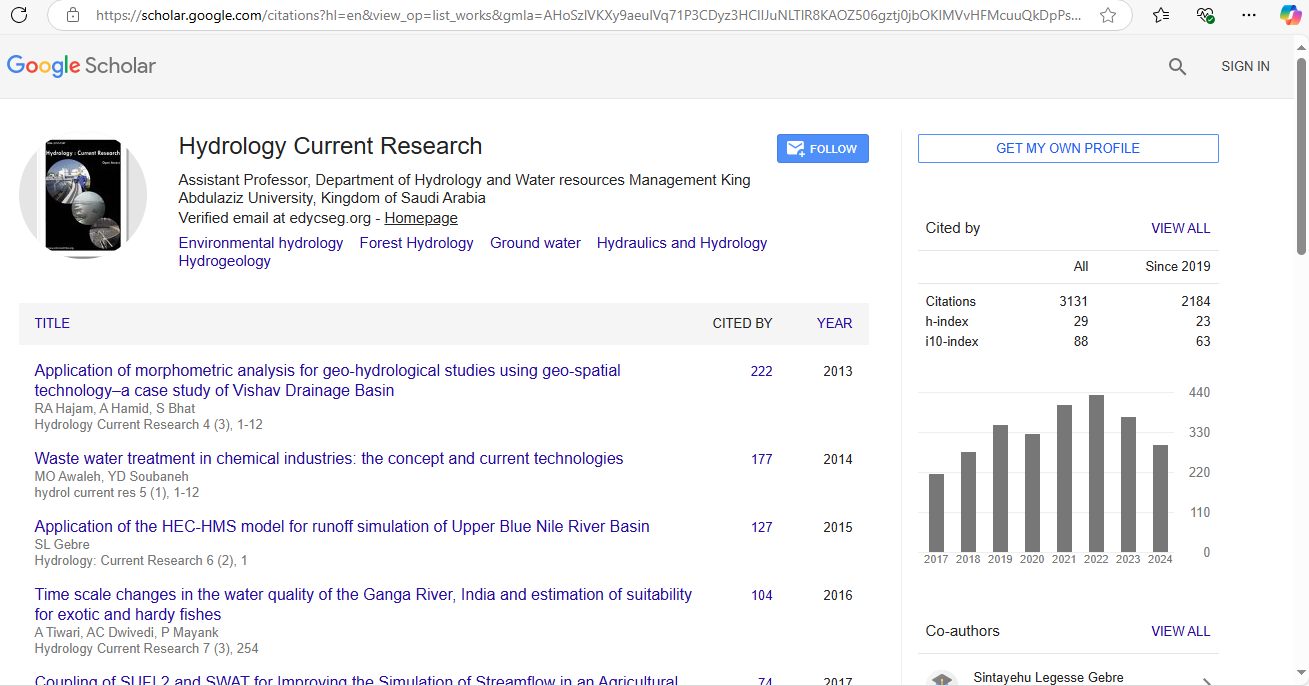
Hydrology: Current Research received 2843 citations as per Google Scholar report