Perspective - (2025) Volume 13, Issue 4
Received: 01-Aug-2025, Manuscript No. jaat-26-183171;
Editor assigned: 04-Aug-2025, Pre QC No. P-183171;
Reviewed: 18-Aug-2025, QC No. Q-183171;
Revised: 22-Aug-2025, Manuscript No. R-183171;
Published:
29-Aug-2025
, DOI: 10.37421/2329-6542.2025.13.369
Citation: El‑Sherif, Yasmine. ”Revolutionizing Space: Servicing, Assembly, and Manufacturing.” J Astrophys Aerospace Technol 13 (2025):369.
Copyright: © 2025 El‑Sherif Y. This is an open-access article distributed under the terms of the Creative Commons Attribution License, which permits unrestricted use, distribution and reproduction in any medium, provided the original author and source are credited.
In-orbit servicing, assembly, and manufacturing (OSAM) represent a paradigm shift in space operations, offering capabilities such as on-orbit repair, refueling, reconfiguration, and the construction of larger structures. This technological evolution is instrumental in extending the operational lifespan of satellites, thereby reducing the overall cost associated with space missions and paving the way for the development of advanced space infrastructure [1].
The core of this advancement lies in the development of sophisticated robotic systems, highly autonomous operations, standardized interfaces for seamless integration, and advanced propulsion technologies essential for precise maneuvering and executing complex tasks in the challenging space environment [1].
This innovative field is pivotal for fostering sustainable space exploration and driving commercialization efforts [1].
The advancement of robotic systems is a cornerstone of in-orbit servicing and assembly initiatives, necessitating the development of sophisticated robotic arms, dexterous manipulation capabilities, and advanced sensor fusion for accurate grasping and docking procedures [2].
Autonomy emerges as a critical facilitator, reducing the dependency on ground control and enabling more rapid mission execution, underscoring the importance of robust control algorithms designed for the harsh conditions of space [2].
Manufacturing in space presents unique and significant advantages, particularly in the production of novel materials and components that are not feasible to create on Earth due to gravitational constraints [3].
Research in this area focuses on adapting additive manufacturing techniques, such as 3D printing, for the space environment, addressing challenges like microgravity, vacuum conditions, and specific material processing requirements to enable the creation of functional parts and structures in orbit [3].
The economic justification for in-orbit servicing is progressively strengthening, with analyses highlighting the substantial return on investment for missions aimed at extending satellite life, facilitating the de-orbiting of defunct satellites, and providing in-orbit refueling services [4].
OSAM technologies are poised to fundamentally alter space economics by significantly lowering operational expenditures and introducing new avenues for revenue generation within the space sector [4].
Standardization of interfaces and docking mechanisms plays a crucial role in enabling the widespread adoption of in-orbit assembly and servicing operations [5].
The development of common interface standards is essential to ensure that diverse spacecraft and servicing vehicles can connect and interact without impediment, fostering interoperability that is fundamental to constructing a connected and efficient orbital ecosystem [5].
Autonomous navigation and control are indispensable for the successful execution of complex in-orbit servicing and assembly operations, demanding sophisticated algorithms for real-time trajectory planning, hazard avoidance, and precise station-keeping within dynamic space environments [6].
The capacity for spacecraft to navigate and maneuver independently drastically enhances overall mission capabilities and efficiency [6].
The establishment of space-based manufacturing capabilities unlocks profound potential for creating innovative materials and intricate structures that leverage the unique conditions of the space environment [7].
Investigations in this domain delve into the fundamental principles and diverse applications of manufacturing in microgravity, with a particular focus on advanced alloys, pharmaceuticals, and complex lattice structures with unique properties [7].
Extending the operational life of satellites through in-orbit servicing is a primary impetus for the advancement of OSAM technologies [8].
This involves addressing technical hurdles associated with rendezvous, proximity operations, capture, and refueling of existing spacecraft, thereby obviating the need for costly replacements and actively contributing to the mitigation of space debris [8].
The development of efficient and versatile propulsion systems is paramount for achieving the precise maneuvering required for in-orbit servicing and assembly tasks [9].
Reviewing various electric and chemical propulsion technologies suitable for proximity operations, docking, and orbital adjustments, this research emphasizes their performance characteristics and energy requirements, crucial for mission success [9].
The critical concern of space debris mitigation is a significant driver for enhancing in-orbit servicing capabilities, especially for the de-orbiting of defunct satellites [10].
This area of research explores technologies and operational strategies for active debris removal and controlled de-orbiting, underscoring the vital role of OSAM in preserving the long-term sustainability of the space environment [10].
In-orbit servicing, assembly, and manufacturing (OSAM) are fundamentally transforming space operations by introducing critical capabilities such as on-orbit repair, refueling, reconfiguration, and the construction of larger space assets. This technological evolution is key to extending the operational life of satellites, substantially reducing launch costs, and laying the groundwork for advanced space infrastructure. The primary drivers for this advancement include the development of sophisticated robotic capabilities, robust autonomous systems, standardized interfaces for seamless connectivity, and advanced propulsion systems designed for precise maneuvering and complex orbital tasks. OSAM is vital for ensuring the sustainability of space exploration and facilitating commercial ventures in orbit [1].
The progress in robotic systems is central to the success of in-orbit servicing and assembly missions, requiring the creation of advanced robotic arms, highly dexterous manipulation abilities, and integrated sensor fusion for accurate object capture and docking maneuvers [2].
Autonomy is a crucial enabler, reducing the reliance on continuous ground control and expediting mission timelines, which highlights the necessity of developing resilient control algorithms capable of functioning reliably in the harsh space environment [2].
Manufacturing in space offers distinct advantages, particularly in the production of unique materials and components that cannot be manufactured on Earth due to the absence of gravity. This involves adapting additive manufacturing techniques, such as 3D printing, to the space environment, overcoming challenges posed by microgravity, vacuum, and specialized material processing to create functional parts and structures in orbit [3].
The economic rationale for in-orbit servicing is becoming increasingly persuasive, with analyses indicating a strong potential for return on investment in missions focused on extending satellite lifespans, performing de-orbiting of defunct satellites, and providing in-orbit refueling services. OSAM technologies are expected to revolutionize space economics by decreasing operational costs and generating novel revenue streams within the industry [4].
A critical factor for enabling extensive in-orbit assembly and servicing is the standardization of interfaces and docking mechanisms [5].
The development of common interface standards allows for seamless connection and interaction between different spacecraft and servicing vehicles. Achieving this interoperability is paramount for building a connected and efficient ecosystem in orbit [5].
Autonomous navigation and control systems are essential for the successful execution of complex in-orbit servicing and assembly tasks. This research area focuses on developing advanced algorithms for real-time trajectory planning, hazard avoidance, and precise station-keeping in dynamic space environments. The ability of spacecraft to navigate and maneuver independently significantly enhances overall mission capabilities and efficiency [6].
The advent of space-based manufacturing opens up unprecedented possibilities for creating novel materials and sophisticated structures that harness the unique conditions of the space environment. This research investigates the principles and applications of manufacturing in microgravity, with a focus on areas such as advanced alloys, pharmaceuticals, and complex lattice structures that benefit from a zero-gravity environment [7].
Extending the operational lifespan of satellites through in-orbit servicing represents a significant driver for the advancement of OSAM technologies [8].
This involves addressing the technical challenges associated with rendezvous, proximity operations, capture, and refueling of existing spacecraft, thereby reducing the need for costly satellite replacements and actively contributing to the mitigation of space debris [8].
The development of efficient and versatile propulsion systems is crucial for achieving the precise maneuvering required for in-orbit servicing and assembly tasks [9].
This work reviews various electric and chemical propulsion technologies suitable for proximity operations, docking, and orbital adjustments, emphasizing their performance characteristics and power requirements essential for successful mission execution [9].
Space debris mitigation is a key impetus for advancing in-orbit servicing capabilities, particularly in the context of de-orbiting defunct satellites. This research explores the technologies and operational strategies for active debris removal and controlled de-orbiting, highlighting the critical role of OSAM in maintaining a sustainable space environment for future use [10].
In-orbit servicing, assembly, and manufacturing (OSAM) are revolutionizing space operations by enabling on-orbit repair, refueling, reconfiguration, and construction. This technology extends satellite lifespans, reduces launch costs, and facilitates advanced space infrastructure through robotic capabilities, autonomous systems, standardized interfaces, and advanced propulsion. Manufacturing in space allows for the creation of unique materials and components not possible on Earth, using adapted additive manufacturing techniques. The economic benefits of OSAM are significant, offering new revenue streams and reduced operational costs. Standardization of interfaces is crucial for interoperability, while autonomous navigation and control enhance mission efficiency. Space-based manufacturing leverages microgravity for novel materials. Satellite life extension through servicing is a major driver, and efficient propulsion is vital for precise maneuvers. OSAM also plays a key role in mitigating space debris by enabling de-orbiting of defunct satellites, ensuring a sustainable space environment.
None
None
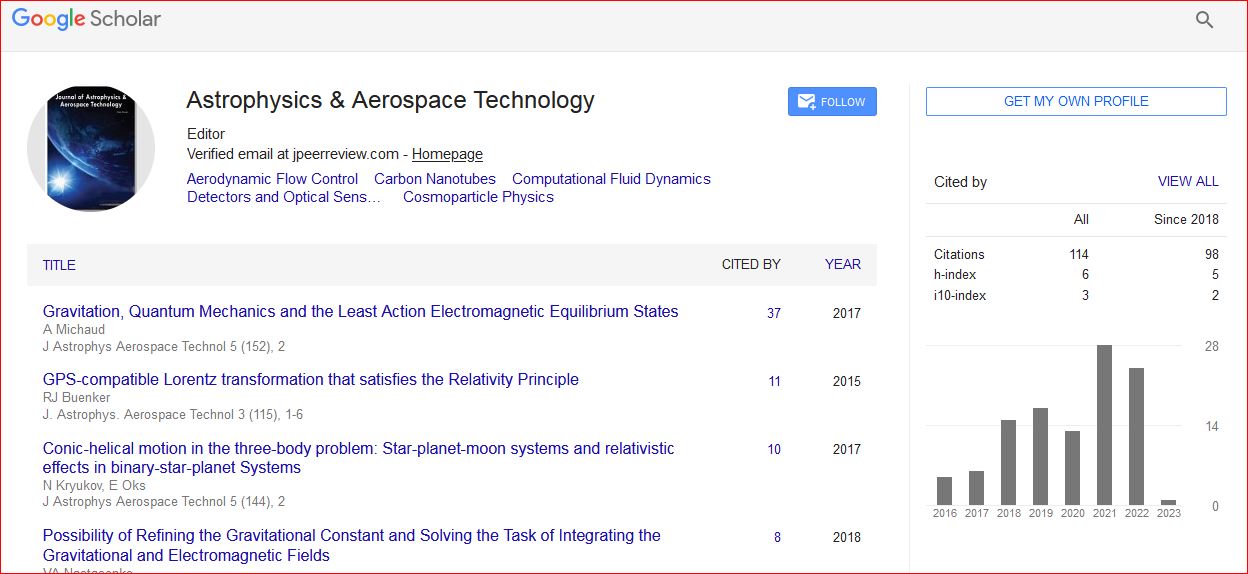
Astrophysics & Aerospace Technology received 114 citations as per Google Scholar report