Short Communication - (2025) Volume 10, Issue 3
Received: 02-Jun-2025, Manuscript No. jcct-26-183219;
Editor assigned: 04-Jun-2025, Pre QC No. P-183219;
Reviewed: 18-Jun-2025, QC No. Q-183219;
Revised: 23-Jun-2025, Manuscript No. R-183219;
Published:
30-Jun-2025
, DOI: 10.37421/2577-0535.2025.9.317
Citation: Romano, Isabella. ”Revolutionizing Cancer Treatment: Neoadjuvant, Adjuvant Therapies.” J Cancer Clin Trials 10 (2025):317.
Copyright: © 2025 Romano I. This is an open-access article distributed under the terms of the Creative Commons Attribution License, which permits unrestricted use, distribution and reproduction in any medium, provided the original author and source are credited.
Neoadjuvant and adjuvant therapies are fundamentally reshaping the treatment paradigms for solid tumors, with a primary objective of enhancing patient outcomes through the eradication of micrometastatic disease or the reduction of tumor burden prior to surgical intervention [1].
Recent therapeutic advancements are increasingly focused on the strategic integration of immunotherapeutic agents, targeted therapies, and novel chemotherapy regimens within the perioperative care continuum [1].
These innovative treatment strategies are undergoing rigorous evaluation in large-scale clinical trials, with the ultimate goal of establishing new benchmarks of care across a diverse spectrum of solid malignancies, including but not limited to lung, breast, and gastrointestinal cancers [1].
The application of neoadjuvant immunotherapy is experiencing a rapid expansion beyond its established roles in melanoma and lung cancer, with ongoing investigations into its efficacy in early-stage breast, esophageal, and gastric cancers [2].
These neoadjuvant immunotherapy trials frequently explore combination approaches with standard chemotherapy, underscoring the evolving strategies in early-stage cancer management [2].
Adjuvant targeted therapies have demonstrated substantial clinical benefits, particularly in well-defined patient populations such as those with HER2-positive breast cancer and EGFR-mutated non-small cell lung cancer (NSCLC) [3].
Research efforts are actively investigating the optimal duration for these adjuvant targeted therapies, their utility in novel combination regimens, and their potential application in other tumor types characterized by specific actionable molecular alterations [3].
The landscape of neoadjuvant chemotherapy for colorectal cancer is undergoing continuous evolution, with a notable emphasis on de-escalation strategies and the assessment of induction chemotherapy followed by chemoradiation for locally advanced rectal cancer [4].
Precision oncology is becoming an indispensable component of neoadjuvant and adjuvant trial designs, utilizing molecular profiling to guide the selection of targeted agents and immunotherapies for maximized efficacy and minimized toxicity [5].
The development of robust predictive biomarkers for response to neoadjuvant and adjuvant therapies is a critical imperative for the advancement of personalized cancer medicine, with extensive research dedicated to identifying patients most likely to benefit from specific treatment modalities [10].
The transformative impact of neoadjuvant and adjuvant therapies on solid tumor treatment is profound, aiming to elevate patient prognoses by addressing micrometastatic disease or diminishing tumor mass before surgical resection [1].
Cutting-edge advancements in this field are centered on the synergistic integration of immunotherapy, targeted agents, and innovative chemotherapy regimens within the perioperative treatment settings [1].
These meticulously designed strategies are progressively being validated in extensive clinical trials to set new standards of care for a variety of solid tumors, encompassing lung, breast, and gastrointestinal cancers [1].
The utility of neoadjuvant immunotherapy is rapidly extending beyond its traditional applications in melanoma and lung cancer, with active trials investigating its effectiveness in early-stage breast, esophageal, and gastric cancers [2].
These neoadjuvant immunotherapy investigations often involve combinations with chemotherapy, highlighting a shift towards multifaceted treatment approaches in early disease [2].
Adjuvant targeted therapies have established a significant track record of success, especially in HER2-positive breast cancer and EGFR-mutated non-small cell lung cancer (NSCLC), leading to improved patient outcomes [3].
Contemporary research is focused on determining the ideal duration of adjuvant therapies, exploring their use in novel combinations, and assessing their applicability to other tumor types harboring specific molecular aberrations [3].
The management of resectable pancreatic cancer is evolving, with a notable increase in the use of neoadjuvant chemotherapy to enhance resectability rates and improve survival outcomes [6].
Clinical trials are actively comparing various chemotherapy regimens and evaluating combinations with chemoradiation administered prior to surgical intervention for pancreatic cancer [6].
The assessment of pathological response following neoadjuvant therapy holds critical importance for guiding subsequent treatment decisions and serves as a crucial endpoint in clinical trials, with ongoing improvements in imaging and pathological analysis enhancing response evaluation accuracy [8].
Neoadjuvant and adjuvant therapies are revolutionizing solid tumor treatment by targeting micrometastatic disease and reducing tumor burden before surgery. Recent advancements include the integration of immunotherapy and targeted agents, with ongoing trials establishing new standards of care for various cancers. The use of neoadjuvant immunotherapy is expanding beyond melanoma and lung cancer to include breast, esophageal, and gastric cancers, often in combination with chemotherapy. Adjuvant targeted therapies have shown significant benefits in HER2-positive breast cancer and EGFR-mutated NSCLC. Research is focused on optimizing treatment duration and exploring new combinations. Neoadjuvant chemotherapy is evolving for colorectal and pancreatic cancers, with pathological complete response emerging as a key endpoint. Precision oncology and molecular profiling are guiding treatment selection to maximize efficacy and minimize toxicity. The development of predictive biomarkers is essential for personalized medicine, and improved pathological response assessment is crucial for guiding further treatment decisions.
None
None
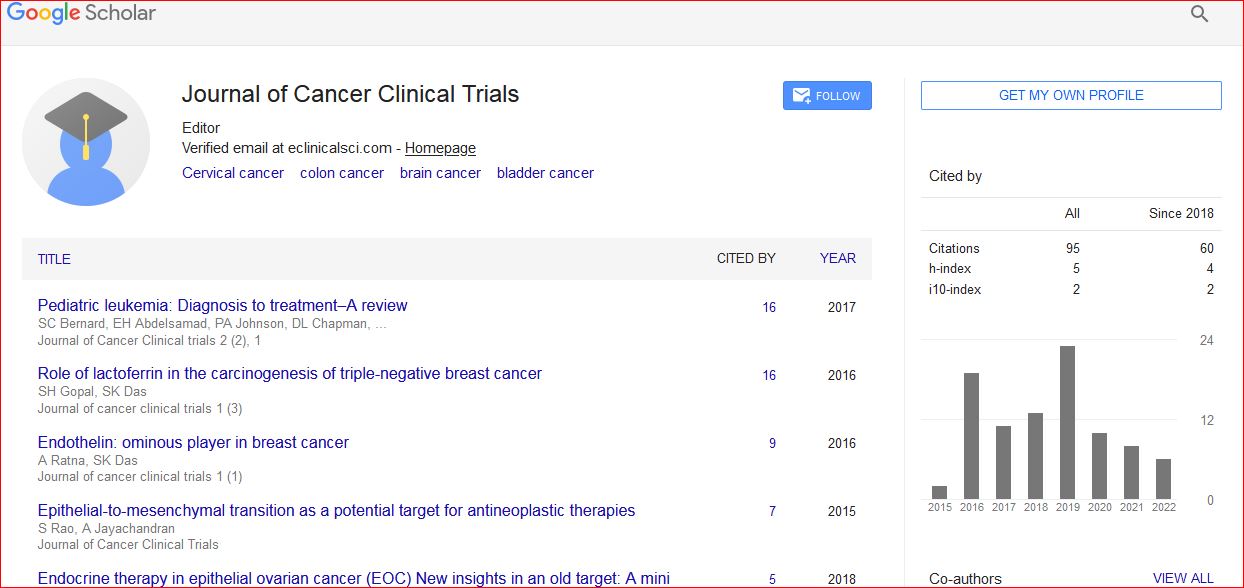
Journal of Cancer Clinical Trials received 95 citations as per Google Scholar report