Commentary - (2025) Volume 11, Issue 4
Received: 01-Jul-2025, Manuscript No. aso-25-184646;
Editor assigned: 03-Jul-2025, Pre QC No. P-184646;
Reviewed: 17-Jul-2025, QC No. Q-184646;
Revised: 22-Jul-2025, Manuscript No. R-184646;
Published:
29-Jul-2025
, DOI: 10.37421/2471-2671.2025.11.178
Citation: Brooks, Natalie. ”Revolutionizing Cancer Care: Image-
Guided and Robotic Surgery.” Arch Surg Oncol 11 (2025):178.
Copyright: © 2025 Brooks N. This is an open-access article distributed under the terms of the Creative Commons Attribution License, which permits unrestricted use,
distribution and reproduction in any medium, provided the original author and source are credited.
Image-guided and robotic surgery are fundamentally transforming oncologic practice by significantly enhancing surgical precision and improving visualization capabilities. These advanced technologies are instrumental in enabling minimally invasive approaches, which in turn facilitate more accurate tumor localization and the achievement of clearer resection margins. The resultant reduction in invasiveness directly contributes to improved patient outcomes, characterized by faster recovery periods and a potential decrease in complication rates. The seamless integration of sophisticated imaging modalities, such as intraoperative ultrasound, MRI, and CT, alongside advanced robotic platforms, empowers surgeons to navigate complex anatomical structures with unparalleled dexterity and control. This synergistic combination is especially impactful in demanding oncologic resections where the meticulous preservation of critical anatomical structures and the complete eradication of tumor tissue are of utmost importance.
Robotic-assisted radical prostatectomy has emerged as a standard treatment modality for localized prostate cancer, demonstrably offering substantial benefits in preserving essential functional outcomes, including urinary continence and erectile potency, when contrasted with traditional open surgical techniques. The sophisticated robotic systems provide surgeons with enhanced three-dimensional visualization and highly dexterous, wristed instruments. These capabilities are crucial for the precise dissection of delicate neurovascular bundles and for the meticulous reconstruction of the urethral anastomosis, leading to improved functional recovery for patients. Intraoperative imaging techniques, encompassing augmented reality and the utilization of fluorescent tracers, play a pivotal role in guiding oncologic resections, particularly in cases involving tumors that are difficult to precisely locate or during the execution of complex dissections. These cutting-edge tools significantly enhance a surgeon's capacity to accurately delineate tumor margins and to identify vital anatomical structures. Consequently, the risk of leaving positive surgical margins and the potential for inadvertent damage to adjacent organs are substantially minimized, leading to safer and more effective surgical interventions. The application of robotic surgery in the management of colorectal cancer has yielded demonstrable advantages, including a notable reduction in intraoperative blood loss, shorter hospital stays, and a more rapid restoration of normal bowel function. The superior visualization and refined precision afforded by robotic platforms prove particularly beneficial for complex procedures such as low anterior resections and challenging pelvic dissections. Crucially, these robotic approaches aid in the preservation of sphincter function, which is vital for maintaining the patient's quality of life. Image-guided techniques are indispensable for achieving accurate lymph node staging across a spectrum of cancer types, with particular significance in the performance of sentinel lymph node biopsies. The judicious combination of advanced imaging modalities with specialized tracer agents enables the precise identification and targeted guidance for the removal of the primary draining lymph node. This targeted approach enhances diagnostic accuracy and effectively reduces the necessity for more extensive and potentially morbid lymphadenectomy procedures. Robotic hepatectomy presents a compelling option for achieving improved outcomes in complex liver resections, facilitating enhanced precision and superior maneuverability within challenging anatomical regions. The observed benefits encompass a reduction in blood loss, often shorter operative durations, and a more accelerated recovery trajectory when compared with conventional open surgical methods. Importantly, these advancements are achieved while rigorously maintaining oncologic safety and achieving complete tumor resection. The burgeoning integration of artificial intelligence with robotic surgical systems heralds a promising future for further elevating surgical performance. This synergy has the potential to provide real-time decision support to surgeons, facilitate the automation of specific surgical tasks, and enable predictive analytics to optimize surgical planning and execution. Such advancements hold the key to enhancing the standardization of oncologic procedures and ultimately improving patient outcomes. Minimally invasive surgical approaches, prominently featuring robotic surgery, have demonstrated significant benefits within the field of gynecologic oncology. Procedures such as hysterectomy and pelvic lymphadenectomy performed robotically are associated with reduced postoperative pain, shortened recovery times, and improved cosmetic results. These advantages contribute to a better overall patient experience and a quicker return to daily activities. Image-guided radiation therapy (IGRT) stands as a cornerstone of contemporary radiation oncology, ensuring the precise targeting of tumors while simultaneously minimizing the radiation dose delivered to surrounding healthy tissues. Advanced techniques, including the integration of cone-beam CT and ultrasound imaging, facilitate highly accurate patient positioning and enable real-time adjustments during treatment delivery. This precision significantly enhances therapeutic efficacy and mitigates the likelihood of treatment-related side effects. Robotic-assisted thoracic surgery, particularly in the context of lung cancer resection, provides surgeons with substantially improved visualization and dexterity. This leads to the utilization of smaller incisions, resulting in reduced postoperative pain and a faster recovery period when compared to traditional open thoracotomy. The capacity to perform complex procedures, such as lobectomies, with a high degree of minimally invasive technique represents a significant and beneficial advancement in thoracic surgical practice.Image-guided and robotic surgical technologies are driving a paradigm shift in oncologic surgery by improving precision, enhancing visualization, and facilitating minimally invasive techniques. These innovations allow for more accurate tumor localization and the achievement of optimal resection margins, leading to better patient outcomes, faster recovery, and potentially fewer complications. The fusion of advanced imaging tools like intraoperative ultrasound, MRI, and CT with sophisticated robotic platforms provides surgeons with superior dexterity and control for navigating complex anatomy, which is particularly vital for challenging oncologic resections where preserving critical structures and ensuring complete tumor removal are paramount.
Robotic-assisted radical prostatectomy has become a gold standard for localized prostate cancer, offering significant improvements in functional outcomes such as continence and potency preservation compared to open surgery. The enhanced 3D visualization and articulated instruments of robotic systems enable meticulous dissection of neurovascular bundles and precise reconstruction of the urethral anastomosis, contributing to better functional recovery. Intraoperative imaging, including augmented reality and fluorescent tracers, is crucial for guiding oncologic resections, especially for difficult-to-localize tumors or during complex dissections. These tools empower surgeons to better define tumor margins and identify critical anatomical structures, thereby reducing the incidence of positive margins and inadvertent damage to surrounding organs, leading to improved surgical safety and efficacy. The implementation of robotic surgery in colorectal cancer treatment has demonstrated benefits such as decreased blood loss, shorter hospital stays, and accelerated return of bowel function. The enhanced visualization and precision offered by robotic platforms are particularly advantageous for procedures like low anterior resections and complex pelvic dissections, aiding in the preservation of sphincter function and improving postoperative quality of life. Image-guided techniques are essential for accurate lymph node staging in various cancers, notably for sentinel lymph node biopsy. Advanced imaging combined with tracer agents helps in identifying and guiding the removal of the primary draining lymph node, which improves diagnostic accuracy and reduces the need for more extensive lymphadenectomies, thereby minimizing morbidity. Robotic hepatectomy facilitates improved outcomes in complex liver resections by offering greater precision and maneuverability in challenging anatomical locations. Benefits include reduced blood loss, shorter operative times, and faster recovery compared to open surgery, all while ensuring oncologic safety and complete tumor resection. The integration of artificial intelligence with robotic surgery presents a promising avenue for further advancing surgical performance. This synergy can provide real-time decision support, automate certain tasks, and offer predictive analytics, potentially leading to greater standardization of procedures and enhanced patient outcomes in oncologic surgery. Minimally invasive approaches, particularly robotic surgery, have yielded significant advantages in gynecologic oncology. Procedures like hysterectomy and pelvic lymphadenectomy performed robotically are associated with reduced postoperative pain, shorter recovery times, and improved cosmetic outcomes, contributing to a better patient experience and faster return to normal activities. Image-guided radiation therapy (IGRT) is a critical element of modern radiation oncology, ensuring precise tumor targeting and minimizing radiation exposure to healthy tissues. Techniques such as cone-beam CT and ultrasound integration allow for accurate patient positioning and real-time adjustments during treatment, thereby enhancing treatment efficacy and reducing side effects. Robotic-assisted thoracic surgery for lung cancer offers enhanced visualization and maneuverability, leading to smaller incisions, less pain, and quicker recovery compared to traditional thoracotomy. The ability to perform complex procedures like lobectomies with minimal invasiveness marks a significant advancement in treating lung cancer.Image-guided and robotic surgery are revolutionizing oncologic practice by enhancing precision, visualization, and enabling minimally invasive approaches. These technologies improve tumor localization, resection margins, and patient outcomes. Robotic surgery offers benefits in functional recovery for prostatectomy and reduced complications in colorectal and thoracic surgeries. Intraoperative imaging aids in precise tumor margin delineation and identification of critical structures. Image-guided techniques are crucial for lymph node staging, and robotic hepatectomy provides improved outcomes in liver resections. Future integration with AI promises further enhancements. Minimally invasive approaches in gynecologic oncology reduce pain and recovery time. Image-guided radiation therapy ensures precise tumor targeting. Overall, these advancements lead to safer, more effective, and patient-centered cancer care.
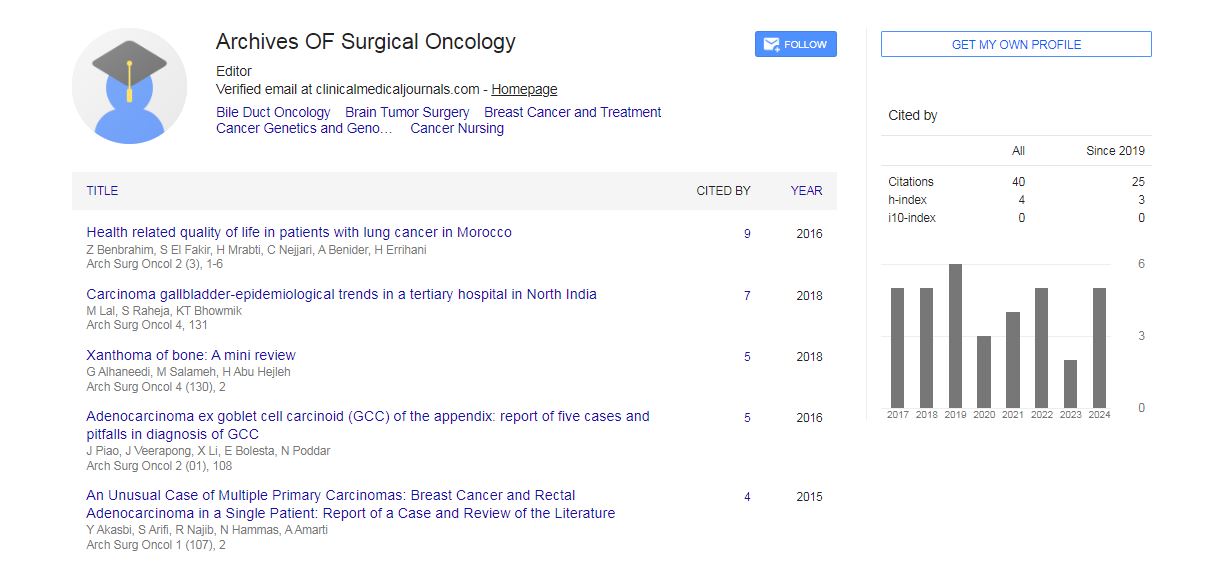
Archives of Surgical Oncology received 37 citations as per Google Scholar report