Short Communication - (2025) Volume 11, Issue 5
Received: 01-Oct-2025, Manuscript No. elj-25-174936;
Editor assigned: 03-Oct-2025, Pre QC No. P-174936;
Reviewed: 17-Oct-2025, QC No. Q-174936;
Revised: 22-Oct-2025, Manuscript No. R-174936;
Published:
29-Oct-2025
, DOI: 10.37421/2472-0895.2025.11.342
Citation: Abril, Garcia. ”Revolutionizing Brain Tumor Diagnosis and Treatment.” Epilepsy J 11 (2025):342.
Copyright: © 2025 Abril G. This is an open-access article distributed under the terms of the Creative Commons Attribution License, which permits unrestricted use, distribution and reproduction in any medium, provided the original author and source are credited.
Significant progress is being made in understanding brain tumors, particularly with a notable shift from traditional diagnostic methods to advanced molecular and genetic profiling. This modern approach enables more precise diagnoses, which is crucial for effective treatment planning. Concurrently, innovative therapeutic strategies, including highly specific targeted therapies and powerful immunotherapies, are substantially improving patient outcomes and offering entirely new avenues for treatment exploration [1].
One specific area of intensive research focuses on how epigenetic modifications drive the aggressive progression of glioblastoma, a particularly challenging brain tumor. This research delves into identifying various epigenetic targets and developing therapeutic agents designed to modulate them. These novel approaches aim to overcome the persistent problem of treatment resistance often encountered in glioblastoma patients, offering hope for more durable responses [2].
The field has also seen substantial breakthroughs in understanding and treating brain tumors in children, a particularly vulnerable patient population. Here, molecular diagnostics are proving essential for accurate risk stratification and for guiding tailored therapeutic interventions. Ongoing novel clinical trials are concurrently working to improve outcomes for these young patients, integrating the latest diagnostic insights into clinical practice [3].
Advanced neuroimaging methods are fundamentally transforming how brain tumors are diagnosed and graded. Techniques such as diffusion-weighted imaging and perfusion Magnetic Resonance Imaging (MRI) provide critical functional and metabolic information that goes well beyond what standard anatomical imaging can offer. This enhanced detail is invaluable for improving surgical planning, optimizing the extent of tumor removal, and accurately assessing a patient's response to various treatments [4].
Immunotherapy represents an evolving and promising landscape for brain tumors, encompassing a range of approaches including checkpoint inhibitors, therapeutic vaccines, and adoptive cell therapies. However, its application in brain tumors faces unique challenges, notably the formidable blood-brain barrier and the highly immunosuppressive tumor microenvironment. Researchers are actively developing sophisticated strategies to overcome these significant hurdles, aiming to enhance overall therapeutic efficacy [5].
A comprehensive survey of current targeted therapies for various brain tumor types underscores the importance of molecular profiling in guiding treatment decisions. These therapies focus on specific genetic alterations within tumors, leading to more personalized and effective treatment options. Many of these agents are already Food and Drug Administration (FDA)-approved, with others in advanced stages of clinical trials, signifying a move towards precision medicine [6].
The integration of Artificial Intelligence (AI) and Machine Learning (ML) is rapidly expanding, particularly in improving the accuracy and efficiency of brain tumor diagnosis and patient prognostication. Systematic reviews and meta-analyses suggest that AI models hold significant promise for enhancing clinical decision-making. These technologies can process vast amounts of data, identifying patterns that human clinicians might miss, thereby leading to earlier and more precise interventions [7].
Modern neurosurgical approaches are continually advancing, aiming to enhance both the safety and the extent of brain tumor removal. Techniques like awake craniotomy, real-time intraoperative imaging, and sophisticated neuro-navigation systems are critical in this regard. These methods collectively contribute to maximizing tumor resection while simultaneously preserving vital neurological function, thereby improving patient quality of life post-surgery [8].
A significant challenge in brain tumor treatment remains the Blood-Brain Barrier (BBB), which often impedes the effective delivery of therapeutic agents. Innovative strategies are now being explored to either bypass or temporarily open the BBB. Approaches like focused ultrasound, the use of nanoparticles, and receptor-mediated transport are proving crucial for improving the overall efficacy of brain tumor treatments by allowing drugs to reach their targets more efficiently [9].
Finally, precision radiation techniques are revolutionizing treatment outcomes for brain tumor patients. Methods such as stereotactic radiosurgery and proton therapy allow for highly accurate dose escalation directly to the tumor while significantly minimizing toxicity to surrounding healthy brain tissue. This represents a substantial improvement over conventional radiotherapy, leading to better therapeutic ratios and reduced side effects for patients [10].
The diagnostic landscape for brain tumors has evolved dramatically, moving beyond conventional methods to embrace advanced molecular and genetic profiling. This shift allows for a more precise understanding of tumor characteristics, which is vital for tailoring effective treatment plans [1]. Furthermore, the integration of Artificial Intelligence (AI) and Machine Learning (ML) is rapidly improving the accuracy and efficiency of brain tumor diagnosis and patient prognostication. AI models show significant promise in enhancing clinical decision-making by analyzing complex data patterns [7].
Complementing these advancements, advanced neuroimaging techniques, including diffusion-weighted imaging and perfusion Magnetic Resonance Imaging (MRI), offer crucial functional and metabolic insights. These techniques provide information far beyond standard anatomical views, significantly enhancing the accuracy of diagnosis, tumor grading, surgical planning, and the assessment of treatment response [4].
Therapeutic strategies for brain tumors are becoming increasingly sophisticated. Targeted therapies, guided by molecular profiling, are now central to treatment decisions. These therapies focus on specific genetic alterations within various brain tumor types, leading to more personalized and effective options. Many such agents are already Food and Drug Administration (FDA)-approved or in late-stage clinical trials, marking a clear move towards precision medicine [6]. Immunotherapy also represents a dynamic and expanding field, incorporating checkpoint inhibitors, vaccines, and adoptive cell therapies. While promising, it faces considerable challenges, particularly the impermeability of the blood-brain barrier and the immunosuppressive tumor microenvironment. Researchers are developing innovative strategies to overcome these obstacles, aiming to boost therapeutic efficacy [5].
Neurosurgical techniques have advanced considerably to enhance the safety and extent of tumor removal. Modern approaches like awake craniotomy, intraoperative imaging, and neuro-navigation systems maximize tumor resection while diligently preserving neurological function [8]. In parallel, precision radiation techniques are transforming treatment outcomes. Stereotactic radiosurgery and proton therapy enable highly targeted dose escalation directly to the tumor, significantly minimizing toxicity to surrounding healthy brain tissue. This represents a substantial improvement over conventional radiotherapy, offering better therapeutic ratios and fewer side effects for patients [10]. A persistent challenge, however, is the Blood-Brain Barrier (BBB), a major obstacle for drug delivery. Innovative strategies, such as focused ultrasound, nanoparticles, and receptor-mediated transport, are being actively pursued to bypass or temporarily open the BBB, thereby improving the efficacy of brain tumor treatments [9].
Understanding specific tumor contexts is also critical. For highly aggressive brain tumors like glioblastoma, research focuses on how epigenetic modifications drive progression. This involves identifying various epigenetic targets and developing therapeutic agents to modulate them, offering new ways to overcome treatment resistance [2]. Similarly, significant breakthroughs have been made in understanding and treating brain tumors in children. Molecular diagnostics are crucial for risk stratification and guiding therapy in this vulnerable patient population, with novel clinical trials continuously improving outcomes [3]. These targeted and specialized approaches underscore the comprehensive effort to address the diverse challenges posed by brain tumors across different patient groups and tumor types.
Progress in understanding and treating brain tumors is rapidly evolving, moving beyond traditional methods to embrace molecular and genetic profiling for more precise diagnoses. Innovative therapeutic strategies, including targeted therapies and immunotherapies, are improving patient outcomes and opening new avenues for treatment. One major focus involves addressing epigenetic modifications that drive aggressive brain tumors like glioblastoma, with new therapeutic agents being developed to overcome treatment resistance. For pediatric brain tumors, molecular diagnostics play a crucial role in risk stratification and guiding therapy, with novel clinical trials showing promise. Advanced neuroimaging techniques such as diffusion-weighted imaging and perfusion MRI are transforming diagnosis and grading by providing vital functional and metabolic information, aiding in surgical planning and response assessment. Immunotherapyâ??s landscape is expanding, encompassing checkpoint inhibitors, vaccines, and adoptive cell therapies, despite challenges like the blood-brain barrier and the immunosuppressive tumor microenvironment. Targeted therapies are becoming more personalized, guided by molecular profiling to address specific genetic alterations, with many agents already FDA-approved or in late-stage trials. The application of Artificial Intelligence (AI) and Machine Learning (ML) is also growing, enhancing the accuracy of diagnosis and prognosis prediction, which significantly improves clinical decision-making. Modern neurosurgical approaches, including awake craniotomy and intraoperative imaging, are maximizing tumor resection while safeguarding neurological function. Crucially, innovative strategies are being developed to overcome the blood-brain barrier, using methods like focused ultrasound and nanoparticles to improve drug delivery efficacy. Finally, precision radiation techniques, like stereotactic radiosurgery and proton therapy, are refining treatment outcomes by delivering targeted doses and minimizing harm to healthy brain tissue.
None
None
Indexed at, Google Scholar, Crossref
Indexed at, Google Scholar, Crossref
Indexed at, Google Scholar, Crossref
Indexed at, Google Scholar, Crossref
Indexed at, Google Scholar, Crossref
Indexed at, Google Scholar, Crossref
Indexed at, Google Scholar, Crossref
Indexed at, Google Scholar, Crossref
Indexed at, Google Scholar, Crossref
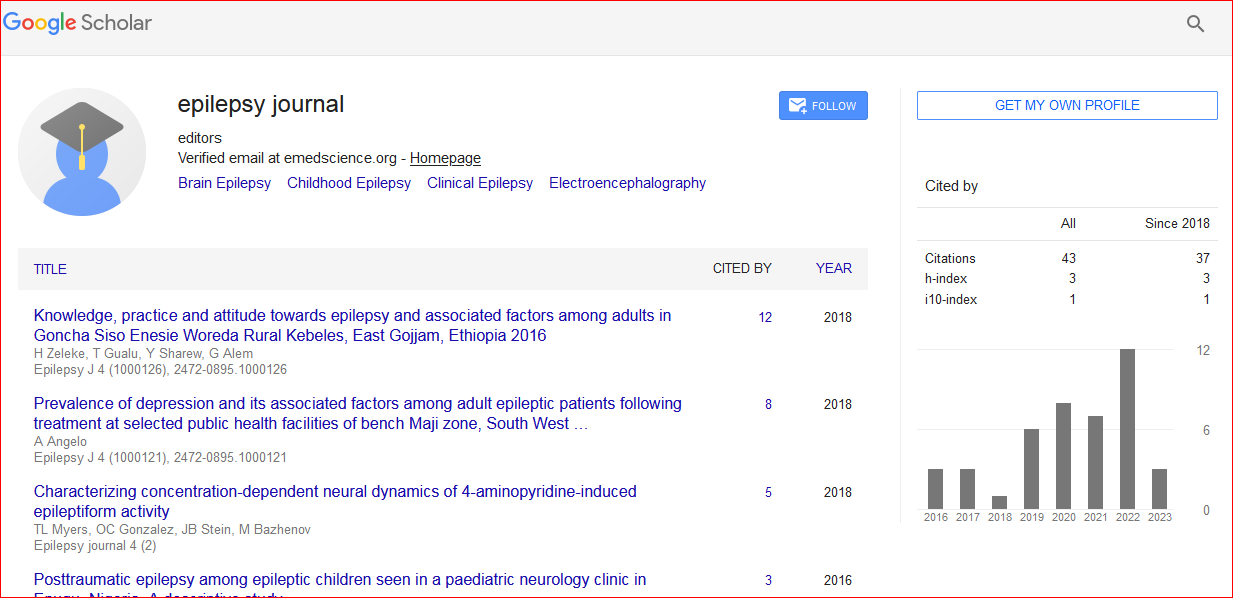
Epilepsy Journal received 41 citations as per Google Scholar report