Opinion - (2025) Volume 16, Issue 2
Received: 01-Apr-2025, Manuscript No. jmbd-26-179371;
Editor assigned: 03-Apr-2025, Pre QC No. P-179371;
Reviewed: 14-Apr-2025, QC No. Q-179371;
Revised: 22-Apr-2025, Manuscript No. R-179371;
Published:
29-Apr-2025
, DOI: 10.37421/2155-9929.2025.16.697
Citation: Johnson, Samuel. ”Revolutionizing Biomarker Discovery: Omics, AI, and Translation.” J Mol Biomark Diagn 16 (2025): 697.
Copyright: © 2025 Johnson S. This is an open-access article distributed under the terms of the Creative Commons Attribution License, which permits unrestricted use, distribution and reproduction in any medium, provided the original author and source are credited.
Recent advancements in biomarker discovery are fundamentally reshaping the landscape of diagnostics and therapeutics for a wide array of diseases. The field has witnessed a significant surge in sophisticated technologies, enabling deeper insights into disease mechanisms and patient stratification. High-throughput genomic techniques, such as next-generation sequencing (NGS) and single-cell genomics, are at the forefront, providing unprecedented resolution in identifying genetic variations and their functional consequences. These genomic tools are complemented by advanced proteomic approaches, including mass spectrometry-based profiling, which allows for the comprehensive analysis of protein expression and modifications, and proximity extension assays (PEA), offering high sensitivity for detecting low-abundance proteins. These cutting-edge tools are instrumental in identifying novel molecular signatures that are crucial for early disease detection, stratifying patients into distinct subgroups, and predicting their response to specific treatments. The integration of multi-omics data, which combines information from genomics, transcriptomics, proteomics, and metabolomics, is proving to be a pivotal strategy for achieving a holistic understanding of disease pathogenesis. This comprehensive data integration is essential for uncovering more robust and specific biomarkers that reflect the complex nature of diseases. Despite the remarkable progress, significant challenges persist, including the need for standardized data processing, rigorous validation of biomarkers across diverse patient cohorts, and the complex pathway to clinical translation. Nonetheless, the field is rapidly evolving, driven by the ultimate goal of achieving true precision medicine, where treatments are tailored to the individual patient based on their unique molecular profile. Single-cell genomics is emerging as a transformative approach, offering unparalleled resolution in biomarker discovery by enabling the interrogation of cellular heterogeneity within tumors and other tissues. This granular analysis allows for the identification of cell-type-specific molecular alterations that might be overlooked by traditional bulk analyses. Key applications include the early detection of cancer through the analysis of circulating tumor cells (CTCs) and the identification of rare cell populations that are critical drivers of disease progression or resistance to therapy. The synergy of integrating single-cell RNA sequencing (scRNA-seq) with spatial transcriptomics and epigenomics provides an even more comprehensive view of the cellular landscape and its associated biomarkers. This integrated approach promises to unlock new avenues for understanding complex biological systems and identifying novel diagnostic and therapeutic targets. Proteomic profiling, particularly when employing mass spectrometry, stands as a powerful methodology for the identification and quantification of proteins, which are often the direct effectors of biological processes and disease states. Innovations in quantitative proteomics, including techniques like TMT-labeling and label-free quantification, are enabling the precise identification of differentially expressed proteins that can serve as critical diagnostic, prognostic, or predictive biomarkers. Furthermore, proximity extension assays (PEA) present a highly sensitive and specific method for multiplexed protein detection, making them exceptionally suitable for analyzing low-abundance biomarkers present in clinical samples. The effective integration of proteomic data with complementary genomic and clinical information is paramount to fully realizing the potential of these protein-based biomarkers. Liquid biopsies represent a minimally invasive yet highly informative strategy for biomarker discovery, with a particular focus on circulating tumor DNA (ctDNA), circulating tumor cells (CTCs), and exosomes. These analyses provide real-time molecular insights into a tumor's status, facilitating early detection, monitoring of treatment response, and the identification of minimal residual disease. Advances in sequencing technologies and digital PCR have substantially enhanced the sensitivity and specificity of ctDNA detection. Exosomes, acting as natural carriers of proteins, RNA, and DNA, are increasingly recognized as a promising source of biomarkers for a broad spectrum of diseases, offering a non-invasive window into cellular states. The integration of multi-omics data, encompassing genomics, transcriptomics, proteomics, and metabolomics, is indispensable for achieving a holistic understanding of disease mechanisms. This comprehensive approach is key to identifying biomarkers that are not only more robust but also more reflective of the multifaceted nature of diseases. Machine learning and artificial intelligence (AI) algorithms are increasingly being deployed to analyze these complex, high-dimensional datasets. These computational tools excel at identifying subtle patterns and correlations that might not be apparent through conventional statistical methods. Such integration facilitates the discovery of novel biological pathways and biomarkers that accurately capture the dynamic and multifactorial characteristics of diseases. Spatial omics technologies, including spatial transcriptomics and spatial proteomics, are revolutionizing our understanding of the tissue microenvironment, a critical determinant of disease progression and therapeutic response. By preserving the spatial context of molecular information, these technologies enable the identification of specific cell-cell interactions and biomarkers that are localized to particular tissue architectures. This spatial resolution is particularly vital for deciphering the complexities of diseases such as cancer, where the tumor microenvironment profoundly influences patient outcomes and treatment efficacy. The development of organoids, coupled with their integration with omics technologies, presents a powerful platform for personalized biomarker discovery and drug testing. Organoids, cultured from patient-specific cells, effectively recapitulate the architecture and cellular heterogeneity of their originating tissues. This provides a more physiologically relevant model for studying diseases and identifying biomarkers. Combining organoid cultures with genomic and proteomic analyses allows for the pinpointing of biomarkers that are predictive of drug response and disease progression in an individual patient, paving the way for truly personalized medicine. The advent of proximity extension assays (PEA) has marked a significant leap forward in protein biomarker discovery, characterized by their high throughput capabilities, exceptional sensitivity, and specificity. PEAs operate by employing antibody pairs that, upon binding to their target analyte in close proximity, generate a template for padlock probe extension and subsequent amplification. This mechanism allows for the highly sensitive detection of even low-abundance proteins. This innovative technology is being widely applied to identify panels of protein biomarkers crucial for early disease detection, prognosis, and therapeutic monitoring across a diverse range of conditions. CRISPR-based technologies are rapidly emerging as potent tools for functional genomics and the critical validation of potential biomarkers. Through precise gene editing, researchers can meticulously investigate the role of specific genes or pathways in disease pathogenesis. This enables the assessment of how genetic alterations impact cellular phenotypes. CRISPR screening facilitates the systematic identification of genes that are essential for disease progression or drug sensitivity, thereby providing a solid foundation for both biomarker discovery and the identification of therapeutic targets. The journey of a biomarker from its initial discovery phase to its eventual implementation in clinical practice is inherently challenging. This pathway is often impeded by the necessity for rigorous validation in diverse patient populations, the standardization of analytical assays, and the complex process of securing regulatory approval. Translational research plays an indispensable role in bridging this critical gap, ensuring that promising molecular discoveries can be effectively and safely integrated into routine clinical practice. Fostering strong collaborations among academic institutions, the pharmaceutical industry, and regulatory bodies is paramount for accelerating the translation of novel biomarkers and ultimately improving patient care.
Biomarker discovery is currently undergoing a revolution, driven by significant progress in diagnostic and therapeutic strategies across a spectrum of diseases. These advancements are largely propelled by novel high-throughput genomic technologies, including next-generation sequencing (NGS) and single-cell genomics, which offer unparalleled resolution in dissecting genetic and molecular profiles. Concurrently, sophisticated proteomic approaches, such as mass spectrometry-based profiling and proximity extension assays (PEA), are enabling a deeper understanding of protein expression and function. These powerful tools are instrumental in identifying novel molecular signatures essential for early disease detection, patient stratification, and the prediction of treatment response. The integration of multi-omics data is emerging as a crucial element for comprehensively understanding disease pathogenesis and for uncovering more robust and specific biomarkers. Despite these remarkable strides, challenges persist in areas such as data standardization, validation across diverse cohorts, and the intricate process of clinical translation, yet the field is rapidly advancing towards the realization of precision medicine. Single-cell genomics is unlocking unprecedented resolution in biomarker discovery by enabling the detailed interrogation of cellular heterogeneity within tumors and other tissues. This approach allows for the identification of cell-type-specific molecular alterations that may be missed by bulk analyses. Its applications are expanding to include early cancer detection from circulating tumor cells (CTCs) and the identification of rare cell populations that contribute to disease progression or therapeutic resistance. The integration of single-cell RNA sequencing (scRNA-seq) with spatial transcriptomics and epigenomics promises a more comprehensive view of the cellular landscape and its associated biomarkers. Proteomic profiling, particularly through mass spectrometry, serves as a powerful tool for identifying and quantifying proteins, which are often direct functional molecules involved in disease processes. Advances in quantitative proteomics, such as TMT-labeling and label-free quantification, facilitate the identification of differentially expressed proteins that can act as diagnostic, prognostic, or predictive biomarkers. Proximity extension assays (PEA) offer a highly sensitive and specific method for multiplexed protein detection, proving suitable for the analysis of low-abundance biomarkers in clinical samples. The integration of proteomic data with genomic and clinical information is vital for fully leveraging the potential of these biomarkers. Liquid biopsies, including those that analyze circulating tumor DNA (ctDNA), circulating tumor cells (CTCs), and exosomes, provide a minimally invasive approach to biomarker discovery. These analyses offer real-time molecular information about a tumor, enabling early detection, monitoring of treatment response, and the identification of minimal residual disease. Improvements in sequencing technologies and digital PCR have significantly enhanced the sensitivity and specificity of ctDNA detection. Exosomes, which carry proteins, RNA, and DNA, are emerging as a promising source of biomarkers for a wide array of diseases. The integration of multi-omics data, encompassing genomics, transcriptomics, proteomics, and metabolomics, is essential for a holistic understanding of disease mechanisms and for identifying more comprehensive and robust biomarkers. Machine learning and artificial intelligence (AI) algorithms are increasingly employed to analyze these complex datasets, identifying patterns and correlations that may not be evident through traditional statistical methods. This integration is key to discovering novel pathways and biomarkers that accurately reflect the dynamic and multifactorial nature of diseases. Spatial omics technologies, such as spatial transcriptomics and spatial proteomics, are providing novel insights into the tissue microenvironment, which plays a critical role in disease progression and response to therapy. By preserving the spatial context of molecular information, these technologies allow for the identification of cell-cell interactions and tissue architecture-specific biomarkers. This is particularly important for understanding complex diseases like cancer, where the tumor microenvironment significantly influences patient outcomes. The development of organoids and their integration with omics technologies offer a powerful platform for personalized biomarker discovery and drug testing. Organoids, derived from patient-specific cells, recapitulate the architecture and cellular heterogeneity of the originating tissue, providing a more physiologically relevant model for studying disease and identifying biomarkers. Combining organoid cultures with genomic and proteomic analyses facilitates the identification of biomarkers predictive of drug response and disease progression in individual patients. The development of proximity extension assays (PEA) has significantly advanced protein biomarker discovery, offering high throughput, sensitivity, and specificity. PEAs utilize antibody pairs that, when in close proximity to their target analyte, form a template for padlock probe extension and subsequent amplification, allowing for the detection of low-abundance proteins. This technology is being applied to identify panels of protein biomarkers for early disease detection, prognosis, and therapeutic monitoring across various diseases. CRISPR-based technologies are emerging as powerful tools for functional genomics and the validation of potential biomarkers. By precisely editing genes, researchers can investigate the role of specific genes or pathways in disease and assess the impact of genetic alterations on cellular phenotypes. CRISPR screening allows for the systematic identification of genes essential for disease progression or drug sensitivity, providing a basis for biomarker discovery and therapeutic target identification. The path from biomarker discovery to clinical application is fraught with challenges, including the need for rigorous validation in diverse patient populations, standardization of assays, and regulatory approval. Translational research plays a critical role in bridging this gap, ensuring that promising molecular discoveries can be effectively implemented in clinical practice. Collaborations between academia, industry, and regulatory bodies are essential for accelerating the translation of novel biomarkers for improved patient care.
Biomarker discovery is being revolutionized by advances in genomic and proteomic technologies, enabling early disease detection, patient stratification, and treatment response prediction. High-throughput methods like next-generation sequencing, single-cell genomics, mass spectrometry, and proximity extension assays are key drivers. The integration of multi-omics data and the application of AI are crucial for a comprehensive understanding of disease. Liquid biopsies offer minimally invasive insights, while spatial omics provides tissue microenvironment context. Organoid technology aids personalized discovery, and CRISPR is vital for functional validation. Despite progress, challenges in standardization, validation, and clinical translation remain, emphasizing the importance of translational research and interdisciplinary collaboration to bring novel biomarkers to patient care.
None
None
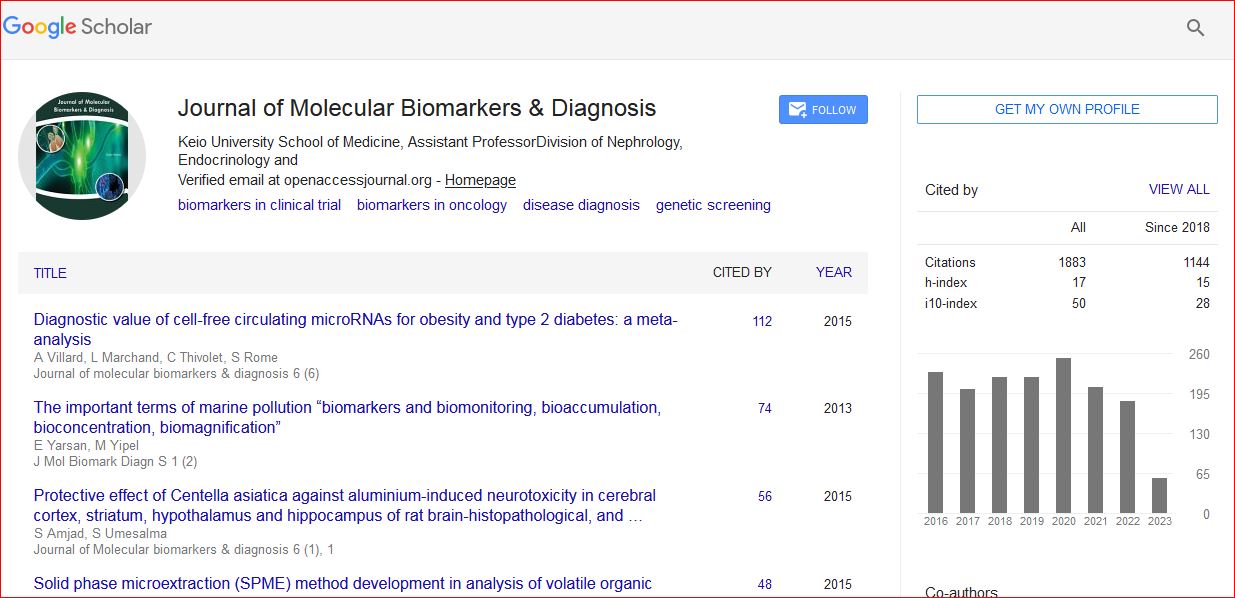
Journal of Molecular Biomarkers & Diagnosis received 2054 citations as per Google Scholar report