Opinion - (2025) Volume 13, Issue 3
Received: 02-Jun-2025, Manuscript No. jaat-26-183158;
Editor assigned: 04-Jun-2025, Pre QC No. P-183158;
Reviewed: 18-Jun-2025, QC No. Q-183158;
Revised: 23-Jun-2025, Manuscript No. R-183158;
Published:
30-Jun-2025
, DOI: 10.37421/2329-6542.2025.13.357
Citation: Sen, Ananya. ”Reusable Rockets: Revolutionizing Space Access and Economy.” J Astrophys Aerospace Technol 13 (2025):357.
Copyright: © 2025 Sen A. This is an open-access article distributed under the terms of the Creative Commons Attribution License, which permits unrestricted use, distribution and reproduction in any medium, provided the original author and source are credited.
Reusable launch vehicles represent a paradigm shift in space access, fundamentally altering the economics and accessibility of space exploration and commercialization. The ability to reuse expensive launch hardware dramatically reduces per-launch costs, effectively lowering the barrier to entry for a wider range of activities. Engineering robust, reliable, and rapidly reconfigurable systems that can withstand multiple flight cycles with minimal refurbishment is the cornerstone of this advancement, paving the way for sustainable space endeavors [1].
The development of advanced materials and sophisticated propulsion systems is crucial for enhancing the performance and reusability of these vehicles. Innovations in materials science, such as ceramic matrix composites, and manufacturing techniques like additive manufacturing, contribute to components that are lighter, stronger, and more heat-resistant. These material advancements directly impact operational costs and broaden mission capabilities, enabling more ambitious space missions [2].
Operational strategies are as vital as technological breakthroughs in realizing the full potential of reusable launch vehicles. Focus on rapid turnaround times and streamlined maintenance procedures are key to achieving operational efficiencies. These efficiencies are critical drivers in reducing the overall cost of space access, thereby making more frequent and diverse space missions economically feasible [3].
The economic benefits stemming from reusable launch vehicles are multifaceted and significant. These include a direct reduction in launch costs, an increased launch cadence, and the cultivation of new space-based industries. By diminishing the financial obstacles, reusability acts as a powerful catalyst for innovation, thereby expanding opportunities for scientific research and commercial ventures within the space sector [4].
Autonomy and advanced control systems are indispensable for the safe and efficient operation of reusable launch vehicles throughout their entire mission profile. Especially critical during ascent, reentry, and landing phases, these systems enable precise maneuvers and reduce the reliance on extensive ground support infrastructure. This technological integration further contributes to substantial cost savings and operational flexibility [5].
The overarching goal of sustainable space access is intrinsically linked to the advancement of reusable launch vehicle technologies. By minimizing the amount of expendable hardware and reducing the environmental impact associated with traditional launches, reusability aligns with long-term objectives for responsible and mindful utilization of space resources [6].
Rigorous risk assessment and the implementation of effective mitigation strategies are paramount for the successful deployment and operation of reusable launch vehicles. Comprehending and managing the inherent complexities associated with multiple flight cycles necessitates comprehensive testing, meticulous validation, and continuous refinement of established safety protocols [7].
Trajectory optimization for reusable launch vehicles presents a unique set of challenges, particularly in achieving both efficient ascent profiles and precisely controlled descent trajectories. The application of advanced algorithms is essential for minimizing fuel consumption and ensuring safe landing conditions, which are fundamental to achieving cost-effectiveness in reusable launch operations [8].
Exploration into innovative propulsion concepts, including advanced rocket engines and novel air-breathing technologies, is ongoing to further augment the efficiency and expand the operational capabilities of reusable launch systems. These developmental efforts aim to reduce dependence on conventional propellants and enhance overall mission performance, pushing the boundaries of what is possible in spaceflight [9].
The economic modeling of reusable launch vehicle programs demands careful consideration of intricate factors such as development costs, ongoing operational expenses, and the dynamics of market demand. Accurate financial projections are indispensable for securing necessary investment and ensuring the long-term financial viability of these complex and ambitious undertakings [10].
Reusable launch vehicles are pivotal in achieving cost-effective access to space. Their core innovation lies in the reuse of expensive hardware, which drastically reduces per-launch expenses. This reduction democratizes space exploration and commercialization by lowering the financial barrier. The engineering focus is on developing robust, reliable, and rapidly reconfigurable systems capable of enduring multiple flight cycles with minimal refurbishment, thus fostering a sustainable space economy [1].
Advancements in materials science and propulsion systems are critical for improving the performance and reusability of launch vehicles. Innovations such as ceramic matrix composites and additive manufacturing yield components that are lighter, stronger, and more heat-resistant. These material improvements have a direct effect on reducing operational costs and enhancing mission capabilities, enabling more ambitious space endeavors [2].
Operational strategies for reusable launch vehicles prioritize rapid turnaround times and efficient maintenance procedures. These operational efficiencies are as important as technological advancements in driving down the overall cost of space access. By streamlining operations, more frequent and diverse missions become economically viable, expanding the utility of space transportation [3].
The economic advantages conferred by reusable launch vehicles are substantial and varied. Key benefits include significant reductions in launch costs, an increased frequency of launch opportunities, and the stimulation of new space-based industries. By lowering financial barriers, reusability fosters an environment conducive to innovation and broadens the scope of opportunities for scientific research and commercial ventures [4].
Autonomy and sophisticated control systems are integral to the safe and efficient operation of reusable launch vehicles. These systems are particularly crucial during the critical ascent, reentry, and landing phases. They enable precise maneuvers and reduce the need for extensive ground support, thereby contributing significantly to overall cost savings and operational reliability [5].
The sustainability of space access is inextricably linked to the maturation of reusable launch vehicle technologies. By minimizing the consumption of expendable hardware and mitigating the environmental impact associated with space launches, reusability supports long-term objectives for responsible and sustainable utilization of space resources [6].
Comprehensive risk assessment and the deployment of robust mitigation strategies are indispensable for the successful implementation and operation of reusable launch vehicles. Understanding and effectively managing the inherent complexities associated with multiple flight cycles require rigorous testing protocols, thorough validation processes, and a commitment to continuous improvement of safety standards [7].
Trajectory optimization for reusable launch vehicles introduces unique challenges, especially concerning the achievement of efficient ascent profiles and precise descent trajectories. Advanced algorithms are employed to minimize fuel expenditure and ensure safe landing conditions, which are fundamental requirements for achieving cost reductions in reusable launch operations [8].
Exploration into novel propulsion concepts, including advanced rocket engines and innovative air-breathing technologies, is crucial for further enhancing the efficiency and expanding the capabilities of reusable launch systems. These developments aim to lessen the dependency on traditional propellants and improve overall mission performance, pushing the boundaries of spaceflight technology [9].
Accurate economic modeling and financial analysis are essential for the success of reusable launch vehicle programs. This involves careful consideration of development costs, ongoing operational expenses, and fluctuating market demands. Robust financial projections are critical for attracting investment and ensuring the long-term viability of these complex and capital-intensive endeavors [10].
Reusable launch vehicles are revolutionizing space access by significantly reducing costs through hardware reuse. This advancement is driven by innovations in materials, propulsion, and operational strategies, including rapid turnaround and streamlined maintenance. The economic benefits are far-reaching, fostering new industries and enabling more research and commercial ventures. Advanced control systems and trajectory optimization are crucial for safe and efficient operations. Sustainability is a key aspect, aligning with responsible space utilization. Rigorous risk management and economic modeling are vital for the long-term success and viability of these programs. Continued exploration of novel propulsion concepts promises further enhancements in performance and efficiency.
None
None
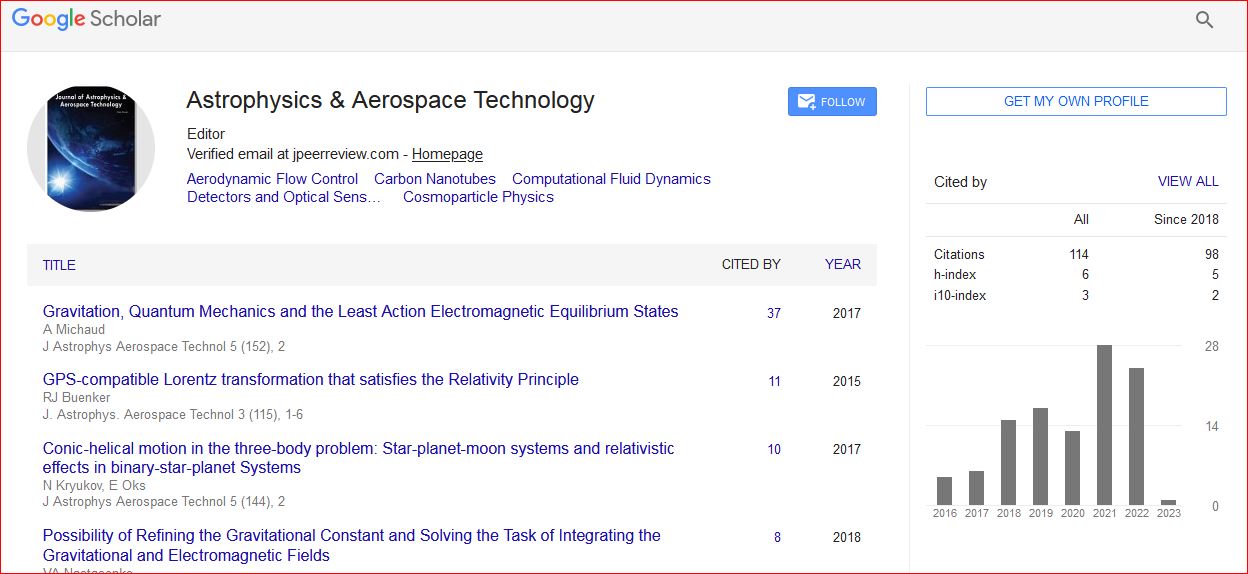
Astrophysics & Aerospace Technology received 114 citations as per Google Scholar report